What makes a civil war a “civil war� Obviously it depends less on who is actually fighting it and more on what other people want to make of it. Several news organizations, most notably NBC and MSNBC, have bitten the bullet and started calling the current “conflict†in Iraq a bonified “civil war.†The Bush administration, still Cheney-ganged into thinking the good guys will rout the bad guys according to the neocon scenario, is loathe to call the debacle of our occupation a “civil war.†But at least there is no doubt in anyone’s mind that what we see is some kind of war, and not just a few rowdies on a Saddam-nostalgia binge. Continue reading Antebellum and Our Civil Bellyache
Gobble, Gobble, Gobble: How Bad Can It Get?
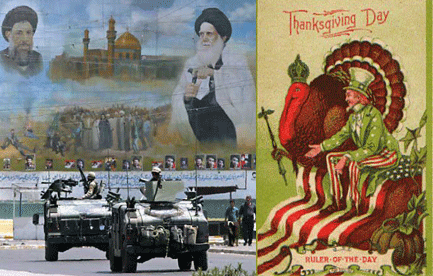
Yesterday millions of Americans celebrated Thanksgiving, an annual food-stuffing ritual commemorating an event in 1621 when the Plymouth Rock Pilgrims hosted the native Wampanoags for a three-day feast to offer thanks for the survival aid given by these gracious hosts. Before long, the Wampanoags and most other indigenous groups encountered by the European illegal aliens of the time were devastated by disease and outright genocide to the point they had little to give thanks for. George Washington enshrined the idea of a national day of Thanksgiving and set November 26 as the mark. During America’s Civil War Abraham Lincoln proclaimed it a national holiday for the last Thursday in November. When a country is embroiled in a terrible family-gutting war, why not broil a bird and give thanks you are still alive? Continue reading Gobble, Gobble, Gobble: How Bad Can It Get?
The Eighth Voyage of Sinbad (Lately Discovered)

by Sean Emer
One night, several months after Scheherazade had ended her fabled thousand and one night succession of tales, the king (sleeping beside his now pardoned bride) suddenly awoke from his slumber – quite a feat indeed, as he had not been able to sleep for the equivalent of roughly 2.7425 years, due to a certain progression of interesting and arousing recounts of people, places, and wonders.
Turning towards his queen, who was knitting contentedly (she had long since disposed of the pesky indulgence of sleep during the darker hours of the day), he started, “My wife, I have a question to ask of you.†Continue reading The Eighth Voyage of Sinbad (Lately Discovered)
An Arabian Night Up Against Walpole
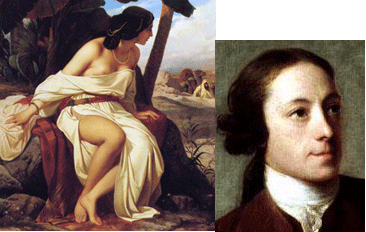
[Webshaykh’s Note: One of the more delightfully nonsensical take-offs on the famous ‘Tales of the 1001 Nights’ was penned by the late 18th century literary wit Horace Walpole. The following is a selection from his ‘Hieroglyphic Tales’, published in 1785.]
The King and his Three Daughters
There was formerly a king, who had three daughters—that is, he would have had three, if he had had one more, but some how or other the eldest never was born. She was extremely handsome, had a great deal of wit, and spoke French in perfection, as all the authors of that age affirm, and yet none of them pretend that she ever existed. It is very certain that the two other princesses were far from beauties; the second had a strong Yorkshire dialect, and the youngest had bad teeth and but one leg, which occasioned her dancing very ill. Continue reading An Arabian Night Up Against Walpole
The Whistle Blower Stops Here

[President Bush Thursday in Billings, Montana, photo by Jason Reed, Reuters, left; President Bush speaking under a halo at the dedication of Oak Cliff Bible Fellowship’s Youth Education Center in Dallas, Texas, 10/29/03, photo by Charles Dharapak, AP, right.]
Recent polls from a number of news organizations and independent groups make it clear that the Bush administration’s dragged-out, coalition-of-the-once-upon-a-time-willing war in Iraq can best be labeled “Mission Botched.†A Newsweek poll from October 26-27 indicated that twice as many American adults think the current strategy is losing ground (60%) as opposed to making progress (29%) in Iraq. Recent polls also indicate that despite the White House election strategy of not straying (even if not calling it staying) from the course, public opinion is singing the blues even in the red states. The reasons for this dissatisfaction with the way in which the war has been waged now cross party lines. The liberal vs. conservative, cut-and-run vs. lobby-and-don’t-tell mantras are increasingly (and fortunately) falling on deafened ears.
The Century Mark

[A few of Jesus Montalvo’s 12 brothers and sisters in Mayaguez say he used to phone home from Iraq, asking them to sing him plenas — Puerto Rican ballads. This Christmas, their brother won’t be here to accompany them on the pandereta drum and the cuatro guitar. Those pictured (from left) are: Segismundo Lopez Montalvo, Leo Montalvo, Olga Montalvo and Clarissa Montalvo.]
Listening to NPR “Morning Edition†on my morning drive to the university, I learned that the death toll of U.S. servicemen this month in Iraq has reached 100. It is hardly more tragic just because a round number is reached. But it does give pause to those ardent defenders of our failed involvement in Iraq that insist we “are not there yet.†What is the threshhold of “there†that would convince unflinching “stay the course†advocates even when just about every marker indicates it is the wrong course? Continue reading The Century Mark
Speaking of Veiling (BBC Style)
A little shameless self-promotion pervades today’s post. Last Thursday I was interviewed by Dan Damon of the BBC World Service for their weekly program on religion. The topic was the history and variety of veiling within Islamic societies. Yesterday the program aired for all 42 million listeners to be edified. You can hear the whole radio program online by going to their program webpage at http://www.bbc.co.uk/worldservice/programmes/reporting_religion.shtml). Continue reading Speaking of Veiling (BBC Style)
Hijab, Raw Meat and Catnip

Many non-Muslims assume that Islam is a far more sexist religion than Judaism or Christianity, usually under the assumption that only the latter two faiths have been secularized into acceptable moral modernity. Media images of women covered in full-length chadors or wearing a solid niqab (face covering) with only slits for eyeholes, the legality of having four wives, Quranic passages torn out of context, misogynist traditions and medieval male musings: all of these suggest that Muslim women have few if any rights. Muslim women in most cases feel otherwise. Many are bemused that their sisters from other faiths are so unaware of the rights Muslim women have enjoyed (at least in legal theory) since the very beginning of Islam. But a problem still remains and that is the unflinching, culturally-induced male chauvanism that crosses the boundaries of established religions. A prime example from down under has recently surrounded a major Muslim figure in Australia. Continue reading Hijab, Raw Meat and Catnip