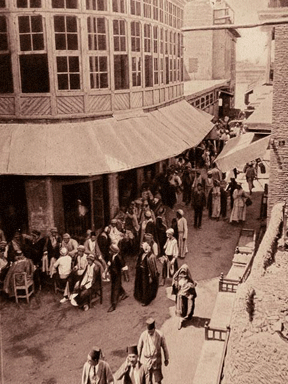
Picture Iraq in 1925


A Street in Baghdad, photo by A. Kerim, 1925.

Can you picture a Baghdad street without damage from the ongoing war in which shrapnel and broken glass draw the blood or ordinary Iraqis of all persuasions? One way is to return to the past more than 80 years ago to the year before the Baghdad Museum was created. The website Iraq Museum International has a number of interesting pages on the archaeological and pictoral history of Iraq. One of these is an online exposition of 72 sepiatone photographs taken by A. Kerim in 1925, published by the Hasso Brothers in Baghdad and printed by Rotophot A.G. in Berlin. These photographs are currently in the Harvard Semitic Museum Photographic Archives. The photographs cover all aspects of life, architecture and daily life and are well worth looking at or using in a classroom.
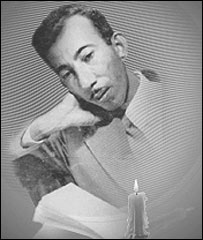

The Letters of Badr Shakir al-Sayyab: #8

[Note: This is the eighth in a series of translations of selected letters of the noted Iraqi poet Badr Shakir al-Sayyab. For more information on the poet, click here.]

Letter #7 2/18/1957

Directorate of Public Trading, Baghdad

My Kind Brother, the Soaring Poet, Mr. Yusuf al-Khal,

Sweet greetings. I have received all four of your letters, but only laziness has caused me to postpone responding to them day after day.

In the month of September I was in Beirut, and I searched for you a lot, but to no avail. I sat at Faisal Restaurant across from the American University, and I roamed the university, but I was not lucky enough to see you or two other brothers whom I was anxious to meet, Khalil Hawi and Munah Khoury. Continue reading The Letters of Badr Shakir al-Sayyab: #8

What the Heck, I mean Hayek…

[Webshaykh’s note: With so much discredited foreign policy decision-making, perhaps we should go back to the Nancy Reagan doctrine and look at the ouija board. Give political anti-realism a chance…what the heck, Mr. Hayek… See it for yourself on Youtube.]

‘Clairvoyant’ sees new Lebanese president, more assassinations, Hizbullah ‘surprise’

Daily Star staff
Tuesday, October 30, 2007

BEIRUT: Reputed clairvoyant Michel Hayek predicted late on Sunday that “Lebanon will witness the election of a new president despite current problems.” He also ruled out the “imminent” threat of civil war. In an interview with George Salibi on New TV, Hayek foresaw “a few skirmishes and problems” in the country.

“There is no impending end to the string of assassinations,” he said, referring to the political murders that have plagued Lebanon since 2005.

Nicknamed “the Nostradamus of the Middle East,” Hayek is known for his yearly predictions for Lebanon, the Middle East and the world. Continue reading What the Heck, I mean Hayek…

A True Culture War


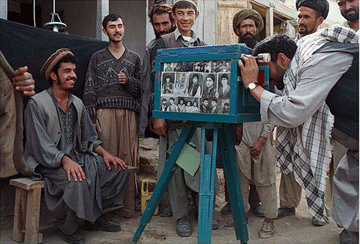
[Photograph taken in Afghanistan by Sergey Maximishin, 2001.]

[Webshaykh’s Note: It is a rare day when an anthropologist’s commentary is published in the New York Times. Here is yesterday’s op-ed by Richard Shweder of the University of Chicago, reproduced below. I invite readers to post their views here. I gave my own view of Anthropo covertus in an earlier post.]

by Richard Shweder, New York Times, October 28, 2007

IS the Pentagon truly going to deploy an army of cultural relativists to Muslim nations in an effort to make the world a safer place?

A few weeks ago this newspaper reported on an experimental Pentagon “human terrain” program to embed anthropologists in combat units in Iraq and Afghanistan. It featured two military anthropologists: Tracy (last name withheld), a cultural translator viewed by American paratroopers as “a crucial new weapon” in counterinsurgency; and Montgomery McFate, who has taken her Yale doctorate into active duty in a media blitz to convince skeptical colleagues that the occupying forces should know more about the local cultural scene.

How have members of the anthropological profession reacted to the Pentagon’s new inclusion agenda? Continue reading A True Culture War

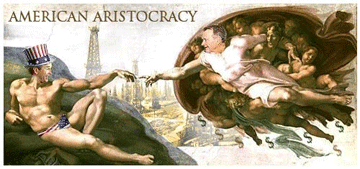
American Aristocracy

Of all the notable things on earth,
The queerest one is pride of birth
Among our “fierce democracy!”
A bridge across a hundred years,
Without a prop to save it from sneers,
Not even a couple of rotten peers–
A thing for laughter, fleers, and jeers,
Is American aristocracy!

English and Irish, French and Spanish,
Germans, Italians, Dutch and Danish,
Crossing their veins until they vanish
In one conglomeration!
So subtle a tangle of blood, indeed,
No Heraldry Harvey will ever succeed
In finding the circulation. Continue reading American Aristocracy

An Old Joke

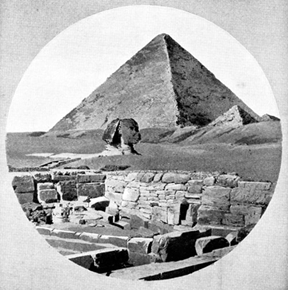
Coming across a cache of Civil War era copies of Harper’s Weekly some time ago, several of the old (almost a century and a half) jokes caught my attention. One of them was about Egypt; well, sort of. Here goes the latest joke from Harper’s Weekly for November 9, 1861, just before a war that was anything but a joke for American history.

Why ought not the people to starve in the deserts of Egypt?

On account of the sandwiches (sand which is) there.

But how came the sandwiches there?

Because Ham was there and his descendants mustered and bred (mustard and bread).

It helps to be a bible trivia expert for that one, but the next joke (from March 15, 1862) seems right up to date, given Haliburton’s infamous drilling oil pipelines to nowhere.

Why do our soldiers need no barbers?

Because they are regularly shaved by the Government contractors.

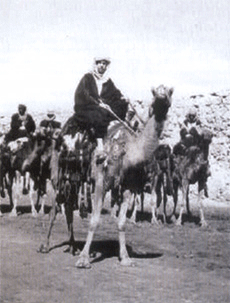
Philby of Arabia

by Robin Bidwell

Philby’s grave in Beirut bears the inscription ‘Greatest of Arabian explorers’ and, in very many ways, this claim by his son is justified. None of the writers that we have discussed saw so much of the Peninsula, visited as he did practically every corner of it nor traversed it so many times in so many different ways. None of them spent more than twenty months in Arabia: Philby was there for most of forty years.

Harry St John Bridger Philby (generally called Jack or Shaikh Abdullah) was born in Ceylon in 1885 and used cheerfully to suggest that he was not really himself but a local baby mistakenly picked up by a careless nurse. After a very successful career at Westminster and Trinity College, Cambridge, he joined the Indian Civil Service and arrived in Bombay in December 1908. When, some two years later, he married, his best man was his cousin, the future Field-Marshal Montgomery. Philby acquired the reputation of being a difficult colleague—indeed he claimed to have been the first Socialist in the Service—but he made his mark as an exceptional linguist and a first-class administrator. Continue reading Philby of Arabia

Dropping a Word Bomb

[The following is an editorial in the Centre Daily News, about a visit to Penn State by the Islamo-Fascist Awareness Weekers, brought to my attention by Jonathan Brockupp in the Department of History and Religious Studies.]

As the world, the country and even formerly placid Happy Valley desperately need unity and understanding, rock star Rick Santorum brought his Islamo-Fascism Awareness Week tour to Penn State this week, spreading his divisive “us vs. them,” “Christians vs. pagans” message.

“Thank youuuuuuuuuuu, State College. You’re a great audience. Here’s one you may have heard before. …” Continue reading Dropping a Word Bomb