The Search for Happiness

By Khalid Kishtainy
Translated by Ramsis Amun

Goodday!

My first intellectual foray as a child was an attempt to discover what happiness was and how I could find it. I was thirteen years old when I borrowed “The Story of Greek Thought”, hoping to find answers to this question from Greek philosophers. I was sorely disappointed. All I found were a few short paragraphs on the subject and I discovered that these philosophers only tasted misery in their lives and that one of them – I think his name was Socrates – ended his life by drinking a cup of hemlock. I closed the pages of the book and spent the next three months suffering from headaches. I still suffer from headaches and, of course, from that sickness called the search for happiness.

In my intellectual journey I came across many further speculations on the subject, of course. The English said that the happy man is one married to a Japanese woman, and who lives with her on the French Riviera, and employs a Chinese cook. I am still uncertain of the third stipulate. Do they mean to cook Chinese meals or to fulfill the needs of the Japanese woman? The Chinese themselves have their own view of happiness. Why not? Are we not enjoined as Muslims to “seek knowledge even in China”? The Chinese say that if you wish to be happy for an hour you need to drink a glass of fruit juice, and if you wish to be happy for three days, get married, and if you wish to be happy for eight days, slaughter a sheep and eat it, and if you wish to be happy for a lifetime, become a gardener! Continue reading The Search for Happiness
What Makes a A Muslim Laugh?

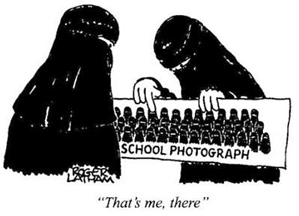
Today’s BBC News has a story with the headline “Does Islam have a sense of humour?” This is the kind of question that makes me want to cry. “Islam”, like any religion, will “have” whatever people read into it. For a Christian or Hindu apologist just about everything that Muslims do is “funny” in the sense of being different and looked down upon, although it is not funny to non-Muslim fundamentalists when Muslims practice their faith in ways that are dismissed as violent or antagonistic. Muslims do not generally take their own faith as a joke, unless they are in the Enlightenment-mentored mode of rationalizing away whatever fixed dogma demands about the power of Allah. Islam is not inherently funny, especially to those who practice it, but neither is it opposed to laughter. Humor is a pan-human trait and it is highly contextual. Yes, there are Muslims who have a sense of humor and those who do not. In the real world how could it be otherwise?

The article’s hook-line teaser notes: “Muslims are often depicted as people who can’t take a joke. But as a stand-up comedy tour showcasing Islamic talent arrives in the UK, is that fair?” There is something quite different about looking for a sense of humor in an entire religious tradition compared to observing what individual Muslims do. Continue reading What Makes a A Muslim Laugh?

Arabia, A Poem from 1815

While reading old books on Arabia in Oxford’s Bodleian Library two summers ago, I came across a rare book indeed. I had the privilege of being the first person ever to read the book, as the folios were still uncut. Considering that the book was published in 1815 and soon thereafter entered the library, it might be readily assumed that it is a book not worth reading. In fact it proved to be a delight and a rarity. The book is called Arabia, A Poem and the author is a man named Johnson Grant. The author was an Oxford chap of St. John’s and is billed as the Domestic Chaplain to the Countess Dowager of Balcarres. No doubt the Countess enjoyed the work, although generations of Oxford students and scholars have somehow passed it by.

It is a rather long poem with extensive commentary. Not surprisingly, the Christian chaplain does not think Islam is the right religion. Continue reading Arabia, A Poem from 1815

Sacrilege and Pilgrimage

One of the most odious acts for a non-Muslim to do is enter Mecca. The swash-buckling Captain Richard Burton (1821-1890) disguised himself as an Afghan (pre-Taliban, of course) Muslim and in 1853 joined pilgrims to Mecca. While not the first Westerner to sneak into the holy city, his account is the most notorious. Here is how Burton describes his participation:

“”Alhamdu Lillah!” Thanks be to God! we were now at length to gaze upon the Kiblah, to which every Mussulman has turned in prayer since before the days of Muhammed, and which, for long ages before the birth of Christianity was reverenced by the Patriarchs of the East. Soon after dawn arose from our midst the shout of ‘Labbaik! Labbaik!’ and passing between the rocks, we found ourselves in the main street of Mecca, and approached the ‘Gateway of Salvation,’ one of the thirty-nine portals of the ‘Temple of Salvation.’ Continue reading Sacrilege and Pilgrimage

Want to Watch My Harem?

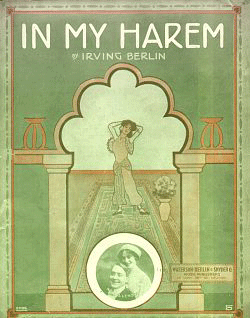
Ah, vaudeville. Before Elvis, the Beatles and the Beastie Boys, there were those corny songs targeting recent immigrants to America. One of those immigrants with a Sicilian last name would have been my grandfather, Martin Varisco, who in 1913 left the Big Apple Blossom to work on the railroad and work his way west. He made it to Ohio, where he married and settled down. But the very year he left New York, the songwriter Irving Berlin produced one of his less memorable songs. This was for the Irish, not the Italians, an important distinction on the streets and in the bars at the time. But here’s what can happen when Tin Pan Alley gets confused with Midaq Alley: an Irishman named Pat Malone with rhyme running amok in a Turkish harem. Continue reading Want to Watch My Harem?

Trillion Dollar Baby

There is only one rock band that I have seen live twice in my life. It was not summer and school was not out and I really think of myself as a nice guy, but, yes, it was Alice Cooper. One of these was the famous green “Billion Dollar Babies” album, which is now beyond 33 (despite the fact it is still 33 rpm) years old. At the time, just graduating from college, a billion dollars seemed astronomical to me. Alice is still performing and selling merchandise, but a billion is no longer a big deal. Consider that a report has just been issued saying that 1.6 trillion dollars will have been spent by the end of next year by our U.S. government on the combined wars in Afghanistan and Iraq. Welcome to our nightmare. Continue reading Trillion Dollar Baby

Imagine a world without football

Having just endured another weekend in which my son flicked from one college game to another on Saturday and channel hopped the pro games on Sunday, I sometimes wonder what would happen if football suddenly disappeared. I don’t think we would have baseball year round and basketball is too indoor a sport for the macho and nacho masses with apparently nothing to do on fall weekends. Of course, American football will not disappear as long as high school and college men have a forum to beat each other within limits (on pain of 15 yard penalties) and bear the manly marks of pain and showboat half way across the field for daring acrobatics. But our Rugby-derived version of the world’s most popular sport is no match for the millions worldwide who follow what we think is soccer and they think is real football (i.e. a foot hitting a ball instead of one body with pads bashing into another body with pads).

Imagine if this culturally transmitted and universally acclaimed sport suddenly lost all its spectators. What if the team showed up with their Nike endorsements and flourescent Gatorade bottles to empty stadiums? Well, you do not have to. Welcome to Lebanon, Continue reading Imagine a world without football

The Letters of Badr Shakir al-Sayyab: #9


The Iraqi Poet Badr Shakir al-Sayyab

[Note: This is the ninth in a series of translations of selected letters of the noted Iraqi poet Badr Shakir al-Sayyab.]For more information on the poet, click here.]

Letter #9 5/7/1958

Baghdad:

My Dear Brother Dr. Suheil (Idris),

A most sincere Arab greeting to you,

You have, undoubtedly, asked yourself the reason for my prolonged silence. Like you, I ask myself the same question.

A whole year has passed, and I have only written two poems…. Sterility is seeping into my soul. Even when I write, I write only about this sterility. However, why do your readers need to endure the bitterness of this sterility of my soul, its barrenness and despair? It is truly a miracle that I am able to write – to write poetry of course. What offering can my arid soul impart? Continue reading The Letters of Badr Shakir al-Sayyab: #9