American Christians and Islam


Author Thomas S. Kidd

In the wake of the September 11 terrorist attacks, many of America’s Christian evangelicals have denounced Islam as a “demonic” and inherently violent religion, provoking frustration among other Christian conservatives who wish to present a more appealing message to the world’s Muslims. Yet as Thomas Kidd reveals in this sobering book, the conflicted views expressed by today’s evangelicals have deep roots in American history.

Tracing Islam’s role in the popular imagination of American Christians from the colonial period to today, Kidd demonstrates that Protestant evangelicals have viewed Islam as a global threat–while also actively seeking to convert Muslims to the Christian faith–since the nation’s founding. Continue reading American Christians and Islam →

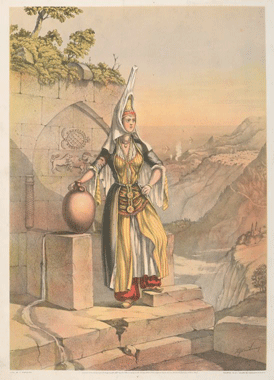
Lithographica Arabica 3: Druse Girl


“Druse Girl”(1862) drawn by Henry J. Van-Lennep, Henry J. (1815-1889), Lithographer,
C. Parsons; Printer of plates, W. Endicott & Co. From “The Oriental Album: Twenty Illustrations, in oil colors, of the people and scenery of Turkey, with an explanatory and descriptive text.” By Rev. Henry J. Van Lennep. Online in NYPL Digital Gallery.

For Lithographica Arabica #2, click here.

Islamic Art at the Freer


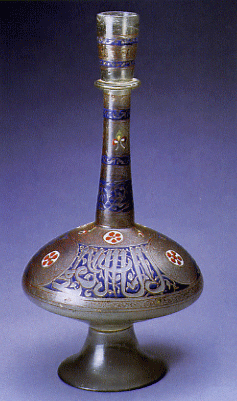
Bottle made for the Yemeni Rasulid Sultan al-Malik al-Mujahid ‘Ali ibn Dawud,
Freer Gallery of Art, Washington, DC.

One of my favorite haunts in Washington DC is the Freer Gallery of Art, part of the Smithsonian row. It boasts an extraordinary collection of Islamic art, well worth viewing and reviewing. But why wait until a trip to Washington, unless you are still braving the leftover throngs at the upcoming inaugural? The Freer’s website hosts high-quality images of many of the objects in its collection. As a Yemenophile, one of my favorites is a beautiful glass bottle made for the Yemeni Rasulid sultan al-Malik al-Mujahid ‘Ali ibn Dawud, who reigned from 1322-1363. The bottle was crafted in Syria and is “enameled and gilt colorless honey-tinted glass” (Rosamond E. Mack, Bazaar to Piazza: Islamic Trade and Italian Art, 1300-1600, Berkeley: University of California Press, 2002, p. 118).

American Grassroots and Democratic Change

by el-Sayed el-Aswad, United Arab Emirates University

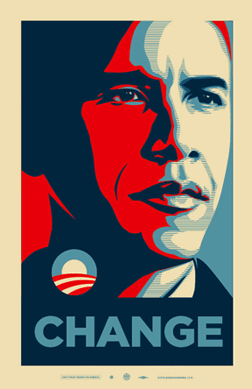
The historic victory of Barack Obama, the first African American president, is the outcome not only of a politically talented and eloquent leader hoping for and acting toward change but also of the relentless will and determination of American grassroots demanding openness, fairness, equality and freedom. American people, with their diverse, rich and dynamic culture, voted for change so as to have not just something new, but to attain liberation and reconstruct fair and peaceful relationships with all people. What is happening inside the most powerful nation in the world must be reflected and enacted in different parts of the globe. People around the world are hoping and expecting that the United States will work to promote peace and a healthy democracy through dialogue, diplomacy and persuasion after eight years of power mismanagement leading to unjustified intervention and irrational wars. Continue reading American Grassroots and Democratic Change →

“Best interests of the state”


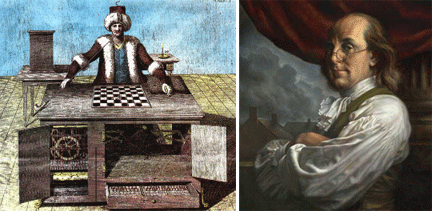
[Note: the following parody, written in critique of proslavery arguments in congress, was one of the last articles penned by Benjamin Franklin. Were Franklin almanacking today, what would Poor Richard have to say about the current state of political stalemate in the Middle East? And what would he think of today’s inaugural?]

To the Editor of the Federal Gazette
by Historicus (Benjamin Franklin)
March 23, 1790

Sir,

Reading last night in your excellent paper the speech of Mr. Jackson in Congress, against meddling with the affair of slavery, or attempting to mend the condition of slaves, it put me in mind of a similar one made about one hundred years since, by Sidi Mehemet Ibrahim, a member of the Divan of Algiers, which may be seen in Martin’s account of his consulship, anno 1687. It was against granting the petition of the Sect called Erika or Purists, who prayed for the abolition of piracy and slavery, as being unjust. Mr. Jackson does not quote it; perhaps he has not seen it. If therefore some of its reasonings are to be found in his eloquent speech, it may only show that men’s interests and intellects operate and are operated on with surprising similarity in all countries and climates, whenever they are under similar circumstances. The African’s speech, as translated, is as follows:

“Allah Bismillah, &c. God is great, and Mahomet is his Prophet.

“Have these Erika considered the consequences of granting their petition? Continue reading “Best interests of the state” →

Another War, Another Defeat


Professor John Mearsheimer

Another War, Another Defeat

The Gaza offensive has succeeded in punishing the Palestinians but not in making Israel more secure.

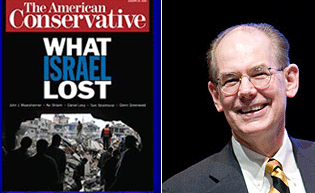
By John J. Mearsheimer, The American Conservative, January 26, 2009

Israelis and their American supporters claim that Israel learned its lessons well from the disastrous 2006 Lebanon war and has devised a winning strategy for the present war against Hamas. Of course, when a ceasefire comes, Israel will declare victory. Don’t believe it. Israel has foolishly started another war it cannot win.

The campaign in Gaza is said to have two objectives: 1) to put an end to the rockets and mortars that Palestinians have been firing into southern Israel since it withdrew from Gaza in August 2005; 2) to restore Israel’s deterrent, which was said to be diminished by the Lebanon fiasco, by Israel’s withdrawal from Gaza, and by its inability to halt Iran’s nuclear program.

But these are not the real goals of Operation Cast Lead. The actual purpose is connected to Israel’s long-term vision of how it intends to live with millions of Palestinians in its midst. It is part of a broader strategic goal: the creation of a “Greater Israel.” Specifically, Israel’s leaders remain determined to control all of what used to be known as Mandate Palestine, which includes Gaza and the West Bank. The Palestinians would have limited autonomy in a handful of disconnected and economically crippled enclaves, one of which is Gaza. Israel would control the borders around them, movement between them, the air above and the water below them. Continue reading Another War, Another Defeat →

A Century of Race Prejudice


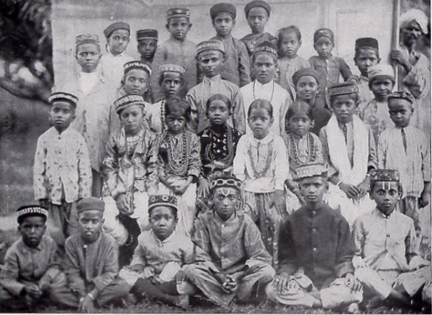
Some pupils of the Methodist Episcopal Day School, Bangalore, South India. The boy’s school has 80, the girl’s school has 50 pupils.

[Note: the following excerpt is from an extraordinary article in the National Geographic Magazine in December, 1910, written some 99 years ago. Time has moved on and the names of the principal players may have changed, but the refrain remains the same.]

Race Prejudice in the Far East
by Melville E. Stone, December, 1910

Although whole libraries have been written concerning Asia and the Asians, there is a widespread belief that, because of the differences in our mentalities, it is not possible for us ever to understand them, or they us. Kipling says that “East is East, and West is West, and never the twain shall meet.” The “oldest inhabitant” in India or China or Japan is sure to tell you that the Oriental mind is unfathomable. I have not the temerity to challenge these opinions. And yet I venture to suggest that there is an older authority holding a different view, and that I still have some respect for Cicero’s idea that there is a “common bond” uniting all of the children of men. Continue reading A Century of Race Prejudice →

Entitled to consideration and respect


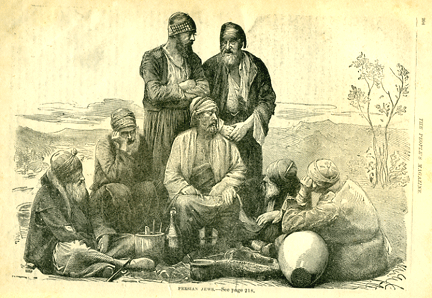
Illustration of “Persian Jews” from the People’s Magazine, 1879

The current fighting in Gaza is a tragedy of Greek dramatic proportions. On the one hand a highly sophisticated military machine wielded at present with Hawkish intent, on the other a ragtag guerilla group bent on lobbing barbs at the Hawk’s fortified lair. And in the middle frightened civilians in a humanitarian nightmare of medieval mindset. The problem is that neither side is really willing to treat the other with consideration and respect. In this unethical tie, of course, the onus must be on the stronger to recognize the limited options of the weaker.

The tragedy does not end with the present loss of life, limb and hope for Gazans. Unfortunately, it overshadows a historical trajectory that created the rise of Zionism as a political ideal in Europe. There is no excuse for the present punishing policies of Israel towards the residents of Gaza. Indeed, it is all the sadder given the sordid history of anti-Semitism in both the Christian-dominated West and Islamic-dominated Near East. Recently I picked up an old magazine from 1879, published exactly 140 years ago. On one page I was struck by the extraordinary pathos of an image of “Persian Jews.” Continue reading Entitled to consideration and respect →