Loving Yemen


Yemen is not quite the desert journalists dream up

The journalistic war talk on terror took a sidestep over the past week or so as commentators sought to tweak the Wikileaks for all they could be imagined to be worth. Here was cable-ready proof that diplomats do not believe exactly what they say in public, that rulers are not always stable and “secret” communication may be secret for a reason. Ah, yes, diplomats with no clothing. But now it’s back to Al Qaeda. In a recent commentary for The Christian Science Monitor, a former senior international correspondent for CNN, Walter Rodgers, weighs in on Al Qaeda in Yemen.

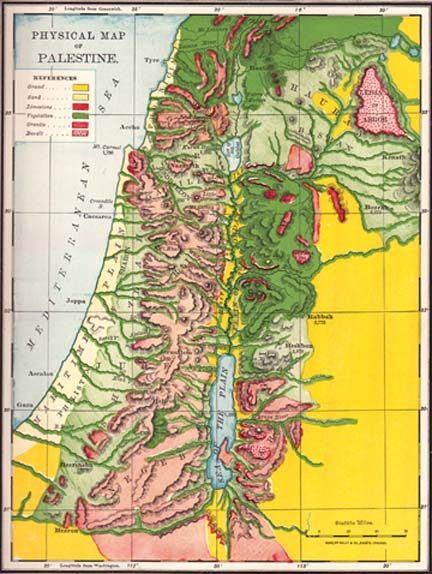
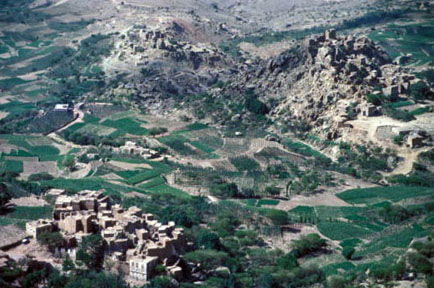
The result is a prime example of run-of-the-treadmill sinthetic (spelling intended) reportage. All the right people are quoted, those who actually know something about Yemen. This includes a former ambassador, Barbara Bodine, a historian, Bernard Haykel and a young political scientist, Gregory Johnsen. Each is granted a short quote, although the reader has no idea what the full context of each comment was. So Ambassador Bodine at some point said “The issue is geography,” which clearly needs explanation. Unfortunately Rodgers flunks his geography lesson. Yemen is not “nearly all mountainous desert.” The only true desert areas in Yemen are along the coast and entering the Arabian desert, not in the mountain valleys and plateaus.

The journalist’s geographical blunders are equaled by his historical ignorance. Continue reading Loving Yemen
Bin Who? Bin Laden?

Two protracted wars drag on as the so-called “War on Terror” seems to be winding down in theory. In another year our hunt for the infamous Osama Bin Laden will be almost a decade old. The detour into Iraq, toppling a brutal dictator and ensuring a far more Iran-friendly government in Iraq, is reaching a deadened end, if you do not count the numerous advisors who will remain in and out of uniform. Then there is Afghanistan, which was the bane of the Brits in the 19th century, the Soviets in the 20th century and most probably the Americans and NATO in the 21st century. Billions of dollars and thousands of lives later the reason the United States originally got involved in the region, specifically to capture Bin Laden and bring him to justice, remains unfulfilled. Whether cooling his heels in a Pakistani border cave or a Swat safe house, the suspected mastermind of the 9/11 bombing is still out there somewhere.

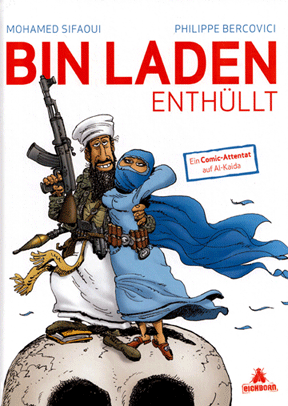
Imagine if Bin Laden could be captured? Well, if you read German, you have a guide. While in Vienna earlier this fall I picked up a copy of Bin Laden Enthüllt, a comic book by Mohamed Sifaoui and Philippe Vercovici (Frankfurt: Eichborn, 2009). Continue reading Bin Who? Bin Laden?

Building Southern Sudan


Building southern Sudan through promotion of our history and culture

Dr. Jok Madut Jok, New Sudan Vision, October 15, 2010

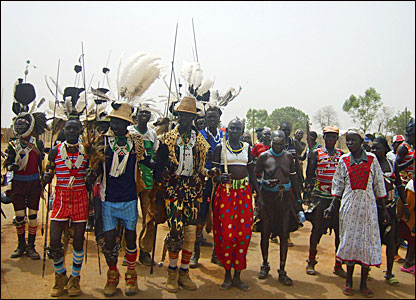
(New York) – To be a nation means having a citizenry that takes pride in citizenship in “South Sudan” first and in tribal citizenship second. Such a nation can no longer assume that shared interests alone will continue to unite us. So far, our struggle to wrestle our freedom from the grips of the Khartoum-based successive governments has been the most unifying force for South Sudan. Now that this struggle has seen some success, what will unite us is the desire to build a strong nation together, and such a nation will need a shared identity. Such a shared identity will need to be harnessed, it needs to be politically constructed, and it is our task to forge it.

To this end, I envision my task as undersecretary of the Ministry of Culture and Heritage as joining a collective effort with the minister, the staff of the ministry and other branches of GOSS to set a policy for constructing our nation’s identity.

A solution begins with the correct identification of the nature of the problem. The most significant enemy of South Sudan’s cohesion, national loyalty and the citizens’ pride in their nation will be a growing sense of exclusion from the national platform, media, government programs and access to services. Any citizen who will feel excluded will never develop that important sense of pride in his/her nation. A starting point to addressing the feeling of exclusion is to state the obvious, that South Sudan belongs to all South Sudanese; it does not belong to any ethnic, religious or political group. Continue reading Building Southern Sudan

Me and the Feminists

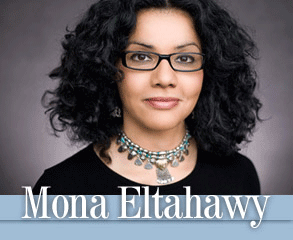
By Mona Eltahawy, The Jerusalem Report, November 24, 2010

I was 23 years old and I was interviewing an Egyptian feminist who had just taken over as editor-in-chief of a women’s magazine of the cooking-and-fashion variety, which she had vowed to turn into the go-to magazine for women’s rights.

I was excited to meet her because she was one of the real-life feminists that my recently returned-to-Egypt self loved to meet to help me turn theory into action. Ever since I’d discovered feminist journals on the bookshelves at my university in Jeddah, Saudi Arabia, at the age of 19, I’d devoured all I could of the theory.

I had returned to Egypt at 21 hungry to put it into action. My first encounter with those essays was nothing short of terrifying. That’s how you know what you need – it scares the hell out of you because it encourages you to jump but you don’t know if you’ll ever land. Religious conservatism was suffocating me in Saudi Arabia and I was losing my mind. I didn’t care about landing. I was overdue for a jump.

So returning to Egypt at 21 after 14 years away was a chance to water that seed of feminism with the sustenance of real-life women who embodied it. I looked for them everywhere I could. Many of the older women practically adopted me, inviting me to their meetings, sending me their latest reports and alerting me ahead of important conferences they were holding. Continue reading Me and the Feminists

Inventing Muslims: 1001 Inventions Exhibit now in New York

New York launch for 1001 Inventions

1001 Inventions at the New York Hall of Science Uncovers a Thousand Years of Science and Technology Developed Throughout Muslim Civilization.

Five-Year Global Tour Makes U.S. Debut Following Record Breaking Runs in London and Istanbul

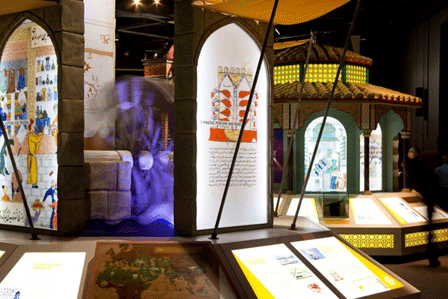
17 November 2010, New York — After blockbuster runs in London and Istanbul, 1001 Inventions, an exhibition highlighting the scientific legacy of Muslim civilization in our modern age, will make its United States premiere at the New York Hall of Science (NYSCI) on December 4, 2010.

The exhibition reveals the forgotten history of men and women from a variety of faiths and backgrounds whose contributions to the advancement of scholarship and technology during the Middle Ages helped pave the way for the European Renaissance. This period of history from the 7th through 17th centuries is commonly–though, often erroneously—referred to as the “Dark Ages.”

The centerpiece of the exhibition is a 20-foot replica of Al-Jazari’s “elephant clock,” which dates to the 13th century. Other signature elements include a model of a ninth century flying machine and a scale model of a Chinese junk ship built in the 15th century. Divided into seven zones, 1001 Inventions includes more than 60 interactive exhibits that delve into discoveries that shaped the home, school, market, hospital, town, world and universe. Visitors will learn when scientists first discovered how we see, how ancient approaches to health influence modern medicine, why East and West share so much architectural heritage, and the origins of everyday items like coffee, toothbrushes, soap, and much more. Continue reading Inventing Muslims: 1001 Inventions Exhibit now in New York

Translating Arabic Literature


Cambridge Arabic expert made executive editor of five-year project, University of Cambridge, November 29, 2010

James Montgomery, Professor of Classical Arabic at Cambridge University, has been appointed as Executive Editor of a five-year project at the Library of Arabic Literature (LAL).

He will work in conjunction with Professor Philip Kennedy (General Editor and Faculty Director, NYUAD Institute) and Shawkat M. Toorawa, (Executive Editor and Associate Professor of Arabic and Islamic Studies at Cornell University).

The project, funded by a grant from NYUAD’s research centre, the NYU Abu Dhabi Institute, will initially publish 35 English translations of the great works of classical Arabic literature. The translations, rendered in parallel-text format with Arabic and English on facing pages, will be undertaken by renowned scholars of Arabic literature and Islamic studies. The translations will include a full range of works, including poetry, poetics, fiction, religion, philosophy, law, science, history and historiography. Continue reading Translating Arabic Literature

The Wacky Wiki Leaks

The media hype over the latest batch of smorgasbord-style Wiki leaks is indeed a feeding frenzy of almost Faustian proportions. Both mundane musings and sensitive undiplomatic quotes are now available online and also on the main pages of major newspapers, like the New York Times. If the day after Thanksgiving is Black Friday, then Mr. Julian Assange has just provided the world with a Black Sunday to boot. But somehow I see more than a minimum of black humor in what libertarian-minded folk might see as a silver lining. Thus far in my casual reading of several diplomatic cables I find nothing I did not already know or suspect. Is there any sane person who does not think that diplomats would spy for their country, no matter what that country? Does anyone other than those who are only glued to Fox News believe that world leaders say what they really think in public and hold no negative views of other world leaders? And, who is silly enough in this day and age to think that any communication marked “secret” will remain so?

The mantra of the news organizations is that people have a right to know how their government works, even if publishing off-the-record remarks (especially of leaders we consider allies) damages the ability of our government to work. If I was Hosni Mubarak or King Abdullah of Saudi Arabia, my biggest concern would not be that the world now knows what I think of the leader in Iran or Iraq, but how the one remaining superpower is unable to keep secret things secret. The damage from these leaks is less what is being said than the mere fact it can so easily be leaked. Continue reading The Wacky Wiki Leaks