An Adeni Artist

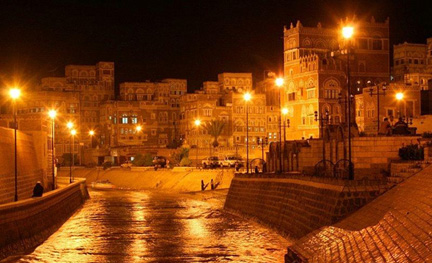
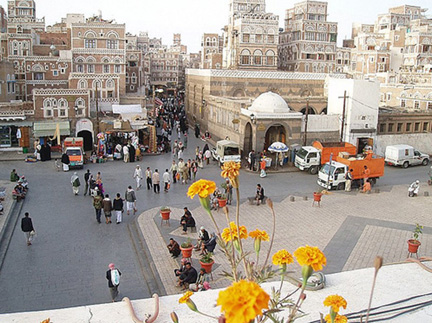
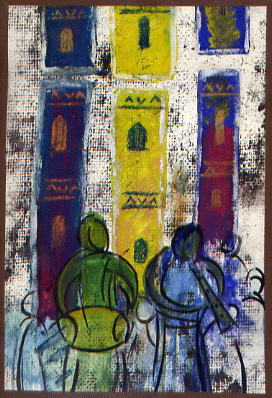
One of my most admired paintings by a Yemeni artist is the painting shown above by the Adeni artist Abdulla al-Ameen. I purchased the painting a decade ago at an exhibition sponsored by Yemen’s Ministry of Culture. Al-Ameen received an M.F.A. in 1984 from the Fine Arts Academy in Moscow. In addition to illustrations in books, he has designed stamps for the Yemeni government. In 1987 he received Kuwait’s “Golden Dhow Medal” for his artistic achievements.

El-Aswad on Bahraini Shi’a


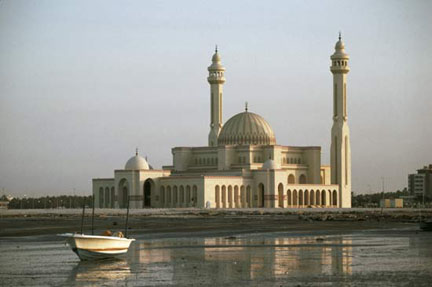
Grand Mosque in Bahrain

Tabsir contributor El-Sayed el-Aswad recently published an article entitled “The Perceptibility of the Invisible Cosmology: Religious Rituals and Embodied Spirituality among the Bahraini Shi’a” in Anthropology of the Middle East, Volume 5, Number 2, Winter 2010 , pp. 59-76. The article is available to subscribers of the journal or for purchase. The abstract is cited here:

This article analyses the relationship between the seen and the unseen in the cosmology and practices of Bahraini Shi’a. Rather than contrasting the visible and the invisible, the study delineates the hierarchical relations between them, within a whole or cosmology, as reflected in various discursive and non-discursive actions that are supported by the religious beliefs of Bahraini Shi’a. Issues of the Hidden Imam, concealment, dissimulation and other unseen dimensions of the cosmos are discussed. The article finds that the Shi’a construct the invisible in their social world by using visible ways of creatively enacting their hidden thoughts and beliefs, as represented in their religious discourses, rituals and body symbolism. Their belief in a divine higher power provides a source of emotional, spiritual and socio-political empowerment.

Ottomaniacs


Süleyman the magnificently polemical

ISTANBUL – Hürriyet Daily News, Sunday, January 9, 2011

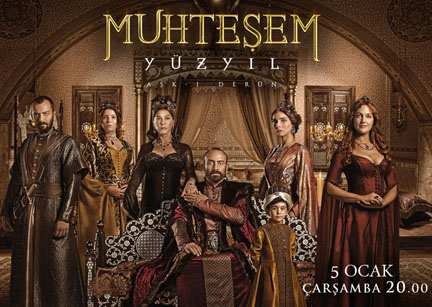
A new TV soap has generated a massive reaction from conservative circles in Turkey, with claims that the Ottoman dynasty is portrayed in the show as both “indecent” and “hedonistic.”

The soap, titled “Muhteşem Yüzyıl” (The Magnificent Century), is based on events that occurred during the reign of Süleyman I, also known as Suleyman the Magnificent.

Surviving heirs of the Ottoman dynasty and members of the ruling Justice and Development Party, or AKP, are among critics of the show.

Reactions started to flow in following the broadcast of the trailer, even before the first episode was aired on Jan. 5.

The Supreme Board of Radio and Television, or RTÜK, is reported to have received thousands of complaints, most of which focus on the Sultan’s alcohol consumption and activities in the harem with his concubines. Continue reading Ottomaniacs →
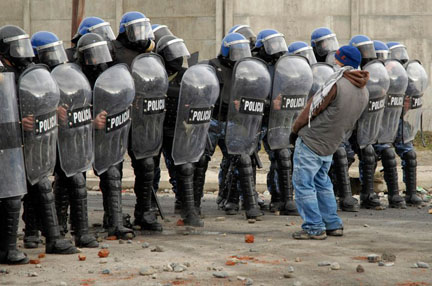
Guns don’t kill, neither do guns die


For the past week the American media has been fixated on an act of violence that has left six dead and wounded fourteen, including Arizona representative Gabrielle Giffords. Last night President Obama, in a stirring and emotional speech at a memorial service for the victims, urged Americans not to use this tragedy as a staging ground for the usual politics of blame:

But what we can’t do is use this tragedy as one more occasion to turn on one another. As we discuss these issues, let each of us do so with a good dose of humility. Rather than pointing fingers or assigning blame, let us use this occasion to expand our moral imaginations, to listen to each other more carefully, to sharpen our instincts for empathy, and remind ourselves of all the ways our hopes and dreams are bound together.

Beneath the brief aura of civility in this tragedy’s aftermath there lingers an ongoing current of uncivil rhetoric, fueled in large part by media pundits eager to gain an audience. The blame has already been assigned over and over again. In this particular case it appears that the killer, Jared Lee Loughner, was an emotionally disturbed individual who acted on his own. Thus, it is no surprise that a Tea Party icon like Kentucky’s newly elected senator Rand Paul would go on Fox News and remind us all: “But the weapons don’t kill people. It’s the individual that killed these people.”

It certainly is true that the Glock 9 mm pistol did not go off on its own, so obviously there is no need to punish the gun involved in this case, nor even the bullets used. The problem is that if we claim that guns don’t kill, we must also admit that guns don’t die either. Continue reading Guns don’t kill, neither do guns die →

Belly Dance a century ago


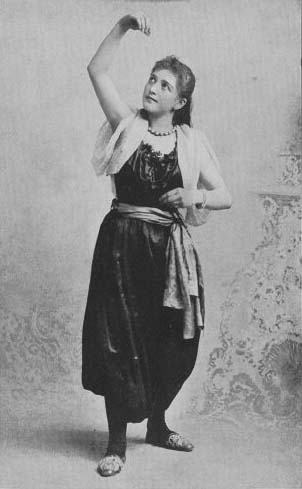
Little Egypt

There are several fascinating videos uploaded on Youtube of belly dance more than a century ago. One is a very short clip of 14 seconds from 1895 of a dancer named “Princess Ali.” Another is an early Edison film of Ella Lola, made in 1898, combined on Youtube with a 1900 track of Turkish music. The video lasts over three minutes. Ella was in costume, but another early video from 1904 shows “Princess Rajah” in the dress of the day dancing away her hoochie koochie as a circus act complete with chair. The queen of the art, at least in hindsight, was “Little Egypt,” who is also to be found in a clip from a movie about striptease. Although not an original film video, there is an interesting Youtube video with vintage “Orientalist” commentary about Egyptian and other North African belly dance at the 1889 L’Exposition Universelle, especially along “La Rue du Caire.”

For an overview of belly dance, see the excellent article by Najwa Adra.

Libya’s novelist Ibrahim al-Koni wins Arab Novel Award


Al-Arabiya, December 16, 2010

CAIRO (Arab Media House)

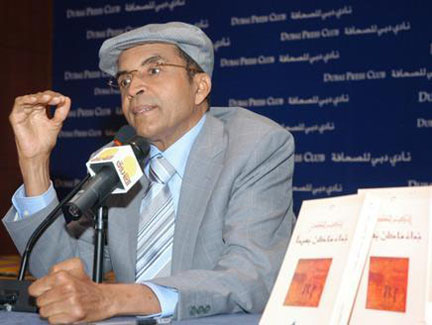
Libyan novelist Ibrahim al-Koni received in Cairo the Arab Novel Award and dedicated the value of the prize to the children of the Tuareg tribes from which he originally hails.

At the closing ceremony of the fifth round of the Cairo Novel Conference, prominent Libyan author Ibrahim al-Koni was chosen from 23 competitors to receive the Arab Novel Award, whose value is 100,000 Egyptian pounds ($18,000).

“Koni was chosen for his ability to breathe life into the desert on the human, natural, spiritual, and mythological levels,” said Syrian critic Sobhi Hadeedi, who headed the jury.

The committee in charge of choosing the winner praised Koni’s ability to utilize folklore, oral tradition, death rituals, and aspects of everyday life in order to create a literary work.

“He creates his own individual anthropology,” added the committee statement. Continue reading Libya’s novelist Ibrahim al-Koni wins Arab Novel Award →