Library Research: A Lament but not an Obituary

I arrived a little early to the Great Mosque of San‘a’ in Yemen to continue my research in the small upstairs room which was the “Western Library.” I sat down in a corner waiting for Qadi al-Sharafi to arrive and open the door. All of a sudden a crazed individual, thinking I was a tourist, started shouting at me. I tried to calm him down but immediately others came to my rescue, explaining that I was a researcher studying manuscripts in the library and should not be bothered. When the Qadi arrived, I followed him upstairs, asked for the manuscript I was working on (which was stored in another room) and spent the day sharing a table with a man reciting Quran and another man reading another manuscript. The Qadi was hard of hearing, so when the phone would ring, it was a comedy routine in Arabic of “what did you say?”. This day is forever stored in my pleasant memory department.

Over the past four decades I have spent many hours in libraries, as an undergraduate browsing little-read, dust-covered books on biblical archaeology at Wheaton College, a graduate student browsing the well-stocked stacks at the University of Pennsylvania, requesting rare 19th century Arabic texts in the Oriental Studies room of the New York Public Library, being served tea while reading manuscripts in the Egyptian National Library (Dar al-Kutub), in awe at the one-of-a-kind Bodleian in Oxford, enjoying the lakeside view from the library of the Institute for Advanced Study in Princeton, being amazed at the private library on the Arabian Peninsula of a shaykh in Qatar, to name only the obvious.

I love libraries, because I love books and I love manuscripts. Of course, I read for information, the goal of research. However, this feeling of love is nurtured by actually touching the hardness of a book, absorbing the aroma of yellowed paper or gazing at the original ink or fading print. The book in hand is no less both subject and object than the libraries where they have a home. My age betrays me; my joy is for the bibliophilic memories but my lament is for the current explosion of the pdfs, the Profoundly Dull Facsimiles, that have transformed the research environment. Yes, I know that the pdf is an amazing gift for anyone who works on old books and ancient manuscripts. Blessed be archive.org and its cyber siblings. A digital copy is definitely a “helpmeet” in the tired old biblical sense, but it is still a lifeless robot beside the paper-and-ink flesh of the original.

In 1981 on my way home from a consulting assignment in Egypt, I carried a rapidly purchased suitcase of dubious quality from the Cairo suq full of the hefty 9-volume set of the mother of all Arabic dictionaries, the Taj al-‘Arus of al-Zabidi. This was the 1306/1889 Egyptian version without vowels. For someone just finishing up a dissertation this was a century-old godsend. The suitcase was so heavy that I gave the airport porter extra bakshish. Somehow it made the weight limit on TWA and I arrived with the precious volumes intact at JFK. As I was lugging the suitcase through the doorway into our home, the suitcase exploded and the volumes poured out on the floor, like an offering to the guardians of the house. I now have downloaded the far superior Kuwait edition of the dictionary in pdf and my revered copy, well thumbed over several decades, catches the inevitable dust-off of no longer being useful. Even the pdf has been superseded by an online searchable site of al-Zabidi and several other major Arabic lexicons, including the archaic-yet-eternal Arabic/English lexicon of Edward Lane (http://arabiclexicon.hawramani.com/).

My own library, especially of Arabic books, was built up over several decades. Every trip I made to the Middle East involved checking out bookstores for interesting books in Arabic. Several of the books I purchased, perhaps most, are now available somewhere on the web in pdf and a few are even searchable online. As I look to downsize the far-too-many books that have accumulated, I do appreciate that I can still have access to the information without having to find space for the physical volumes. Like all researchers these days, I have access through pdfs of books and manuscripts I never knew existed or would only find in the storage recess of a major university library, if there. My lament is not for the benefit of progress, just as I would not turn in my Acura TSX for the horse and buggy my grandparents rode more than a century ago. My memories of books, libraries and bookstores are well embedded inside me; any sadness I feel is for those who may not have or take the opportunity to engage with books face-to-face in a space that no digital version can replace.

This is not an obituary. Libraries, especially those useful for scholars of all stripes, are not going to disappear in the near future. There are books upon books in the market and many more coming into print every year. Johannes Gutenberg need not roll over in his grave, although I suspect this 15th century inventor might turn sommersaults over the website named for him (https://www.gutenberg.org/). The lament is not that you cannot share what I have experienced, but that you actually do not have to; but you should.

Tabsir is back

In September 2005 I started the blog Tabsir (“Insight”) with several other colleagues to provide information on the Middle East as a supplement to the news and to note items of interest. The blog has been in hibernation since late 2018 as I simply had no time to keep it going. I am reviving the blog for posting items time to time and hope to involve several other academic colleagues as well.

Geocolonialism and the War in Yemen

harb
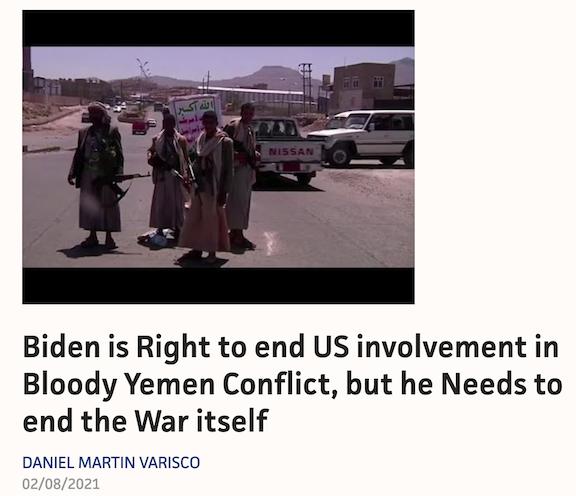
In April Secretary-General Antonio Guterres called the situation in Yemen the world’s worst humanitarian crisis. After more than three years of a lopsided war between a Western-supported Saudi/Emirati coalition and a rebel group in control of the capital Sanaa and most of the estimated 28 million Yemenis, the crisis is only getting worse.

Now coalition forces are attempting to wrest control of the vital port of Hodeidah from the Huthi forces, thinking that such a loss would force the Huthis to accept their terms for a total submission. Since this port supplies most of the food and aid entering Yemen, loss of the port would likely trigger a siege to literally starve the Huthi areas into submission. The Huthis know this and are not likely to give up the port without a bloodbath. Meanwhile several hundred thousand residents fear for their lives and many have already fled to areas with no resources whatsoever. The UN fears a renewed outbreak of cholera, which has already affected more than one million Yemenis. Negotiations continue by the UN Special Envoy Martin Griffiths to stop the impending violence.

But in the midst of all this turmoil, one recent pundit argues that the eastern province of Marib, firmly in control of the Saudi/Emirati alliance, shows how one province succeeds in the midst of Yemen’s war. Not only is this sparsely populated and oil-rich area considered a success, it is said to be “thriving.” A football stadium with German turf and according to FIFA standards is being constructed and there is a new university for 5,000 students. The biblical land of the Queen of Sheba and famous Marib dam mentioned in the Quran (which was bombed at one point by the Saudis) is said to be “regaining a slice of its historical importance.”

So what is the lesson for Yemen’s future from this miracle in the desert? For journalist Adam Baron “Marib’s experience holds wider lessons for Yemen’s future: embracing decentralisation, empowering local actors, and focusing on ground-up stabilisation are all strands of the story that international and local players interested in bringing peace and stability to Yemen should note.” The main local actor here is a tribal sheikh named Sultan Arada, drawing on support of the conservative Islah movement. With outside money pouring in, he has morphed into the sultan of a fiefdom. The current “stability” is grounded not on local concerns but from the top-down flow of money from the neighboring international players, Saudis and Emiratis.

Yemen’s future is not in Marib, nor in building state-of-the-art FIFA stadiums in a country with a ravaged infrastructure, ongoing water crisis and sectarian violence fueled by the grueling three years of war. Marib is currently a colony of the Saudis, just as the Emiratis would like to take control of the island of Socotra and the port of Aden. The two wealthiest states of the now moribund GCC are carving out their zones of influence on the backs of people in the poorest country in the Arabian Peninsula. Without the billions of dollars worth of weapons and strategic intelligence from the West, this war dividend could never have been realized.

Welcome to the latest, post-Cold War twist in the land once thought to be Holy. It is no longer direct Western intervention but a shared geocolonialism, in which the proxy war between Saudi Arabia and Iran is applauded and abetted by Western leaders. Muhammad bin Salman’s recent trip to the U.S. sold his snake-oil reform in exchange for buying more weapons and all that he assumes oil-drenched money can buy. Meanwhile the Saudi abysmal track record on human rights and the war crimes of the Saudi-led coalition in Yemen are ignored. If Marib is the model for Yemen’s future, then the only democracy, for its flaws, in the Arabian Peninsula will be geocolonized into yet another make-believe kingdom or emirate.

Arabic Dictionaries Online

lisan

In 1981, while visiting Egypt for a consulting assignment with USAID, I purchased the old Cairo edition of the massive dictionary Tāj al-‘Arūs of Murtaḍā al-Zabīdī (d. 1790). This was in about 10 large and heavy volumes. For it and a few other books I bought a cheap suitcase and paid the porter who carried it from the taxi to the airline desk a large baksheesh. When I arrived back in New York, as I was entering the door of our home, the suitcase burst open and Tāj al-‘Arūs was spread on the floor.

That was some 35 years ago, but now I have pdf files of the entire modern Kuwaiti edition courtesy of archive.org. While a scholar of Arabic used to either buy the physical book (I purchased a set of Lisān al-‘Arab in Baghdad in 1979) or be based near a major library (I had the advantage of the Oriental Room of the New York Public Library), now all it takes is a click of a mouse and many megabytes of space to build up a library of Arabic dictionaries.

For those who are looking for Arabic dictionaries available online or in pdf format, here is a list. Others are welcome to suggest sources they know.

Online Arabic Dictionaries

• The first place to go for classical Arabic is al-Bāḥith al-‘Arabī (http://www.baheth.info/), which is searchable by word in Arabic for the following dictionaries:
Lisān al-‘Arab of Ibn Manẓūr (d. 1311 CE); Maqāyyis al-lugha of Aḥmad ibn Fāris (d. 1004) ; al-Siḥāḥ fī al-lugha of Ismā‘īl ibn Ḥammād al-Jawharī (d. 1003); al-Qāmūs al-muḥīṭ of al-Fīrūzābādī (d. 1329); and, al-‘Ubāb al-zākhir of al-Ḥasan ibn Muḥammad al-Ṣaghānī (d. 1252).

• The Arabic website al-Ma‘ānī (http://www.almaany.com/) is an excellent source for Arabic definitions of Arabic terms.

• For Arabic to English, the original text of Edward Lane’s (1863) An Arabic-English Lexicon is available as an online pdf at http://www.tyndalearchive.com/TABS/Lane/. It is also available as a download at archive.org and at http://www.studyquran.co.uk/LLhome.htm

Arabic Dictionaries in PDF

• Al-Fayrūzābādī’s al-Qāmūs al-muḥīṭ is at https://archive.org/details/QamusMuhit
• Ibn Manẓūr’s Lisān al-‘Arab is at https://archive.org/details/lisan.al.arab
• Al-Ṣaghānī’s al-Takmila wa-al-dhayl is at https://archive.org/details/TKMLH
• Al-Zabīdī’s massive Tāj al-‘arūs (Kuwaiti version) is at https://archive.org/details/taga07

• see also Dozy, R. (1881) Supplement aux Dictionnaires Arabes. Leiden Brill. at http://gallica.bnf.fr/ark:/12148/bpt6k6254645z

Arabic/English, English/Arabic, etc.

• Baretto, Joseph (1804) A Dictionary of the Persian and Arabic Languages. Calcutta : S. Greenway, India Gazette Press. Vol. 2 at https://archive.org/details/dictionaryofpers02barriala

• Johnson, Francis (1852) A Dictionary, Persian, Arabic and English. London: W.H. Allen. at https://archive.org/details/b22651366

• Penrice, John (1873) A Dictionary and Glossary of the Kor-ân. London: Henry S. King. at https://archive.org/details/bub_gb_QYwq3ylpv6kC

• Richardson, John (1810) A Vocabulary, Persian, Arabic, and English; abridged from the quarto edition of Richardson’s dictionary is at https://archive.org/details/vocabularypersia00richiala

• Steingass, Francis Joseph (1882) English-Arabic Dictionary: For the Use of Both Travellers and Students. London: W. H. Allen and Co. at https://archive.org/details/englisharabicdi00steigoog

• Steingass, Francis Joseph (1884) The Student’s Arabic-English Dictionary. London: Crosby, Lockwood and Son at https://archive.org/details/cu31924026873194

• Wehr, Hans (1960) Arabic-English Dictionary is available as a pdf at https://archive.org/details/Arabic-englsihDictionary

• Wortabet, William Thomson Arabic-English Dictionary is available as a pdf at https://archive.org/details/WortabetsArabic-englishDictionary

Arabic Dialect Dictionaries

• Ben Sedirah, Belkassam (1910) Petit dictionnaire arabe-français de la langue parlée en Algérie, contenant les mots et les formules employés dans les lettres et les actes judiciaires. Alger: Jourdan. at https://archive.org/details/petitdictionnair00abaluoft

• Biberstein-Kazimirski, Albert de (1860) Dictionnaire arabe-francais contenant toutes les racines de la langue arabe : leurs dérivés, tant dans l’idiome vulgaire que dans l’idiome littéral, ainsi que les dialectes d’Alger et de Maroc. Paris: Maisonneuve: Éditeurs pour les langues orientales, Européenes et comparées. at https://archive.org/details/dictionnairearab02bibeuoft

• Cameron, Donald Andreas (1892) An Arabic-English vocabulary for the use of English students of modern Egyptian Arabic. London: Bernard Quaritch. at https://archive.org/details/arabicenglishvoc00cameuoft

• Crow, Francis Edward (1901) Arabic manual. A colloquial handbook in the Syrian dialect, for the use of visitors to Syria and Palestine, containing a simplified grammar, a comprehensive English and Arabic vocabulary and dialogues. London: Luzac and co.
at https://archive.org/details/arabicmanualcoll00crow

• Hinds, Martin and el-Said Badawi (1986) A Dictionary of Egyptian Arabic is available as a pdf at https://archive.org/details/ADictionaryOfEgyptianArabicArabicEnglish

• Landberg, Carlo (1901) Études sur les dialectes de l’Arabie méridionale. I: ḤaḍramoÅ«t. Leiden: Brill. at https://archive.org/details/tudessurlesdial00unkngoog

• Landberg, Carlo (1909) Études sur les dialectes de l’Arabie méridionale. Datina. Leiden: Brill. https://archive.org/details/p2tudessurlesdia02landuoft

• Nishio, Tetsuo (1992) A Basic Vocabulary of the Bedouin Arabic Dialect of the Jbāli tribe (Southern Sinai). Tokyo : Institute for the Study of Languages and Cultures of Asia and Africa. https://archive.org/details/basicvocabularyo00nish

• Rhodokanakis, Nikolaus (1908) Der vulgärarabische Dialekt im Dofâr (Zfâr). Vienna: Alfred Hölder. at https://archive.org/details/dervulgrarabis10rhod

Arabic Thesaurus

• Ibn Qutayba Adab al-kātib. Beirut: Mu’assisa al-Risāla. at https://archive.org/details/tanmawia.com_15789

• Ibn Sīda, Al-Mukhaṣṣāṣ. Beirut: Dār al-Kutub al-‘Ilmiyya. at https://archive.org/details/mukhsasmukhsas

• Khuwārizmī, Muḥammad ibn Aḥmad (1866-1903) Liber Mafâtîh al-olûm: explicans vocabula technica scientiarum tam Arabum quam peregrinorum. Edited by G. Voten. Lugduni Batavorum: Brill. [in Arabic] at https://archive.org/details/b29006247

Specialized Arabic Terms

•Al-Damīrī (1908) Ad-Damîrî’s Ḥayât al-Ḥayawān (A Zoological Lexicon). Translated by A. S. G. Jayakar. London: Luzac. Vol. 2, Part 1. at https://archive.org/details/addamrsaytalaya00damgoog

• Al-Damīrī Ḥayāt al-ḥayawān ms. at https://al-mostafa.info/data/arabic/depot/gap.php?file=m013645.pdf

• Fleury, V and Muammad Souhlal (1915) L’arabe pratique et commercial à l’usage des établissements d’instruction et des commerçants, lecture, écriture, grammaire, syntaxe, exercices d’application, conversation, lexiques, dictionnaire commercial. Alger: Jourdan.
at https://archive.org/details/larabepratiqueet00fleuuoft

• Dozy, Renard (1845) Dictionnaire Détaillé des noms des vêtements chez les Arabes. Amsterdam: Jean Müller. at https://archive.org/details/dictionnairedt00dozyuoft

• Fonahn, A. (1922) Arabic and Latin Anatomical Terminology. Kristiania: Jacob Dybwad. at https://archive.org/details/arabiclatinanat00fona

• Ibrāhīm, Rajab (2002) al-Mu‘jam al-‘Arabī li-asmā’ al-malābis. Cairo: Dār al-Mufāq. at https://archive.org/stream/FP56847/56847#page/n0/mode/2up

• Mu‘jam muṣṭlaḥāt al-‘ulūm al-shar‘īyya. Saudi Arabia, 2017. Vol. 1 at https://archive.org/details/momsolshPDF

• Siddiqi, Abdussattar (1919) Studien über die Persischen Fremdwörter im klassischen Arabisch. Göttingen, Vandenhoeck. at https://archive.org/details/studienberdiep00sidd

• Yāqūt, Mu‘jam al-buldan. at https://www.4shared.com

Exploring Arabic Texts:

There are many more sources available at archive.org if you put “Arabic language” in the search bar. Important sources for links to pdfs of Arabic language texts include the following:

• Arabic Collections Online (NYU Aby Dhabi): http://dlib.nyu.edu/aco/
• 4shared.com: https://www.4shared.com/
• Al-Madinah Inernational University Digital Library: http://dlibrary.mediu.edu
• al-Maktaba al-Shāmila: http://shamela.ws/
• Mawqa‘ al-ḍīyā‘: http://www.aldhiaa.com/arabic/book.php?sort=all
• al-Mostafa: https://www.al-mostafa.com/
• Waqfeya: http://waqfeya.com/category.php?cid=6

• See the list of sites at https://digitalorientalist.com/2015/01/16/full-text-online-arabic-sources-a-preliminary-list/

al-Juwayni on Islamic Law

juwayni

David R. Vishanoff has recently published online A Critical Edition, English Translation, and New Commentary on Imām al‑Ḥaramayn al-Juwaynī’s Leaflet on the Sources of Law
(Kitāb al‑Waraqāt fī uṣūl al‑fiqh).

“For an English-speaking student who wishes to understand the theory behind Islamic law, the first step is to read an introductory legal theory text such as Muslim students traditionally read and memorize in the Arab world. The Kitāb al-Waraqāt fÄ« uṣūl al-fiqh, or Leaflet on the Sources of Law, attributed to the KhurāsānÄ« Shāfiʿī AshÊ¿arÄ« scholar Imām al-Ḥaramayn AbÅ« al-MaʿālÄ« Ê¿Abd al-Malik ibn AbÄ« Muḥammad al-JuwaynÄ« (d. 1085), is a good choice, for two reasons.

First, it is brief, yet covers all the main concepts, terms, and principles of the classical Islamic discipline of legal theory (uṣūl al-fiqh), which explains the scriptural “roots” or “sources” (uṣūl) from which the detailed rules of Islamic law (fiqh) derive their authority, and the interpretive process that connects each rule to its sources. It defines what law and legal theory are, then explains how to analyze the language of Muslim scriptures (how to translate commands into laws, and various ways to resolve contradictions between texts), and then goes on to describe several other tools that one can use when scripture does not provide a clear rule (e.g. textual criticism and reasoning by analogy). It concludes with a description of who is qualified to use legal theory, and how certain they can be about the conclusions they reach.

Second, it is representative of mainstream SunnÄ« views that dominated legal thought in al-Juwaynī’s day and that are still widely accepted today…”

click here to go to the website.

Pierre Cachia 1921-2017

pierre

Pierre Cachia 1921-2017

Pierre Cachia slipped away peacefully on 1st April, a few days shy of his 96
th birthday, surrounded by his children and grandchildren. With the passing
of this key architect of Arabic studies who made modern Arabic literature a
serious academic subject in both the UK and US, those of us who have
studied and worked with him will not only mourn the loss of a friend,
teacher, and mentor, but also the irretrievable era in which a first
generation of post-War American and European Arabists and Orientalists made
tremendous strides in fashioning academic studies of modern Arabic
literature into what it is today: grounded in native fluency of the Arabic
language, informed by real experiences lived in close proximity with Arab
writers and storytellers, and took seriously the concerns and priorities of
Arab scholars, critics and intellectuals.

Born in Faiyum (Fayyum) on 30 April 1921 to Maltese father and Russian
mother, Pierre grew up in Upper Egypt. He successively attended French,
Italian, Egyptian and American schools before he enrolled at the American
University in Cairo, where he earned his BA degree. After war service with
the British 8th Army in North Africa, Italy and Austria, he moved to
Scotland. He received his doctorate at the University of Edinburgh in 1951
and joined its Faculty. He was appointed Professor of Arabic Language and
Literature at Columbia University in 1975 and would remain there until he
retired in 1991. However, he continued to teach and write, and in fact he
published many of his important works after retirement. He wrote scholarly
articles and books on a variety of subjects, translated classical and
modern literary and critical works, and published other scholars in *Journal
of Arabic Literature*, which he co-founded and on whose editorial board he
served for many years.
Continue reading Pierre Cachia 1921-2017