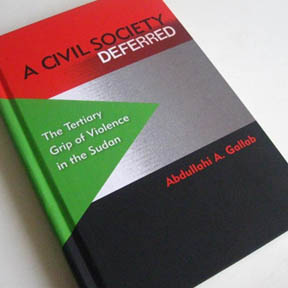
A View of Abdullahi Gallab’s A CIVIL SOCIETY DEFERRED from a precolonial perspective
By Jay Spaulding, African Arguments, November 28, 2011,
“Men make their own history, “ wrote a famous individual long ago, “but they do not make it as they please; they do not make it under self-selected circumstances, but under circumstances existing already, given and transmitted from the past.†Subsequent historians have endeavored to elaborate hierarchies of historical causation within which diverse material, socioeconomic and conceptual entities are seen to constrain the exercise of free will. Nowhere has the examination of constraint received greater attention than among the colonized communities of the not-so-distant past, including the Sudan. One of the virtues of Abdullahi Gallab’s A CIVIL SOCIETY DEFERRED lies in the author’s mastery of a wide variety of theorists of historical causation and colonial constraint. The wealth of their insights has allowed him to rearrange largely familiar information about the Sudan into an original and impressive interpretive architecture. His approach, the opposite of reductionist, resonates at many levels of understanding. A second virtue of A CIVIL SOCIETY DEFERRED is that the author knows, profits from, and builds upon the efforts of previous Sudan scholarship. The book consciously joins and illuminates an extended ongoing discussion.
The author’s central effort is to discern the colonial origins of the current Sudanese state. Few will challenge this thesis, and other contributors to this discussion will undoubtedly address the theme at length. But is there anything that one might add to perhaps embellish A CIVIL SOCIETY DEFERRED from the remote perspective of precolonial Sudanese history? I would like to propose two ideas for possible consideration. Continue reading A CIVIL SOCIETY DEFERRED