The Quran in East and West: Manuscripts and Printed Books


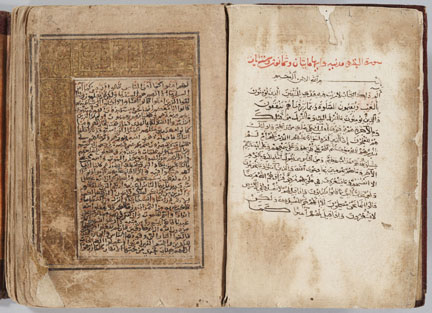
Burke Arabic MS 1, unsigned and undated (Iraq or Iran, before 1300 CE)

The following is a nicely done website about a Quran exhibition held at the Burke Theological Library of Columbia University in 2005 and curated by the historian Dagmar A. Riedel.

During the month of Ramadan, Muslims commemorate the revelation of the Quran to the prophet Muhammad. In Fall 2005, from October 4 until November 2, Burke Library exhibited some of its Qurans to explore during Ramadan 1426 AH how attitudes toward Islam are reflected in the books that give readers access to its revelation.

Since Burke Library was founded as a Protestant research collection, the study of Islam is not often associated with its holdings. But its small collection of Near Eastern manuscripts includes five Qurans which represent the regional esthetic traditions of Quran illumination between the thirteenth and nineteenth centuries CE. Furthermore, Burke Library owns many of the seminal works of Quran scholarship published in early modern Europe, documenting how non-Muslim Europeans translated the Arabic Quran first into Latin and then into European vernaculars. The exhibition traced the process, stretching from the twelfth to the nineteenth century, by which the European approach to the Quran was transformed from an angst-ridden defense against yet another Christian heresy to the investigation of another strain of monotheism.

The 2005 project was made possible by Michael Boddy’s enthusiastic support which in turn ensured the permission of Sara J. Myers, the director of Burke Library, to go ahead with an exhibition that in the middle of the term occupied space in the Burke’s conference and reading rooms. I am also indebted to Jean W. Ashton, the director of the Rare Book and Manuscript Library, for lending a Quran from the David E. Smith Collection of Oriental Manuscripts for the exhibition. In the winter of 2011, Burke Library director John B. Weaver generously sponsored the web adaptation of the original brick-and-mortar exhibition.

Exhibit Curator
Dagmar A. Riedel
The 8th Voyage of Sindbad: #1


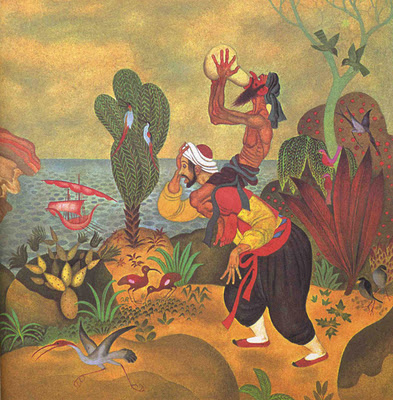
illustration by Gustaf Tengrren

[Webshaykh’s Note: This last semester I taught an Honors Seminar on the Arabian Nights. The last assignment asked students to write the 8th voyage of Sindbad, drawing on what happened in earlier voyages. I will post several of these here for your enjoyment. The first is by Taryn Teurfs…]

The 8th Voyage of Sindbad

by Taryn Teurfs

Sindbad began to recall his eighth voyage, his most truly remarkable voyage that was kept clandestine. He began:

I was visiting the palace of King Haffwadar because he spoke of a sword he needed me to capture in turn for a great reward. The Sword of Harun al-Rashid, as legend has it, belonged to the caliph himself and possesses a mystical element: If the true descendant of Harun al-Rashid obtains that sword, with one touch the sword lights on fire and can cut through 1000 enemies with one lash. King Haffwadar had no evidence that he was a descendant of Harun al-Rashid, but one of his magicians had a vision of Haffwadar holding the sword so Haffwadar felt that fate was telling him he was its rightful owner.

The sword was located in the Isla de los Monos, comprised of apes of all different shapes and sizes, but a thousand times more powerful that the island I visited on my third voyage. The journey to this island is so dangerous King Haffwadar couldn’t risk his life to obtain the sword but knew the type of journeys I would go on to try and recover valuables or ensure the safety of a kingdom.

“Sindbad”, said King Haffwadar, “Before you go to the island you must obtain a mirrored box, an ice crystal, and the secret potion of Ashwayar. It is said in the legend you must use these items to defeat the evil jinn Shahidi who controls the island. You must seek the enchantress Ashwayar and ask her for these pieces. I am giving you this compass presented by the magician as guidance. It shall bring you to the sword in haste.” I came upon Ashwayar at the great lake. She had long beautiful black hair like the starless sky. She sat amidst a rose bush undraped, likened as the great Almighty had created her.

“Ashwayar,” I began. “I am called Sindbad. I have sailed here from afar to —“ Continue reading The 8th Voyage of Sindbad: #1 →

Billions for Millions


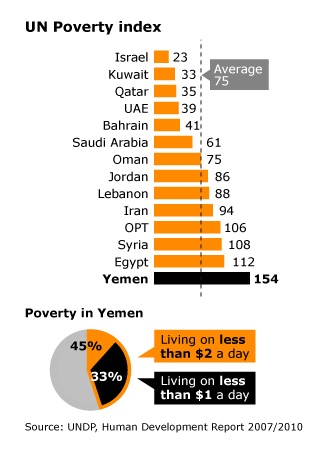
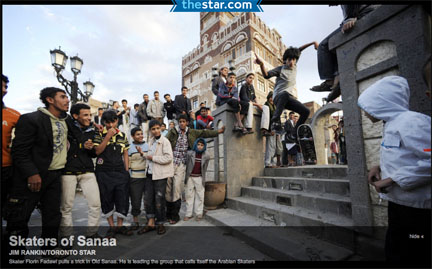
Yemen is about to be gifted with 3.25 billion dollars in aid from Saudi Arabia, according to Al Jazeera. With about 24 million people in Yemen, this is quite a hefty donation. Other donors will kick in to round it up at 4 billion. So the question now is who will benefit from all this money and how will such a vast amount actually be channeled into the public sector. There is no question that Yemen faces a severe humanitarian crisis with rising levels of malnutrition and health problems due to the insecurity and economic quagmire following the dictatorial rape of Yemen’s wealth by the late President Ali Abdullah Salih and his cronies. If the money is really funneled into health, education and needed infrastructure, this will be a valuable boost to getting the country back on track. But it is a big “if” given the continuing unrest throughout the country, the violence of Ansar al-Sharia in the south and the lack of a viable governmental civil service. How much of this aid will continue to end up in the pockets of officials, since corruption became endemic during the Salih regime?

And what are the strings to such a vast amount? Yemen has a diverse religious history with both Zaydi and Shafi’i followers who have lived in relative peace, separated by politics rather than doctrinal fighting, for centuries. But the influx of conservative Wahhabi cum Salafi views with Saudi financial backing threatens to create greater tension over religious affiliation. Do the Saudis simply want to extend their royal influence to the south or are the leaders genuinely concerned about the plight of Yemen’s population?

There is an old phrase in American English: “Don’t bite the hand that’s feeding you.” This is good advice as long as the hand is only feeding you and not at the same time grabbing you by the neck and forcing you to be something else than you want to be. It remains to be seen how the aid money will be spent, but Yemen is clearly the beneficiary of largesse that other struggling countries in the region have not received; Sudan and Somalia, for example.

But, as another American saying goes, “Don’t look a gift horse in the mouth,” even if it has a Saudi brand.

What and who are not working in Yemen


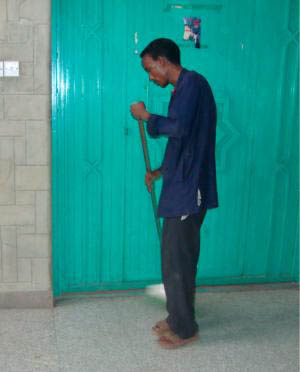
a Yemeni worker; photo by Amira Nasser

Severe working conditions with no way out

Amira Nasser, Yemen Times, May 17, 2012

Despite the revolution which exploded last year in Yemen with demands for human rights and opportunities, thousands of Yemenis still work in slave-like conditions with little hope of escape.

Surviving in Yemen’s harsh economy with limited choices has forced countless Yemenis to take work that affords them little social mobility, and leaves them drowning in debt.

Tight circumstances

Waheeb Abdul-Wahab, a 13-year-old, works in a mechanic shop with his 7-year-old brother, Majed, from 7a.m. to 4p.m. daily. They each make YR 1000 , less than 5 US dollars, for a long day of strenuous labor.

“My brother and I give some of the money to my mother and we keep about YR 600 for ourselves.”

Waheeb added that he alone makes roughly YR 8000 to 9000 in profits for the shop owner on a daily basis, but he keeps only YR 1000 for himself.

He and his brother are an example of thousands of Yemeni children who are forced to work demanding jobs in order to sustain their families. Continue reading What and who are not working in Yemen →

Muhammad Asad Between Religion and Politics


by Talal Asad, Islam Interactive, May 21, 2012

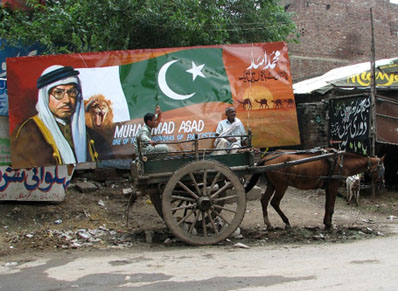
In April 2011 an international symposium was held in Riyadh, under the auspices of the King Faisal Center for Research and Islamic Studies as well as the Austrian Embassy to Saudi Arabia, on the life and work of my father. The conference as a whole was entitled “Muhammad Asad – A Life for Dialogue,” but I was asked by the organizers to write specifically on “Muhammad Asad Between Religion and Politics.” Unfortunately I was unable to attend the symposium so I sent in my written contribution to be read out by someone else at the meeting. What follows is a slightly elaborated version of the argument I sent.

I should begin by correcting a view that has become common among people interested in my father’s life and work, that his conversion can be seen as the building of a bridge between Islam and the West. He has even been described by some as a European intellectual who came to Islam with the aim of liberalizing it. Nothing could be further from the truth. When he embraced Islam (aslama, “submitted,” is the Arabic term) he entered a rich and complex tradition that had evolved in diverse ways – mutually compatible as well as in conflict with one another – for a millennium-and-a-half. Thus in his own life’s work he sought to use the methodology of the medieval Spanish theologian Abu Muhammad Ibn Hazm, he drew often and copiously on the interpretations of the nineteenth-century Egyptian reformer Muhammad Abduh, and again, despite strong disagreement on various points of substance with the fourteenth-century Syrian theologian Taqi al-Din Ahmad Ibn Taymiyya, he attempted, like the latter, to integrate reason (‘aql), tradition (naql), and free-will (irāda), to form a coherent and distinctive vision of Islam. His view of Sufism, incidentally, was also influenced by Ibn Taymiyya, for whom it was the excess of Sufis rather than Sufism as such that was the object of reproach. In fact most of what my father published in the early years of his life (Islam at the Crossroads, the translation of SahÄ«h al-Bukhāri, the periodical Arafāt, etc.) was addressed not to Westerners but to fellow-Muslims. I would say, therefore, that he was concerned less with building bridges and more with immersing himself critically in the tradition of Islam that became his tradition, and with encouraging members of his community (Muslims) to adopt an approach that he considered to be its essence. His autobiography was the first publication that was addressed to non-Muslims (as well as to Muslims, of course), a work in which he attempted to lay out to a popular audience not only how he became a Muslim but also what he thought was wonderful about Islam. His translation of the Qur’an into English, completed in the latter part of his life, was not simply a translation: it was a detailed presentation of his final vision of Islam. Continue reading Muhammad Asad Between Religion and Politics →

Lawrence of Arabia’s Death


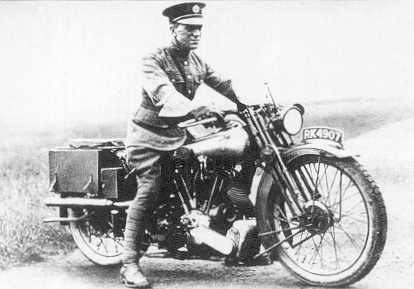
Lawrence of Arabia on his Brough Superior

Strategist of the Desert Dies in Military Hospital

Lord Allenby’s tribute – “Valued comrade”

The Guardian, May 19, 1935

We regret to announce the death of Mr. T. E. Shaw (“Lawrence of Arabia”), which occurred shortly after eight o’clock yesterday morning in Wool Military Hospital, Bovington Camp, Dorset. Mr. Shaw, who until recently was an aircraftman in the Royal Air Force, was injured in a motor-cycling accident on Monday night and did not recover consciousness.

Tragic as it is that such a remarkable career should have been ended by a simple road accident, an official statement issued yesterday shows that if his fight for life had succeeded it would still have been a tragedy, for Mr. Shaw’s brain was irreparably damaged.

Mr. Shaw was 46 years of age.

After a post-mortem examination by Mr. H.W.B. Cairns, the London specialist, the following statement was issued: –

“The post-mortem examination conducted by Mr. Cairns showed such severe lacerations and damage to the brain that in the event of his recovery he would have only regained partial use of his speech and eyesight. In view of the immense activity and energy of Mr. Shaw it is felt that this may be some consolation to those who had entertained anxious hopes of his recovery.”

Another statement issued was: “The funeral of Mr. T. E. Shaw, formerly Colonel Lawrence, will take place at Moreton Church, Dorset, at 2.30pm on Tuesday. The service will be a simple one and no mourning and no flowers are requested. Apart from those specially invited the service will be confined to his particular friends and those who were associated with him in Arabia. Continue reading Lawrence of Arabia’s Death →