Body Politics: Muhammad and Middleton


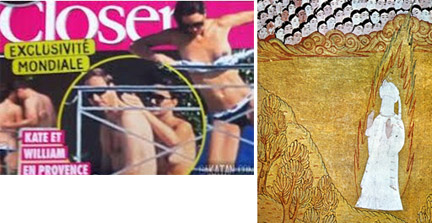
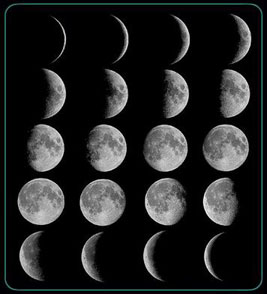
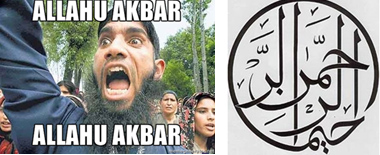
The offending photographs of Kate Middleton, left; an Islamic depiction of Muhammad by not showing his face, right


[Note: The following commentary has been posted to my column “Middle East Muddle” on the online website of Anthropology News, published by the American Anthropological Association. To read the entire commentary, click here. For more commentaries on “Middle East Muddle, click here.]

Two scandals have dominated the news, at least in Europe and America, over the week following the 9/11 anniversary. The first, which has yet to abate as I write this, is the widespread protests against a pathetic anti-Muslim film trailer trolled from Youtube, rhetorically warmed over in Arabic and promoted by extremist Muslims to stir up violence. The troll took a toll with the American ambassador and several other Americans killed in Libya, violent clashes in Egypt and in Yemen and a range of protests (many of which have remained peaceful) across Muslim communities. The second, which is equally absurd as a pretext, is the voyeuristic publishing by French, Irish and Italian tabloids of a long-distance photograph of the naked breasts of Kate Middleton, the newly wed wife of Britain’s Prince William. The paparazzi have once again harmed Britain’s royal family, first by chasing Princess Diana and now by turning a powerful lens on a private moment in a private home while Diana’s son vacationed in France. In both the body is all about politics…

For the entire commentary go to “Middle East Muddle” by clicking here.

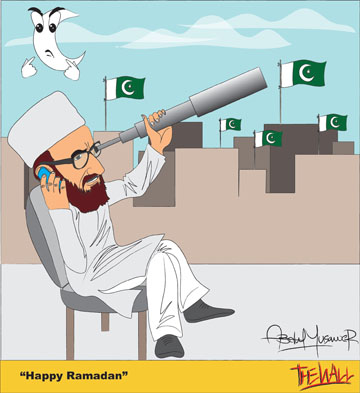
The reform of the Islamic calendar: the terms of the debate, #2


Source of image

click here.]

The legal opinion of Qadi Shakir

Egyptian qadi Ahmad Muhammad Shakir (who was to become President of the Egyptian Supreme Court of the Shariah at the end of his career, and who remains to this day an author of reference in the field of hadith) (9), wrote a lengthy legal opinion in 1939 on the subject of the Islamic calendar, entitled : “The beginning of Arab months… is it legal to determine it using astronomical calculations?”. (2) According to him, the Messenger took into account the fact that the Muslim community of his time was “illiterate, not knowing how to write nor how to count”. So, he recommended to its members to observe the new moon to carry out their religious duties at the time of fasting and hajj. But the community evolved considerably over time, and some of its members even became experts in astronomy.

According to the principle of Muslim law which states that “a rule is no longer applicable, when the factor which justified its existence has disappeared”, the Messenger’s recommendation didn’t apply anymore to the Muslims, after they had learned to read and count and had ceased being illiterate. Therefore, according to Shakir, contemporary ulama’ commit an error of interpretation when they give to the Messenger’s hadith the same interpretation that applied at the time of Revelation, as if the hadith prescribed immutable rules. But, it has stopped being applicable to the Muslim community long ago, based on the principles of the shari’ah themselves. Continue reading The reform of the Islamic calendar: the terms of the debate, #2

The reform of the Islamic calendar: the terms of the debate, Part 1


[Note: This is a two-part article. After reading this you can proceed to Part two by clicking here.]

by Khalid Chraibi

Shortcomings of the Islamic calendar

A calendar associates a specific date with each day of any given week, month or year, to enable people to manage all their activities over an extended period of time. They must be able to anticipate, plan and organize in advance, using the information provided by the calendar, everything that they need to do. But, in Muslim societies, people wait to see, each country for itself, the appearance of the new moon at the end of each lunar month, before they declare the beginning of a new lunar month. As a result:
– the information in the Islamic calendar does not extend beyond the current month;
– and the data it shows each month differs from one Muslim country to another.
For instance, the first day of Ramadan 1427 corresponded to Saturday, September 23, 2006 in 20 countries ; Sunday, September 24 in 46 countries ; and Monday, September 25 in 5 countries. (1) This situation is in no way unusual, but can be observed every month.
Because of these shortcomings, after the major Muslim countries were occupied by foreign powers in the 19th and 20th centuries, Muslim people started using the Gregorian calendar to meet all their needs, and only care about determining Islamic dates on momentous Islamic religious occasions.

But, to this day, they regularly get puzzled at the inability of the Islamic calendar to predict precisely, well in advance, the day on which major Islamic events such as the first day of Ramadan, or eid al-fitr, or eid al-adha, or the first day of the new Islamic year are to take place. Continue reading The reform of the Islamic calendar: the terms of the debate, Part 1

Beyond Allahu Akbar: WWMD, WWJD, WWYD


The manipulated political fury expressed in religious rhetoric over a pathetically provocative anti-Islamic film trailer buried among the millions of needles in the haystack that is Youtube continues, now with a focus in Pakistan. It is not surprising that most Muslims should find the film’s absurd claims offensive. Yet, despite the media images of angry rock throwers holding signs in English, this does not drive the vast majority into the streets or trespassing into Western consulates. If all the cameras stopped rolling, the riots would stop cold. But, of course, now the cameras never stop and any bit of footage can appear on Youtube in a nanosecond. What should we do?

My friend Omid Safi posts on a commentary blog he calls “What Would Muhammad Do?” In his comments on this controversy, he notes that there is enough textual information to reconstruct what Muhammad did when he was insulted:

Yet we know that our Prophet himself was the target of repeated assaults and mockery, and even in his moment of triumph when he had the power to punish, he chose to forgive his enemies and set a higher moral example.

We invite Muslims from every country to raise their voice and be heard, and yet to do so in a way that honors the very example of the manners, the ethics, the path, and the being of the Prophet that we so adore.

There is no way, other than by religious faith in sacred writings, to know what the real Muhammad would do in the modern world, all those hadiths notwithstanding. So in effect Omid and everyone else must argue for what they would expect Muhammad to do if he did live today. But he doesn’t, and neither does Jesus or Moses or any of the revered prophets of the three major monotheisms. In a sense all of the commentary on the reaction to the film is WWWWMTD “what we would want Muhammad to do.”

WWMD is, of course, a take off on WWJD. Since J (as in Jesus) happens to be a revered prophet in Islam as well as Christianity, in principle a Muslim can accept that Muhammad and Jesus would do the same thing morally as guided prophets of the same God. Continue reading Beyond Allahu Akbar: WWMD, WWJD, WWYD

Syrian Refugees in Lebanon


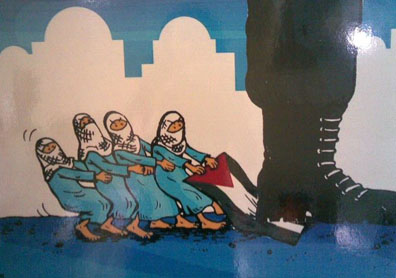
Image from Museum of Resistance in Lebanon; photograph by Estella Carpi

Syrian refugees in Lebanon: when the Apollonian cannot expect anything from the Dionysian

by Estella Carpi

While based in Lebanon, I personally find no way of getting out of the emotional whirlwind of suffering that the Syrian revolution, the merciless state repression and the subsequent armament of the revolutionaries have been giving rise to for 18 months. Without aiming at prematurely assessing the size of the emergency response to the “Syrian humanitarian crisis”, I would like to discuss here the Lebanese phenomenological approach to the current events by using the Syrian refugees’ lens.

Although used to regarding Syria as a model of stability and harmony, and as a place where people allegedly identify through the imposed order, the Lebanese suddenly find themselves taking care of the Syrian Leviathan. If Lebanon has always embodied the Dionysian, with its several war scars, social open wounds and its incontrollable emotionalities, Syria has always represented the rational, organized and balance-keeper Apollonian to the outsider’s eye. Continue reading Syrian Refugees in Lebanon

Finally, Indonesian Outrage Looks Productive


by Kevin Fogg

In the last week, as protests have flared around the Muslim world about the film Innocence of Muslims, Indonesia has not been left out. Protests in Jakarta and Surabaya (the capital and second largest city, respectively) on Friday and Saturday were led by the group Hizbut Tahrir. Today more violent protests flared at the US Consulate in Medan and again at the US Embassy in Jakarta, where police arrested four instigators from the frequently-unruly group Front Pembela Islam (Islamic Defenders’ Front).

Since democratization in 1998, Indonesians (especially those in Jakarta, but also in other cities) have not been shy about protesting. Protests in front of the American Embassy (which also faces the central square in Jakarta and the site of most major protests) are not uncommon, but other countries are also frequently the target of protests, including majority-Muslim countries like Malaysia. Most of these protests about overseas issues have no impact on government policy, or on the issues that they are protesting about, but one case this summer shows the flip side of the coin: protests that became productive in international relations

Indonesians were outraged at news in June and July about sectarian clashes involving the Muslim Rohingya minority in Burma. These deaths were not the worst in the ongoing struggles of the Rohingya–involving denied refugee status, limitations on international aid, years of discrimination, and other woes–but the opening of the press in Myanmar allowed news on the conflict, which fed into Indonesian Muslim outrage. Not sparing anyone in their anger, Indonesians even loudly criticized Nobel Prize Winner Aung San Suu Kyi for not paying enough attention to this issue. This led in August to several demonstrations across the country, even including the leader of the national Indonesian Ulama Council. Indonesian attention has kept up since the initial news, too, with the largest Islamically-minded paper in the country hosting a special page for news on the “Rohingya Tragedy,” with new articles almost every day. Continue reading Finally, Indonesian Outrage Looks Productive

Islam Without Red Lines

By Anouar Majid

The violence that erupted in the wake of the YouTube on the Prophet Mohammed is a wake-up call to all who care about the future of human civilization and, particularly, that of Arabs and Muslims living in Muslim-majority nations. (Muslims living in the United States are having the time of their lives—the land of what Iranian mullahs call Great Satan is the best place on earth for them.) Still, Muslims everywhere have been unable to unbind their ties to religious orthodoxy, clinging tenaciously to the decrees of religious scholars in mosques, as well as to the fatwas pronounced on the tube and the net alike.

I arrived in Morocco, arguably the most liberal country in the Arab world and a reliable partner of the West for decades, on the eve of the YouTube trailer controversy. As soon as I heard about the murders in Libya and the violent protests in Egypt and elsewhere, I chose not to be silent in the face of Islamist fury. I spent time explaining to cab drivers, unemployed youths, poorly educated workers, and highly educated professionals that the US government can’t control what people post on the Internet. I tried to get my interlocutors to understand that Muslims are laughably easy to manipulate—all one only has to do is draw a caricature of the Prophet or make a film about him to turn them into the world’s laughingstock. Continue reading Islam Without Red Lines

Newsweak


Edward Said wrote a poignant critique of media coverage of the Iranian hostage crisis just over three decades ago. He called it “Covering Islam.” The subtitle was “How the Media and the Experts Determine How We See the Rest of the World.” Once again Islam is being covered, the latest being the “cover” on Newsweek Magazine. Said’s [Covering Islam (1997 edition), p. lv.] assessment is as relevant as ever today:

For the right, Islam represents barbarism; for the left, medieval theocracy; for the center, a kind of distasteful exoticism. In all camps there is agreement that even though little enough is known about the Islamic world there is not much to be approved of there.

The latest Newsweek cover demonstrates just how weak its sense of responsible news reporting is. The trope of “Muslim Rage” conflates the cultural dimensions of politics with a religious faith. When Israeli planes bomb Hamas in Gaza, no major newspaper calls this “Jewish Rage.” When Terry Jones burns a Quran or when Anders Behring Breivik shoots fellow Norwegians, I have yet to see a headline of this act as one of “Christian Rage.” Rage is almost always political at base and the events subsumed under a blanket umbrella of “Muslim Rage” are local politics to the core. The fact that we see these images on CNN and the Internet tells us more about the audience than it does about those engaged in the activities.

The photograph captures “rage” to be sure, but the choice of turbaned and bearded protesters (when the majority in Cairo at least are young clean-shaven men in Western clothing lobbing rocks at the police) identifies rage with a style of dress and a style of dress with a violent religion. Ironically, the voices of those who are enraged are not to be heard anywhere inside the story. Instead, the cover boasts an article inside by Aayan Hirsi Ali, a controversial Somali whose claim to fame was posing naked with Quranic verses on her body and then becoming a darling of the Islamophobic mob. Her knowledge of Islam is so immature and biased that the very idea she might have something to contribute to the issue staggers my imagination.

I see little difference between this cover photo and that on the French tabloid Closer, which brandished the privately bared royal breasts of British princess Kate Middleton. Continue reading Newsweak