Tabsir Redux: Headless in Saudi Arabia

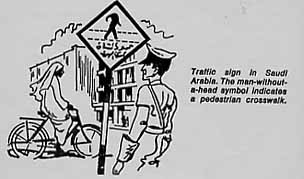
[”Traffic sign in Saudi Arabia. The man-without-a-head symbol indicates a pedestrian sidewalk.”]

I recently came across a rather plebian junior high school level text on The Middle East: History, Culture, People (by Thomas G. Kavunedos and Harold E. Hammond, Bronxville, New York, Cambridge Book Company, Inc, 1968). The book is quite forgetable, but some of the illustrations bring you to a full stop. My favorite is the illustration above. If indeed this was once the sign for a crosswalk, no wonder everyone seems to drive Mercedes in the kingdom.

Daniel Martin Varisco

[Tabsir Redux is a reposting of earlier posts on the blog, since memories are fickle and some things deserve a second viewing. This post was originally made on October 10, 2006.]

Lebanese Hymns of Love and War- Part 2


Artwork by Lebanese artist Fady Habib

By George N. El-Hage. Ph.D.
[Originally written in Arabic and Translated by Allen Lederman and George Nicolas El-Hage. For part 1, click here.]

1 – Glory be to Lebanon and the strength and dignity of man in her, now and forever.

2 – Oh my Lebanese friend, if only you could witness the politicians, and by God they are many. Those who deprived politics of its national obligations, you will see them as they are, without their chameleon skins, parrot tongues, and raven cloaks. If only you saw them in the mirror of truth and patriotism, you would curse them and refuse their sedition.

3 – Because Lebanon embodies love, and love embodies God, Lebanon endures. Fear not, oh Lebanese.

4 – No. The sound of the cannons and the explosions of the bombs and bullets no longer frighten our women. For the Woman who reared history’s greatest heroes is able to beget heroism any time.

5 – Those who died in the cause of Lebanon know they live in our hearts and that to die for Lebanon, is to live.

6 – Never have invaders and oppressors been more powerful than a people fighting for its survival. Thus we know we will triumph and endure.

7 – Those who sold their homeland and bartered their cause do not even deserve the curse of history, for he who has neither country nor cause, is non-existent.

8 – Those whom Lebanon harbored and fed, and carried their cause to the world, chased her people out, starved and killed them. We will continue to love them, for what good is it to love only those who love you. Continue reading Lebanese Hymns of Love and War- Part 2

Iranian Studies Directory Online


Putting the world’s scholars and organisations at your fingertips, the Iranian Studies Directory (ISD) is a pioneering initiative to develop a comprehensive reference and research facility that will open up the fields of Persian and Iranian studies to academics, teachers, students, curators, professionals and lay enthusiasts across the globe.

If you are in any way involved in the world of Iranian or Persian studies, get networked now! Register with this public resource and connect yourself to other professionals and institutions in your field throughout the world.

A Bulgarian in 19th century Yemen


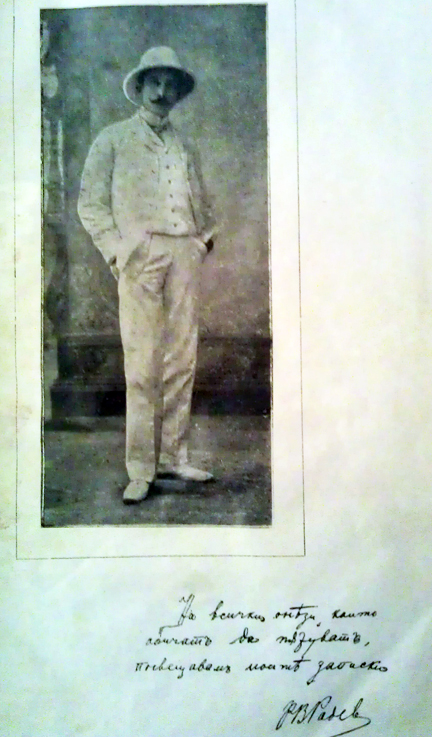
Photo of R. V. Radev with signature: “For these who love to travel, i devote my travel notes.”

The blogger Ruslan Trad has sent along an interesting piece regarding a Bulgarian traveler to Yemen, R. V. Radev, who published a book on his travels in 1906. If you can read Bulgarian, check out the original blog item. Otherwise, Ruslan has sent me a brief translated excerpt and some of the photographs, which I include here.

“Much like the Bedouin in the vast desert – one of those few unknown patches on the Earth’s surface, unexplored by Europeans – the Arab of the Happy Arabian coast today fights a legendary battle that turns fighters into heroes, invulnerable even to the slashes of the vengeful, merciless blade of Istanbul. A revolutionary network with its center in Syria is redoubling its efforts and preparing to sweep over all of Arabia, which has an estimated population of 12 million. Standing in the path of these millions is nothing more than one or two hundred thousand government clerks, looters, Turks and a few garrisons, spread around fortified checkpoints – a battle that would take no more than a couple of days to reach a favorable outcome, were it not for the proverbial scuffles between the various chiefs of the numerous tribes inhabiting Arabia, or for Turkey’s underhanded tactics in handing out bribes – gifts to some, privileges and unlimited power to others. Turkey sows the seeds of rivalry among the Sheikhs so they would fight and destroy each other. Neither the masses, nor the intellectual class, the rich Arabs, seem to understand that it would take no more than a couple of hours to resolve the issue of freedom and independence for Arabia, for which so much blood has, and continues to be shed…” Continue reading A Bulgarian in 19th century Yemen

Tabsir Redux: The Cynical Dairy Farmer’s Guide to the New Middle East


BY Karim Sadjapour, Foreign Policy, June 15, 2011

How a couple of cows explain a changing region: equal opportunity offender edition.

In the early years of the Cold War, in an effort to simplify — and parody — various political ideologies and philosophies, irreverent wits, in the spirit of George Orwell, went back to the farm. No one really knows how the two-cow joke known as “Parable of the Isms” came about, but most students of Political Science 101 have likely come across some variation of the following definitions:

Socialism: You have two cows. The government takes one of them and gives it to your neighbor.

Communism: You have two cows. The government takes them both and provides you with milk.

Nazism: You have two cows. The government shoots you and takes the cows.

Capitalism: You have two cows. You sell one and buy a bull.

Over the years, the parables gradually expanded, using the two-cow joke to explain everything from French unions (You have two cows. You go on strike because you want three cows.) to the Republican Party (You have two cows. Your neighbor has none. So what?). While in its original iteration the cows were a metaphor for currency, capital, and property, they later began to take on different meanings.

Today, the Middle East has replaced the Cold War as America’s primary foreign-policy preoccupation. As opposed to the seemingly ideologically homogenous communist bloc, however, the 22 diverse countries that compose the modern Middle East are still confusing to most Americans. Why can’t the Israeli and Palestinians stop fighting already? What’s the difference between Libya and Lebanon again?

Herewith then is a satirical effort to simplify the essence of Middle Eastern governments so that, in the immortal words of George W. Bush, “the boys in Lubbock” can read it. And, rather than symbolizing property, the cows here symbolize people, which — funny enough — is how most Middle Eastern regimes have traditionally viewed their populations.

Saudi Arabia
You have two cows with endless reserves of milk. Gorge them with grass, prevent them from interacting with bulls, and import South Asians to milk them.

Iran
You have two cows. You interrogate them until they concede they are Zionist agents. You send their milk to southern Lebanon and Gaza, or render it into highly enriched cream. International sanctions prevent your milk from being bought on the open market.

Syria
You have five cows, one of whom is an Alawite. Feed the Alawite cow well; beat the non-Alawite cows. Use the milk to finance your wife’s shopping sprees in London.

Lebanon
You have two cows. Syria claims ownership over them. You take them abroad and start successful cattle farms in Africa, Australia, and Latin America. You send the proceeds back home so your relatives can afford cosmetic surgery and Mercedes-Benzes.

Hezbollah
You have no cows. During breaks from milking on the teat of the Iranian cow you call for Israel’s annihilation. Continue reading Tabsir Redux: The Cynical Dairy Farmer’s Guide to the New Middle East

Central Asia Archaeology Conference at Hofstra


Colloquium at Hofstra University
Art and Archaeology of Central Asia: Works in Progress
Saturday, January 26, Breslin Hall 105

Session I
11:00 am – 12:45 pm

Michael D. Frachetti
Washington University in St. Louis
Agriculture and Mining among Highland Mobile Pastoralists of Semirech’e (3000 – 1500 BCE)

Claudia Chang
Sweet Briar College, Virginia
Progress on the Archaeological Researches
on Iron Age settlements on the Talgar Fan

Perry Tourtellotte
Sweet Briar College, Virginia
Mortuary and Settlement Landscapes of the Iron Age:
Talgar Fan and Beyond

Lunch
12:45 pm – 1:30 pm

Session II
1:30 pm – 4:15 pm

Pavel Lurje
Hermitage Museum, St Petersburg, Russia
Personal Names throughout the History of Chorasmia

Fiona Kidd
Metropolitan Museum of Art, New York
Some New Thoughts on the Procession Scene
in the Paintings of Akchakhan-kala

Anna Feuerbach
Hofstra University
Recent Research on Industrial Remains at Ancient Merv Continue reading Central Asia Archaeology Conference at Hofstra