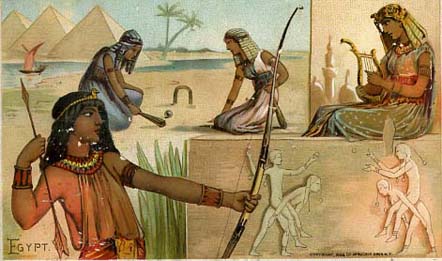
In the 1889 series depicting the nations of the world, Egypt also appears:
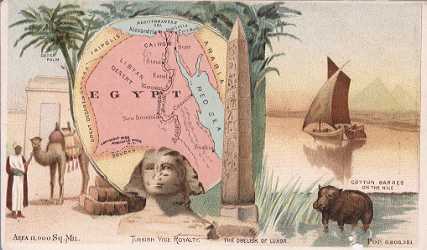
Area: 11,000 sq. mi
Population: 6,806,381
Government: Turkish Vice Royalty
Scenes: Date Palm; The Obelisk of Luxor; Cotton Barges on the Nile
In the 1889 series depicting the nations of the world, Egypt also appears:
Area: 11,000 sq. mi
Population: 6,806,381
Government: Turkish Vice Royalty
Scenes: Date Palm; The Obelisk of Luxor; Cotton Barges on the Nile
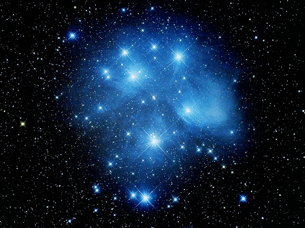
Modern photograph of the Pleiades
The Pleiades in Arab Folklore
The most famous star in Islamic folklore is undoubtedly the Pleiades. Commentators regard the reference in surah al-Najm (#53) of the Quran as the Pleiades; in fact the Arabs often referred to the Pleiades simply as al-najm (the star par excellence), a usage parallel to that in Sumero-Akkadian (Hartner 1965:8). In a well-known tradition, Muhammad links the early summer heliacal rising of the Pleiades with the beginning of the heat, crop pests and illnesses. In another tradition, more political than weather-related, Muhammad is supposed to have told his uncle Abbas (for whom the Abbasid caliphate was later named) that kings would come from his descendants equal to twice the number of stars in the Pleiades. This would imply that Muhammad thought there were 13 stars in the asterism, since the Abbasid caliphs numbered twenty-six (Ibn Mâjid in Tibbetts 1981:84). Continue reading Islamic Folk Astronomy #4

Anyone who is interested in issues of Islam in America must certainly go see the new Shahrukh Khan film My Name is Khan. Despite all of its Bollywood silliness and melodrama, the film is surprisingly discerning on the experiences of Muslims in American society. Though it is set almost entirely in the U.S. (beginning in San Francisco and ending in Georgia), this film will go down as one of the most important Bollywood movies Shahrukh Khan has ever done.
Most obviously of course, the film reminds audiences all around the world that Bollywood’s biggest star ever is in fact a non-violent Muslim (the film’s most repetitive line is “My name is Khan, and I am not a terrorist”). But it also does a number of other absolutely fascinating things, such as performing a reinterpretation of the Qur’anic Abraham-Ishmael story, and in a surprising turn, it spotlights the U.S.’s government abandonment of poor African-American communities. Continue reading My name is Khan
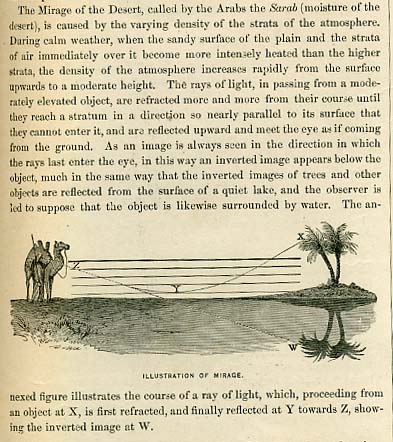
In a previous post I discussed two lithographs from the 1873 edition of Warren’s geography. One of the more fascinating illustrations is one explaining the desert mirage. Here is the discussion and image from the text.
to be continued …
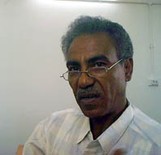
Shaqi Shafiq, Adeni poet
Exercises in Struggling with Loneliness
by Shawqi Shafiq, Translated by Sinan Antoon, Banipal
Rub the heart’s ring
rub it well
to erase the dust of depression
Rub it again carefully
so that the wall of forgetfulness shines
or
draw a circle/put a dove, or two, inside it/watch the wings move (that is if there are any)
You will ask: What if the circle crumbles?
What if the dove flies away
or if I am bothered by the wings’ noise
I will say to you: erase the circle
for all the traces to disappear
or put a fresh woman
instead of the dove
to seek revenge
for the aridity of an apartment
devouring your mouth