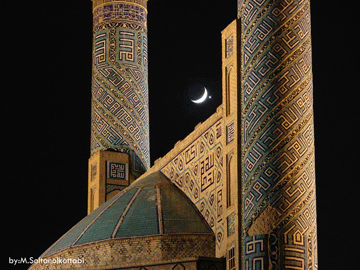
Full Moon on lunar eclipse and Venus, dated June 18, 2008 – Photo by Mohamad Soltanolkotabi
by Khalid Chraibi
“The sun and the moon follow courses (exactly) computed;â€
(Koran, Ar-Rahman, 55 : 5)
“It is He Who made the sun to be a shining glory and the moon to be a light (of beauty), and measured out stages for it; that ye might know the number of years and the count (of time).†(Koran, Yunus, 10:5)
“The ulamas do not have the monopoly of interpretation of the shariah. Of course, their advice must be sought in the first place on shariah matters. (But) they do no make religious law, in the same way that it is not the law professors who make the law, but parliaments.†(Ahmed Khamlichi, Point de vue n° 4)
Issue # 1: Why do Muslims observe the new moon to determine the beginning of months?
When the Messenger was asked by his Companions for a method to determine the beginning of the month of fasting, he told them to begin fasting with the observation of the new moon (on the evening of the 29th day of sha’aban) and to end fasting with the new moon (of the month of shawal). “If the crescent is not visible (because of the clouds), count to 30 days”. (1)
At that time, the Bedouins didn’t know how to write or how to count. They knew nothing about astronomy. But, they were used to observe the stars, at night, in order to find their way in the desert, and to observe the birth of the new moon to determine the beginning of months. The Messenger’s recommendation fitted perfectly with the specifics of their situation.
Issue # 2: Why is the new moon visible, at its birth, in some regions of the world only? Continue reading Issues in the Islamic Calendar →