Category Archives: Arab-Israeli Conflict

Can’t Win for Losing


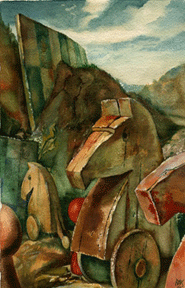
[”Cease Fire” by Samuel Bek]

Wars are never won until they can be relegated safely to the history books. The recent Israel/Hizballah flare up is no exception. The spin masters are at work with both the main proponents claiming victory. Since Israel for the time being maintains 30,000 soldiers in southern Lebanon, continues to dominate the sky and has not yet ceased its sea blockade of Lebanon, the winner should be obvious. With the deployment of UNIFIL and Lebanese troops to replace the IDF, the goal of stopping Hizballah military muscle would seem to be on target. But Israel’s latest reaction is the kind that the term “Pyrrhic victory” (closely following the Bush administration’s ill-conceived invasion of Iraq) seems destined to define. The Katusha rockets will no longer thud aimlessly into northern Israel, but then there were hardly any being shot before Israel invaded. Continue reading Can’t Win for Losing

For Whom the Toll Rings a Bell


“Guernica” by Pablo Picasso, 1937, left; John Donne, right

In four weeks of fighting, since the Hizbollah raid of July 12 on an Israeli military outpost, what started out as an apparent effort to retrieve two captured Israeli soldiers has escalated into a nightmare for all involved. According to the BBC, as of August 8 the results are predictably ugly, with Lebanon taking the brunt but Israel also suffering greatly:

Deaths: 998 Lebanese, 102 Israeli
Injuries: 3,493 Lebanese, 690 Israeli
Displaced: 915,762 Lebanese, 500,000 Israeli

If this were a movie, it would be a smash hit, since it has killed more than twice as many in the nearby Iraq War during the past month. Of course, the death toll in the latest Israel-Lebanon war has a way to go until it reaches the estimated 40,000 plus Iraqi civilians who have died since the U.S. invasion. And there must be another 149,000 deaths to equal the Lebanese Civil War (1975-1990), which also had Israeli involvement. It is even a steeper climb to match the estimated 400,000 victims in Darfur.

So how should we read death tolls? What do such lists account for beyond the obvious fact of people not dying of natural causes (unless you think war is natural)? Here is an experiment you can try on your own. Check out the war death tolls posted at Wikipedia. What is your first reaction: to look for the largest losses or to count up the total losses? Of course I can’t find any information on the number of people who have died from peace, even on Google.

As John Donne told it awhile ago,

“Who casts not up his eye to the sun when it rises? but who takes off his eye from a comet when that breaks out? Who bends not his ear to any bell which upon any occasion rings? but who can remove it from that bell which is passing a piece of himself out of this world? No man is an island, entire of itself; every man is a piece of the continent, a part of the main.

If a clod be washed away by the sea, Europe is the less, as well as if a promontory were, as well as if a manor of thy friend’s or of thine own were: any man’s death diminishes me, because I am involved in mankind, and therefore never send to know for whom the bell tolls; it tolls for thee.”

Daniel Martin Varisco

“On the Eve of Modernity”


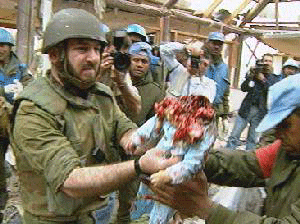
[The Israel bombing of Qana yesterday was not the first such attack on this town. The horrendous picture above is from a similar bombing there in April, 1996, when as many as 300 villagers were killed.]

In a syndicated commentary on July 28, New York Times columnist Thomas Friedman illustrated the journalistic malady that exemplifies biased reportage masquerading as informed analysis. While in Damascus he picked up a copy of the English-language Syria Times and noted an ad box that read “The Middle East on the Eve of Modernity.” He continues:

“I thought: What a perfect way to describe the Middle East today – going back to some pre-modern era? Alas, the Syria Times was not trying to be ironic. It turned out the headline was the title of a book about the 18th century. But had it been a news headline, it would have been apt. Continue reading “On the Eve of Modernity”

Football and Mouth Disease

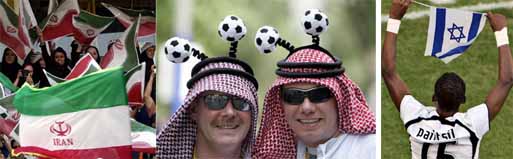
Is the fan base for the World Cup half full of it or half witted? Not unlike the competitive spirit of the Olympic Games, nationalistic fervor tends to run rampant every four years in pursuit of the top position in world football. This is not to be confused with the helmet and padding show that Americans tolerate between beer commercials, although some of us may be forgiven for comparing the two when American Budweiser reigns as the official beer of the World Cup.

In the games so far Middle Eastern countries have not fared well. None are expected to move along to the next stage. Ironically, this puts Saudi Arabia, Tunisia and Iran on an equal footing with the United States, whose chances of moving on hinge upon an unlikely scenario with Team USA having to beat Ghana. Continue reading Football and Mouth Disease

Unwanted: Dead, Alive or on Tape

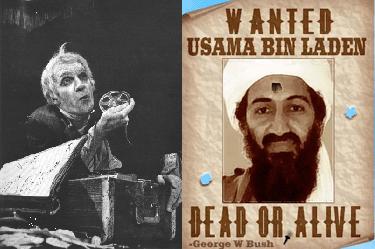
Osama Bin Laden is alive and well … well, he is still reduced to just a faceless voice without access to a video camera. The mass-media elected leader of Al-Qaeda sent another audiotape to al-Jazeera on Sunday. According to al-Jazeera, the tape is “believed by Washington to be authentic.” It was his first public relations event since January and it seems to be more of a “I am still here and hearing the news” message than anything else. And so the distant-learning op-ed propaganda war goes on, but who is listening? Continue reading Unwanted: Dead, Alive or on Tape

Naked and with Shame

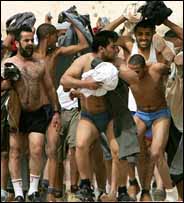
The front page of today’s New York Times has a tabloid flavor: a group of charging Palestinian men stripped down to their underwear and running shoes. The event on Tuesday was an Israeli raid on a Palestinian prison in Jericho. This time the walls came tumbling down due to tanks and bulldozers and the power was outside rather than inside the walls. At stake were six Palestinians previously held in Israel, remanded to the Palestinian authority under a shared incarceration process and now reclaimed by Israel. It seems the British and American monitors decided to leave in fear for their own safety and immediately (perhaps in as little as 10 minutes) the Israeli authorities moved in. As hard as it may be to believe, there are even deeper levels of trust in the volatile Arab-Israeli crisis. Fearing that Hamas might break the agreement, Israel decided to do a preemptive breaking of the agreement themselves.
Continue reading Naked and with Shame