Category Archives: Arab-Israeli Conflict

The Problem with ‘My Problem with Jimmy Carter’s Book’

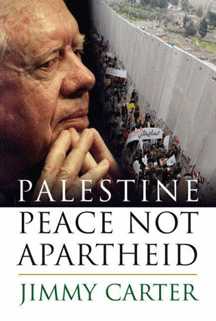
Middle East Quarterly, published by Daniel Pipes’ organization Middle East Forum, contains an article titled “My Problem with Jimmy Carter’s Book”, by Kenneth Stein, the first executive director of the Carter Center in Atlanta from 1983 to 1986, and currently a professor of Contemporary Middle Eastern History at Emory University. Stein, it will be remembered, resigned from his affiliation with the Carter Center, where he was a Middle East Fellow for over two decades, in protest over former President Jimmy Carter’s book, Palestine: Peace Not Apartheid. Touring the country explaining his objections to his former boss’s perspective on the Israeli Palestinian conflict, Stein has refrained from tarring Carter with the label “Jew-hater” (this from the ever-subtle David Horowitz), or claiming that Carter’s criticisms of Israeli policy stem from Carter having “enriched[ed] himself with dirty money”–dirty Arab oil money, specifically–from Shaykh Zayed bin Sultan al-Nahyan of the United Arab Emirates, “an unredeemable anti-Semite and all-around bigot” (this from the extraordinary Alan Dershowitz in an article) It should be noted, since Dershowitz does not, that much of the alleged dirty money that flowed through the Carter Center would have supported—and in the early years, been managed and disbursed by–Professor Stein. Continue reading The Problem with ‘My Problem with Jimmy Carter’s Book’

Water rather than Whining


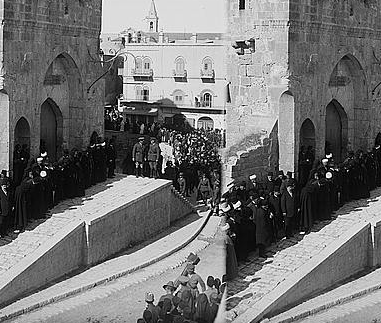
[“…I entered the city officially at noon, “December 11th”, with a few of my staff, the commanders of the French and Italian detachments, the heads of the political missions, and the Military Attaches of France, Italy, and America. The procession was all afoot, and at Jaffa gate I was received by the guards representing England, Scotland, Ireland, Wales, Australia, New Zealand, India, France, and Italy. The population received me well…” (General Allenby in Source Records of the Great War, Vol. V, ed. Charles F. Horne, National Alumni 1923)]

[Note: Almost 90 years ago, on December 9, 1917, General Allenby marched into Jerusalem to accept the surrender of the city by Ottoman Turkish officials. But unlike the current debacle in Iraq, where liberation has not been followed up by tangible development, it was the ability of British engineers to provide clean drinking water that helped smooth the transition from Ottoman rule to a mandate, ultimately as unclean and messy as it would become. It is worth reading the following excerpt by W. T. Massey, not only for strategic advice on how to win over a conquered populace, but also for a prime example of the journalistic ethnocentrism in which the West provides a “civilising hand” to the poor Oriental.]

THE TOUCH OF THE CIVILISING HAND
by W. T. Massey (1919)

It is doubtful whether the population of any city within the zones of
war profited so much at the hands of the conqueror as Jerusalem. In
a little more than half a year a wondrous change was effected in the
condition of the people, and if it had been possible to search the
Oriental mind and to get a free and frank expression of opinion,
one would probably have found a universal thankfulness for General
Allenby’s deliverance of the Holy City from the hands of the Turks.
And with good reason. The scourge of war so far as the British Army
was concerned left Jerusalem the Golden untouched. For the 50,000
people in the City the skilfully applied military pressure which
put an end to Turkish misgovernment was the beginning of an era
of happiness and contentment of which they had hitherto had no
conception. Justice was administered in accordance with British
ideals, every man enjoyed the profits of his industry, traders no
longer ran the gauntlet of extortionate officials, the old time corruption was a thing of the past, public health was organised as far as it could be on Western lines, and though in matters of sanitation and personal cleanliness the inhabitants still had much to learn, the appearance of the Holy City and its population vastly improved under
the touch of a civilising hand. Sights that offended more than one of
the senses on the day when General Allenby made his official entry had
disappeared, and peace and order reigned where previously had been but misery, poverty, disease, and squalor. Continue reading Water rather than Whining

BBC Reporter Johnston Freed

BBC NEWS, 2007/07/04 08:37:02 GMT

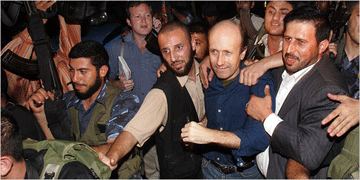
BBC correspondent Alan Johnston has been released after 114 days in captivity in the Gaza Strip. He describes the “appalling experience” at the hands of his captors, called the Army of Islam.

“I am hugely grateful to all the people – an amazing number of people that worked on the Palestinian side, the British government, the BBC from top to bottom, and a huge amount of support from BBC listeners and viewers.

I had a radio almost throughout, and was able to follow all the extraordinary level of support and interest in my case, and it was a huge psychological boost.

I am immensely grateful. It’s just the most fantastic thing to be free. Continue reading BBC Reporter Johnston Freed

The Gates of Gaza


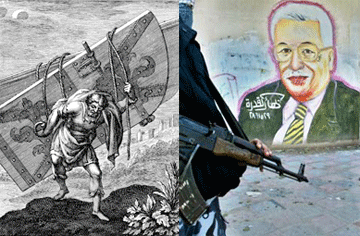
Illustration: left: “Samson carries gates” by Johann Christoph Weigel, 1695; right, Large mural of Palestinian presidential candidate Mahmoud Abbas in Gaza city, December 26, 2004, Reuters

The fragile and it seems futile political engagement of Fatah and Hamas has run into a veritable brick wall in Gaza, not surprising given all the mud slinging that has been going on. Hamas supporters have stormed what they see as the Bastille of President Mahmoud Abbas and in biblical terms carried away the gates. In reading the news reports today and looking at the pictures, especially the Hamas fighters gloating in Abbas’s former presidential office, it is as the baseball sage said “déjà vu all over again.” With fighting still continuing in Palestinian refugee camps in Lebanon, the agony of Palestinian suffering endures. Of course, this is not the first time that havoc has raged in Gaza. Since so little is held sacred in the “Holy Land,’ we might as well raid scripture and summon up an ancient moral tale that ended with a blind man’s suicide in which the temple walls came tumbling down. Today it is obvious there is no Samson in the heroic sense, and recent events confirm that the the blind still lead the blind, while much of the rest of the world simply turns a blind eye. In such times perhaps the only antidote to unstoppable tears is poetry… Continue reading The Gates of Gaza

Six Biblical Days of War

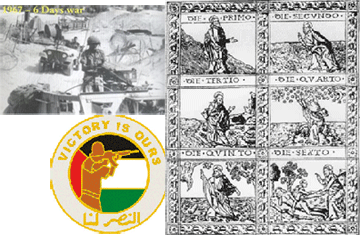
Quick, here’s a trivia question. How long did it take God to create the world, according to the book of Genesis? Six days, of course. If you miss this one, you may have been brought up in the backwaters of the Amazon, although it would not be the fault of Christian missionary translators who have tried to undo God’s rash Babeling of tongues to get the Bible into every known tongue. But what’s a day? Before the scientific revolution sealed by Darwin, the ordinary 24-hour variety day posed few problems for the devout. Once it seemed that the world must be older than Bishop Ussher’s supposed official date of 9 AM on October 23, 4004 BC, seeds of doubt grew into Enlightenment-nurtured forests. But is nothing sacred? it turns out that poor Bishop Ussher never ordained that God slept in late on Day One; the distinction of 9 AM goes to a certain Dr. John Lightfoot. But there’s still the problem of how to define a day, especially in a creation scenario in which the creation of light precedes the sun, moon and stars. Theologians in retreat (as distinguished from those who remained, and still do so, in denial) resorted to a semantic salvation of the scriptural record, arguing that with God a day is the same as a thousand years.

Tomorrow, June 5, is the 40th anniversary of a modern event on Holy Land soil of biblical proportions: the Six-Day War of 1967 in which Israel expanded its borders, took total control of Jerusalem and embroiled the region in the plight of the Palestinians. It only took six days for the overmatched armies of Egypt, Jordan and Syria to be effectively eliminated and since that war there has been little doubt that Israel as Zionist-revived David to a disorganized Arab Goliath lies only in myth. Only six days, but how long is a day? Continue reading Six Biblical Days of War

Lebanese Hymns of Love and War

By George N. El-Hage

1-
Thirty years of prosperity, patriotism, harmony and florescence, ruined in one year, it is true that destroying is easier than building, but it is also true that a year in which the masks fell and the buffoons stepped from their disguises into the shadows, was more real to them and to us than the thirty years they masked themselves in falsehood, hypocrisy and exploitation.

2 –
There were those who sold Lebanon and lost their families, their children and their villages. Then the strangers spit in their faces and cursed them. Their shekels were plundered, the price of treason. Do not ask those of their honor and patriotism. How can they give you what they do not possess?

3 –
The youth of Lebanon who abandoned their books and embraced rifles, know that they will triumph, because those who know how to live life, know how to live death and resurrection. Continue reading Lebanese Hymns of Love and War

A Voice in the Wilderness that is Gaza


[Illustration: Khalil Yaziji found two bodies outside his shop, al-Jazeera.]

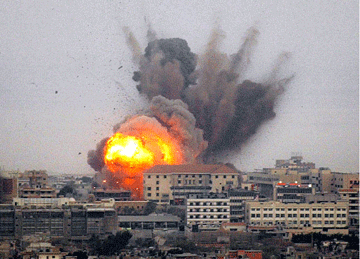
So what is today’s top story of violence in the Middle East? Take your pick: the Lebanese army vs. Fatah al-Islam in the camps of Tripoli, a Taliban-ignited bomb exploding in a market and killing civilians in Afghanistan, an assassination attempt on the mayor of Mogadishu, six U.S. soldiers and an interpretor killed in Diwaniya in southern Iraq, more deaths in Gaza. Reading the news (I almost made the anachronistic slip of “picking up” a newspaper) today is a time warp back to the revelationary isle John of Patmos and his prophetic vials of plagues. I am not referring to an incendiary end of the world scenario spun by the late Jerry Falwell (may he rest in Baptist solitude), but the continuing hell on earth. If you think this is about religion (or democracy), think again. Remove the politics (and American involvement or influence) from each of the stories above and the religion is reduced to a drizzle.

So here is my pick of the day, one from the little guy. Al-Jazeera, which has the resources and access that Western journalists can only dream about, published a piece by reporter Laila Haddad, who interviewed a variety of ordinary Palestinians living through the nightmare of Gaza these days. It is worthwhile looking at the violence from the ground-up, a welcome break from the bird’s-dropping view usually spun in the media. Here is what Khalil Yaziji, 26 years old, a shopkeeper and banker thinks of his present and future: Continue reading A Voice in the Wilderness that is Gaza

Apocalypse Watch: The Man Who Knows Squat

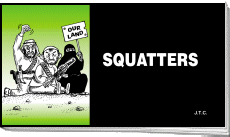
Most people find it hard to take cartoons seriously, apart from political satire and that can become a deadly issue, depending on the target. Given the recent Danish cartoon controversy it would seem that comics and religion do not mix well or at least settle well for the believers who see themselves as the target. But what about comic relief for the political struggle between Israel and the Palestinians? Fundamentalist tract artist Jack Chick, whose comic empire is dedicated to winning souls for Christ by drawing on God’s hate, has been using his pen to spread a rather sinister version of the fundamentally reduced Gospel for over 40 years. One of his more recent offerings is called “The Squatters” and it provides a virtual roadmap to apocalypse. Continue reading Apocalypse Watch: The Man Who Knows Squat