Category Archives: Arab-Israeli Conflict

Bashing the academic Left

by David Newman, The Jerusalem Post, April 14, 2009

For the past two years I represented Israel’s universities in the UK in the debate surrounding the proposed academic boycott. There were many who could not accept the fact that a professor with left-of-center views should fill this role. The Department of Politics at Ben-Gurion University where I work has been described by its detractors as being the most left-wing academic department in Israel. After all, they would argue, people like myself are part of the problem, not the cause, and as proof of their argument they would roll out the same two or three names of Israeli academics (most notably Ilan Pappe) who had taken the unprecedented step of actually supporting the boycott. The proposed boycott proved to be a great opportunity for some left-wing bashing rather than focusing on the real problem – the growth of anti-Israel sentiment among specific groups within the UK university faculty union.

The last few years have been “in season” for attacking the academic left, a form of academic McCarthyism that is hard to recollect going back 10 or 20 years. Most pernicious and consistent is the self-styled Campus Watch, created by the neo-con critic of the Israeli left, Daniel Pipes. It uses students and faculty to spy on those teaching courses on Israel and the Middle East. Anyone who so faintly utters a word of criticism is immediately labeled as such, including some of the best critical scholars of Israel today. Continue reading Bashing the academic Left
Reflections on Gaza


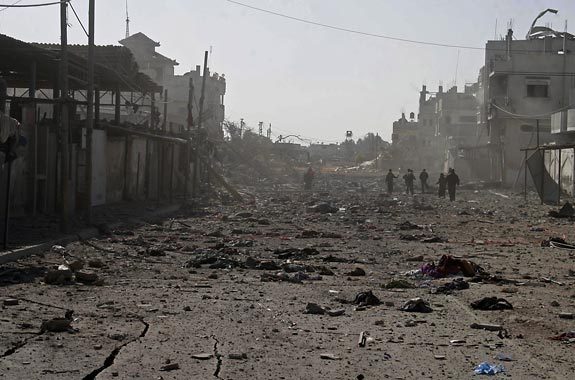
Palestinians walk in the rubble following an Israeli airstrike Wednesday in Rafah refugee camp in the southern Gaza Strip. Photo by Khaled Omar, The Associated Press.

Why did Israel start this War?
by Amr al-Azm, Brigham Young University

There are several answers to this question depending on which angle you look at it from.

The facts on the ground (Time Line) run as follows:

June 19 – An Egyptian brokered truce begins between Hamas and Israel. It calls for Hamas to stop cross-border rocket fire and for Israel to gradually ease its embargo on Gaza.

July 27: Israel kills Shihab al-Natsheh, a senior Hamas fighter, in his house in the West Bank city of Al-Khalil. Hamas protests action and Israel claims that the West Bank is not covered by the ceasefire.

November 5: Israel raids supposed smuggling tunnels in the Hamas-controlled region. Six Palestinians killed in the attack. Hamas responds by firing several dozen rockets and mortar shells at western Negev in Israel in retaliation. No casualties or property damage is caused, but three women are treated for shock. Continue reading Reflections on Gaza

Blood money for Killing Yemeni Jew


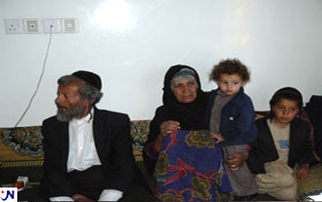
Yemeni Jews: source: Yemen Observer

by Nasser Arrabyee, Yemen Observer, March 3, 2009

A Yemeni primary court in Amran, north of the country, ruled on Monday a payment to be made of 5.5 million YR (US$ 27,500) in blood money for the murder of a Jewish man by Yemeni, Abdul Azeez al-Abdi, last December.

The court, chaired by Judge Abdul Bari Aqaba, also ordered that the convict should be placed in a psychotic sanatorium. The father of the Jew refused the sentence and asked for an appeal to be made to demand the death penalty against the convict.

“As long as there is no justice for us, then (they should) deport us to Israel, it’s better for us.” Continue reading Blood money for Killing Yemeni Jew

Occupying more than our minds

American minds these days are occupied with the financial crisis. The increasingly distant Iraq War, ever expanding military muscle in Afghanistan and recent loss of life and massive destruction in Gaza have been knocked off the front page and main story of daily newscasts. Problematic as the economy worldwide is, we will survive. It is not wealth that has disappeared, nor the ability to make money, but confidence in a system that by its very nature rewards with one hand and takes away with the other. As in economics, so in politics, it seems. And “occupation” is the main problem. In a short interview on FORA TV, Dr. Abdul Mawgoud Dardery (Assistant Professor of Cultural Studies and Critical Discourse at South Valley University, Egypt) brings this point into focus. Of course occupation has been the rule of history with “to the victor go the spoils” a mantra of civilization’s domination of those not considered sufficiently civilized. But unless the occupier empties the land of those already occupying it, as all the American continents’ countries have attempted to do, problems necessarily remain. In fancy we think of getting along with others as a melting pot; for much of the Middle East it has been more of a smelting and pelting pot … and the beating goes on.

Daniel Martin Varisco

Suspects detained in Cairo blast

Suspects detained in Cairo blast
BBC News, February 23, 2009

Egyptian police are questioning three suspects over the bombing of a Cairo market that killed one person and injured 20 others, officials say.

They were detained near the market shortly after the blast, police said.

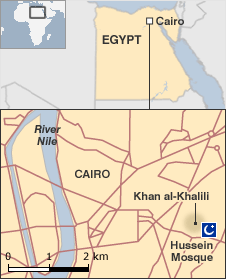
It happened at an open-air hotel cafe packed with tourists in the Khan al-Khalili area – a major attraction and home to a prominent mosque.

French President Nicolas Sarkozy has expressed “deep sorrow” at the death of a French teenager in the blast.

Police said they thought the device had been thrown from a balcony. It is not yet known who was responsible. Continue reading Suspects detained in Cairo blast

Hampshire College Divests or Do They?

Divestment is a two-edged sword. Earlier this week a number of pro-Palestinian sites were ethused with the apparent decision of Hampshire College to divest its financial portfolio from investments in companies involved in the occupation of Palestine. I provide one such report below, followed by a clarification from Hampshire College that the decision was purely on financial grounds and not political.

Hampshire College becomes first college in U.S. to divest from Israeli Occupation!
Global BDS Movement, 2/12/2009

[press kit attached below] – Hampshire College in Amherst, MA, has become the first of any college or university in the U.S. to divest from companies on the grounds of their involvement in the Israeli occupation of Palestine.

This landmark move is a direct result of a two-year intensive campaign by the campus group, Students for Justice in Palestine (SJP). The group pressured Hampshire College’s Board of Trustees to divest from six specific companies due to human rights concerns in occupied Palestine. Over 800 students, professors, and alumni have signed SJP’s “institutional statement” calling for the divestment. Continue reading Hampshire College Divests or Do They?

Why the Muslim World Can’t Hear Obama


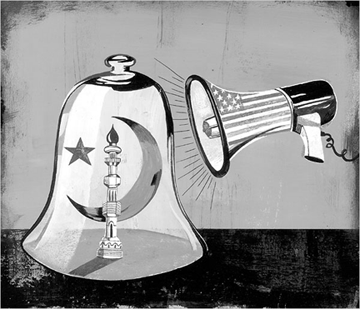
Art by Olaf Hajek for The New York Times

Why the Muslim World Can’t Hear Obama
By ALAA AL ASWANY, The New York Times, February 7, 2009

PRESIDENT OBAMA is clearly trying to reach out to the Muslim world. I watched his Inaugural Address on television, and was most struck by the line: “We are a nation of Christians and Muslims, Jews and Hindus, and nonbelievers.” He gave his first televised interview from the White House to Al Arabiya, an Arabic-language television channel.

But have these efforts reached the streets of Cairo?

One would have expected them to. Mr. Obama had substantial support among Egyptians — more than any other American presidential candidate that I can remember. I traveled to America several days before the election. The Egyptians I met in the United States told me — without exception — that they backed Mr. Obama. Many Egyptians I know went to his Web site and signed up as campaign supporters. Continue reading Why the Muslim World Can’t Hear Obama

Disproportional suffering


Residents returned to their homes around Gaza City on Friday. Tyler Hicks/The New York Times

Gaza is not history, nor is it likely to be soon. The bombs may have ceased on both sides, but the human toll presages a bleak future. Both sides have grievances, but the grief from death, maiming and sheer destruction of property and homes is incredibly disproportional. Even Independent observers must acknowlege this:

Up to 10 times as many Palestinians were killed as Israelis. The Palestinian Ministry of Health says 1,314 Palestinians were killed, of whom 412 were children or teenagers under 18, and 110 were women. On the Israeli side, there were 13 deaths between 27 December and 17 January, of whom three were civilians killed by rockets fired from Gaza. Of the 10 soldiers killed, four were lost to “friendly fire”.

Even if the Palestinian figure is disputed, it is clear that the death toll was massively higher for Palestinians than Israelis. Proportionality is not simply a matter of numbers, however. Continue reading Disproportional suffering