Category Archives: Animals

Dinosaurs in Yemen


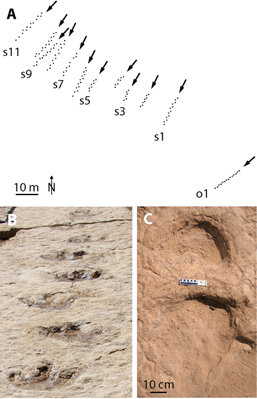
(A)-Map of tracksite with ornithopod (trackway o1) and sauropod (trackways s1–s11) trackways, (B)-Trackway of the ornithopod (trackway o1: steps 3–10), and (C)-Sauropod left manus and pes print (trackway s6: step 12).

Scientists have discovered the first dinosaur tracks on the Arabian Peninsula. In the May 21 issue of the journal PLoS ONE, they report evidence of a large ornithopod dinosaur, as well as a herd of 11 sauropods walking along a Mesozoic coastal mudflat in what is now the Republic of Yemen. “No dinosaur trackways had been found in this area previously. It’s really a blank spot on the map,” said Anne Schulp of the Maastricht Museum of Natural History in The Netherlands. He conducted the study with Ohio University paleontologist Nancy Stevens and Mohammed Al-Wosabi of Sana’a University in Yemen.

The finding also is an excellent example of dinosaur herding behavior, the researchers report. The site preserved footprints of 11 small and large sauropods — long-necked, herbivorous dinosaurs that lived in the Jurassic and Cretaceous periods — traveling together at the same speed. Continue reading Dinosaurs in Yemen
Animal House in the 15th Century: Part 1

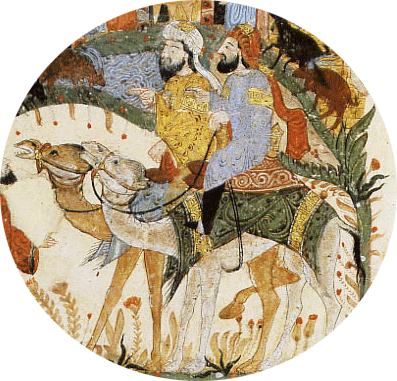
One of the most entertaining Arabic compendia on animal life, taken in the loose sense of the term for things that breathe or are thought to breathe, is the Hayât al-Hayawân (Life of Animals) of the Egyptian savant Kamâl al-Dîn Muhammad ibn Mûsâ al-Damîrî. Writing a century before Columbus discovered America, al-Damiri spins stories about animals with a variety of folklore about uses of animal products and parts. A scientist would no doubt shudder at the magical and literary focus of the text, only occasionally finding description useful today. A partial English translation was made by a British officer, Lieutenant-Colonel Jayakar, and published in two volumes in 1906 and 1908 in India. Unfortunately, this text is virtually inaccessible. I have looked at two copies, one in the New York Public Library and the other at the Library of Congress, and only with trepidation have I turned the fragile pages in this poorly bound volume. So far there is no digital version, which is a shame, since it is a delight to read.

Our author was a prolific copyist, quoting from over 800 other authors and providing a thousand entries, some simply an animal’s name and its more common synonym. Ironically, Jayakar’s Victorian sensitivity makes the translation as much an oddity as the primary work. Continue reading Animal House in the 15th Century: Part 1

Muhammad the Profit: Commerce, Play, and Entertainment in the Neoliberal Imperium

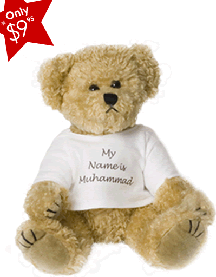
Following a link on the website www.korans.com can take you to the website www.teddybearmuhammad.com, which hawks the cute and cuddly namesake of Islam’s prophet. As the site explains, the bear commemorates the Sudanese government recently accusing 54-year old British schoolteacher Gillian Gibbons of blasphemy for “allowing” her class of 7-year old students at Khartoum’s Unity High School to choose what some considered the wrong name for the class stuffed animal. (The children named the bear after a popular classmate, not directly for the Prophet). The incident provided Sudanese politicians with an opportunity for local pandering, geopolitical bluster and a demonstration of sovereignty in reaction to international condemnation of the genocide in Darfur.

Cultural sensitivities about divine names and images are real, even when in particular instances they are feigned, exaggerated, or used as weapons in military or political conflicts. This reality is what gives their manipulation its potential power, although it also lays such manipulations open to exposure, derision, and failure. Continue reading Muhammad the Profit: Commerce, Play, and Entertainment in the Neoliberal Imperium

Traveling Light in Arabia

[Note: the following list of items for light camping in Arabia is provided by G. Wyman Bury for the early part of the 20th century.]

CAMP EQUIPMENT
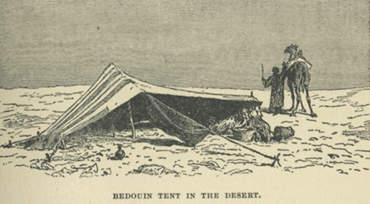
Try to do without a tent. Arabs hate pitching tents after a long day’s march, and seldom pitch them well. They draw fire and afford no protection, while preventing your own observation; they also betray the site of your camp to bad characters and casual callers on the look out for supper.

BEDDING
Avoid Wolseley valises or anything with pleats and folds, which become the permanent abiding places of parasitic insects.
‘Blankets.’ One each for the men. A few extra for convalescents or invalided men. Two for yourself.
‘Pillows.’ Carry your spare clothes in a green canvas sack. Continue reading Traveling Light in Arabia

A Sailor and His Camel Ride


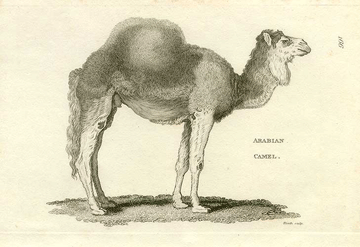
[Illustration: Arabian Camel from George Shaw, Zoology (1801)]

[Joseph Osgood was a Black American sailor who visited the Yemeni port of Mocha about a dozen years before the start of the American Civil War. He offers a rich, descriptive account of his visit to the Yemeni coast, including a sailor’s view of the ship of the desert.]

No wheel carriages are used here, the most general mode of transportation being by camels, for which the males along are serviceable. The flesh of the camel forms a staple article of food, the head and neck being excepted, because one of the race unwittingly rendered these parts unholy by obtrusively poking his head and neck into Mahomet’s tomb. Wellsted says that a camel is welcomed at its birth, by the Arab, with “another child is born unto us.” Continue reading A Sailor and His Camel Ride