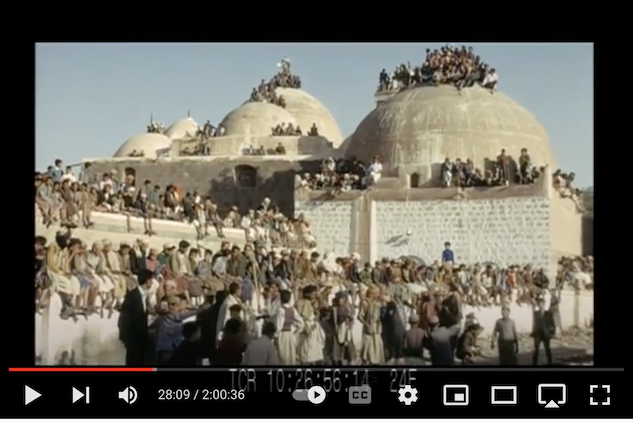
This exquisite film was produced in 1973 and filmed in 1972, thus representing Yemen half a century ago. It is now available on Youtube. The filmmakers were Karen and Alain Saint Hilaire. The camera was a bolex ebm electric. It has filmed when Qadi al-Iryani was the head of government. There are scenes from the Tihama, Sanaa, Sa‘da, Ma’rib, etc, including many crafts, fishing, agriculture, a funeral, celebration of the end of the civil war and much more. It is well worth spending two hours to watch this archival film of a Yemen now largely past but not forgotten.
Qadi al-Iryani in 1972Celebration in Sanaa on the anniversary of the end of the civil war
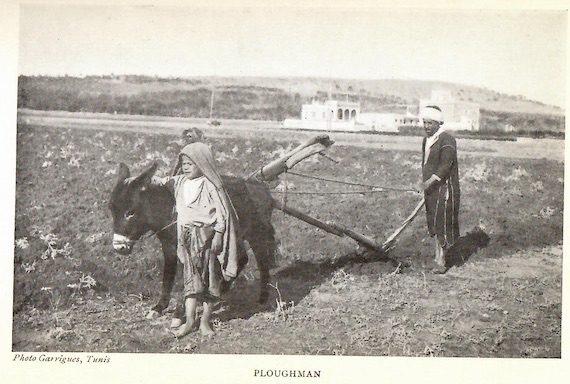
I am always intrigued by old photographs of traditional ploughs in the Middle East. The picture above is from a 1925 travel book by Norma Lorimer entitled By the Waters of Carthage. It has several photographs. The book is available at archive.org.
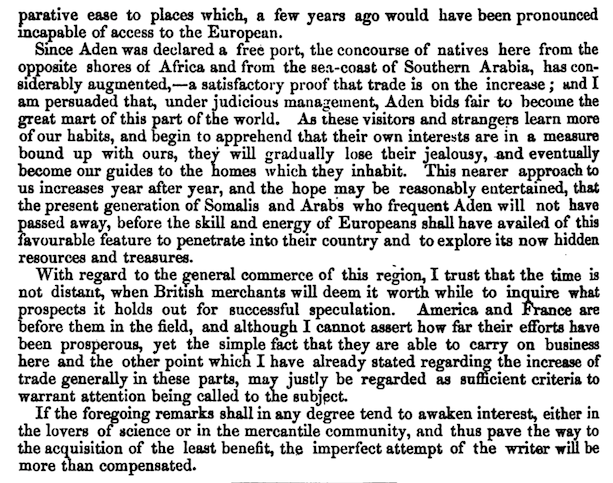
James Vaughn, a physician stationed in British-controlled Aden in the mid-19th century, published an article in 1853 in the British Pharmaceutical Journal and Transactions (12:226-229,385-388), which is available online. After discussing several medicinal and local exports, such as incense, dragon’s blood, and local dye plants from Yemen and from Somalia, he admonishes his colleagues back in England to do serious study of the botanical wealth of Yemen. I attach his comments below as they are still relevant a century and a half later…
My friend, the historian G. Rex Smith, has recently translated into English a marvelous travel diary by the French military official and traveller Pierre Loti (1850-1923). It is also available on Amazon as a Kindle Book. This day-by-day diary details Loti’s trip along the caravan trail of 1900 from the coast at Bushire to Shiraz and his ultimate goal of Isfahan in order to visit the area during the season of roses. One might expect such an account to be dry, but Loti comments on what he saw, including the people, along the way and one gets a first-hand sense of what it was like to travel a treacherous route that was at times over pure desert and at other times up or down seemingly impenetrable mountain heights. There is also a brief account of his stop at Muscat on the way to Persia. Smith, with the aid of his son, has done an admirable job in reflecting the flavor of the original French and includes 24 photographs taken by Loti. This is a book well worth reading, whether you are interested in Persia at the time or not.
The original French version is available as a pdf here. Archive.org has quite a few of his works.
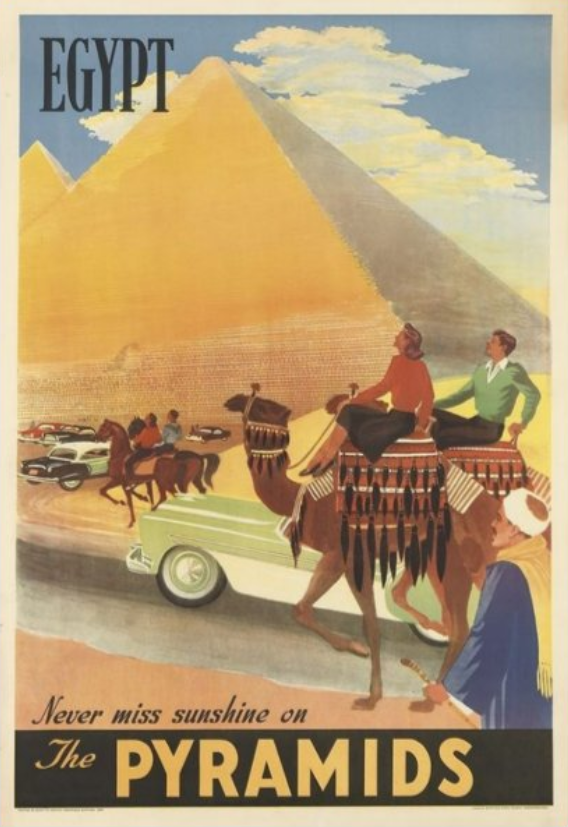
The image above, a drawing from the 1850s, epitomizes how the camel has been imagined for everyone in America, the West and just about everywhere outside the area where camels were important domestic animals. A turbaned man astride a galloping camel: Orientalism has ruled the day. And when Westerners visited the Middle East, riding a camel became a touristic must-do, as in the image below:
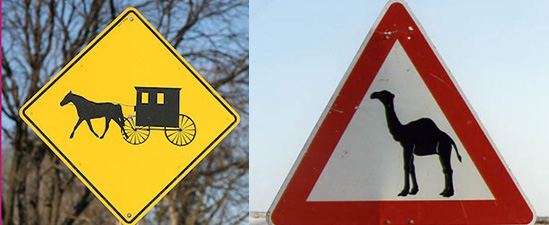
Camels (the one-humped kind) do exist outside the Middle East, including the Old West of the United States and Australia. But take a look at the next picture of two warning signs. One is from Qatar, where camels sometimes cross a rural road, and the other is from the Amish country in Ohio. The Amish are a group who came to America to escape persecution in Europe and maintain an old lifestyle without electricity or automobiles. I used to visit the Amish parts of central Ohio when I was a child and it was always a game to see who could spot the first Amish buggy. So, I would have been quite shocked to see a camel warning in Ohio.
But today it may be necessary, since the Amish are now raising camels for milk, an idea sparked by a Saudi that led to a company, Desert Farms, being formed in 2015. The prices are a bit out of reach at $18 for 16 ounces of fresh camel milk or $72 for 200 grams of powdered camel milk. But as the site exclaims, camel milk is halal and even if not really kosher, it can be at times.
So if you can afford it or find it (and good luck at that), drink up.