Category Archives: Environment

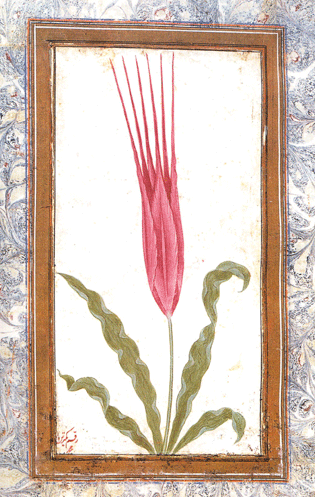
Tulip mania


Unnamed tulip from the Turkish ‘The Book of Tulips’, ca. 1725

Webshaykh’s Note: With winter snow buffeting Europe and the Middle East, what better time to think about tulips, an Ottoman treasure that took Europe by storm almost half a millennium ago. There is an excellent book on The Tulip by Anna Pavord (Great Britain: Bloomsbury, 1999), but one of my favorite articles is one that Jon Mandaville wrote for ARAMCO World over three decades ago. The full article is available online, but I provide the first part below.]

Turbans and Tulips
Written by Jon Mandaville. ARAMCO World Magazine, May/June, 1977

Tulips come from Holland. Right? Wrong! Or at least, they haven’t always. Tulips come from Turkey, the only country in the world to call one of its major eras of national history—the years 1700 to 1730—the “Tulip Period.” And how that era got its name . . . thereby hangs a tale.

Tulips, even in the early 18th century, were nothing new to Turkey. Along with other bulbous plants such as the narcissus, the hyacinth and the daffodil, tulips had grown there for centuries, both wild and domesticated for house and garden. The Tulip Period took its name from an established hobby, which started as court fashion, grew into a generalized fad and fancy, and finally became an explosion of unrestrained international speculation in bulbs which buyers never even saw.

It all began when tulips first went to Europe. In 1550, no one in Holland had heard of tulips. Different varieties do grow wild in North Africa and from Greece and Turkey all the way to Afghanistan and Kashmir. Very occasionally they are even found in southern France and Italy, usually in vineyards or on cultivated land, which has led some botanists to speculate that they may have been brought back by the Crusaders.

The Persians were familiar with tulips, but they didn’t domesticate them as thoroughly as the Turks. For centuries they admired the flowers wild. Even as decorative motifs in Persia, they were never as popular as the narcissus, iris or rose.

In Turkey it was different. Continue reading Tulip mania
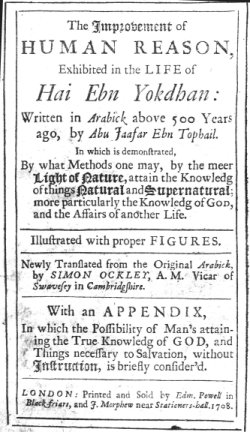
Ibn Tufayl’s Fable


What would happen to a child growing up on an island outside any human society? In real life such a scenario would be absurd. No child could survive from birth on his or her own, despite exotic accounts of feral human babies being reared by animals. But as a thought experiment, it makes an intriguing story. Such is the philosophical fable spun by the Andalusian Muslim scholar Ibn Tufayl over eight centuries ago. I have just finished teaching this text and the lessons in it are fresh in my mind.

If you have never read this classic fable, it can be found online in the original 1708 translation into English by Simon Ockley. A more recent translation by Lenn Evan Goodman is available from Amazon. The author was a distinguished Muslim intellectual who borrowed from the earlier Greek icons Aristotle and Plato, as well as the commentaries by earlier Muslim philosophers like Ibn Sina (Avicenna) and al-Farabi. His fable combines logical arguments, inductive scientific observation and a form of intuition that leads to a union with the One. Continue reading Ibn Tufayl’s Fable

Leaves from an old Bible Atlas #6


Hurlbutt’s Atlas, p. 118

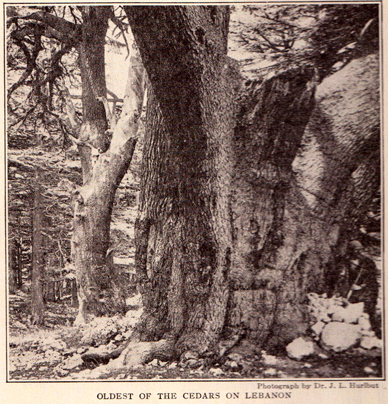
The Christian fascination with the Holy Land as a window into interpretation of the Bible has a long and indeed fascinating history of its own. Here I continue the thread on Jesse Lyman Hurlbutt’s A Bible Atlas (New York: Rand McNally & Company, 1947, first published in 1882). Ah, those cedars of Lebanon, hewn for Solomon’s temple but a few being left for the intrepid explorer, in this case Rev. Hurlbutt himself. Here is his sketch of that temple. Continue reading Leaves from an old Bible Atlas #6

Camels in Vienna


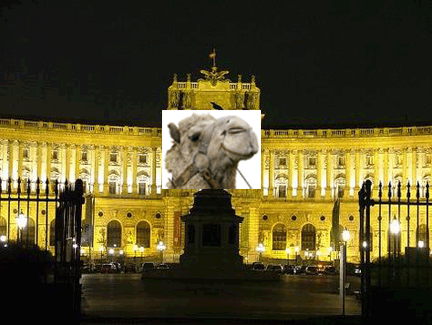
Today I am leaving for Vienna and the forthcoming “Camels in Asia and North Africa
Interdisciplinary workshop” to be held Tuesday & Wednesday 5-6 October, 2010 at the
Austrian Academy of Sciences, AAS, Dr.-Ignaz-Seipel-Platz 2, 1010 Vienna. If you have an interest in any aspect of camels and are near Vienna, Austria, you might want to join in.

Here are the details, also available in pdf from the website.

This workshop aims at a comprehensive discussion on Old World camels (Dromedary and Bactrian camel) including the following topics:
• Origin and domestication
• Conservation of the wild Bactrian camel
• Veterinary folk medicine
• Socio-economic significance: Breeding, caring, trading
• Art: Petroglyphs, poetry and music
• History and Symbolism of camels in Asia and Austria

These issues will be addressed by scholars from the natural sciences as well as from the social sciences and humanities Continue reading Camels in Vienna

and where is the city of the future?


Take a look at the picture above. This is the recently operationalized city of Masdar, one that seems to come right off the drawing boards of 2001: A Space Odyssey or at least Star Wars. Imagine a city with zero carbon emissions. Imagine a perfectly planned city from top to bottom, fueled by solar power and clean as the pure desert sand. This one happens to have been built on the desert sand, only a short commute by a carbon-emitting vehicle from the city of Abu Dhabi. Forget the Seven Wonders of the Ancient World; here is Futurama out of the Arabian Nights.

Today’s New York Times has a lengthy article about the architectural feat, designed by Foster & Partners. All it takes is money (lots of money) and visionary architects. In this Disney on Sand there are even battery-powered pod vehicles, which operate underground out of sight and take people from place to place without drivers. The author of the article, Nicolai Ouroussouf, mixes praise with a dose of populist realism and rightly so: Continue reading and where is the city of the future?

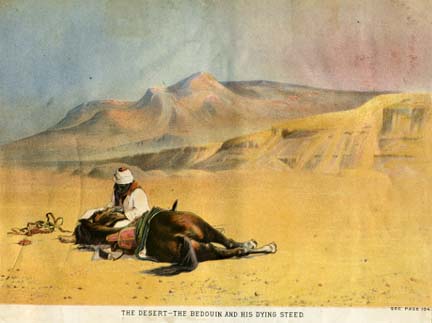
Colorful Lithographic Orientalism #5: Steed

As noted in a previous post, I recently went through a late 19th century scrapbook that belonged to my great, great aunt. She had cut out pictures that interested or amused her. Several of these have Orientalist themes. Sometimes a picture is worth a thousand words; other times the picture says enough for itself. In this series, I leave the image to speak for itself. If you would like to comment on what you see or imagine, please do so in the comments section.

For #4, click here

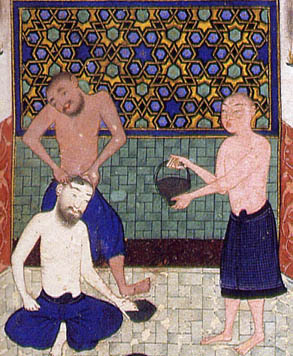
Ibn Abī Bakr al-Azraq on Massage Oils: #1


The Arab physician Ibrāhīm ibn ‘Abd al-Rahman ibn Abī Bakr al-Azraq, wrote an important medical text near the end of the 9th century A.H./fifteenth century C.E. This is his Tashhīl al-manāfi‘ fī al-ṭibb wa-al-ḥikma, which was published in Cairo in the late 19th century and has been republished many times since then. One of his chapters deals with adhān, that is oils and lotions that were rubbed on the body either in the hot bath or just for general health. Here is my translation of his account on oils.

Section on the Benefit and Influence of Oils (adhān)

The Prophet, may Allah bless him and grant him salvation, said: “Eat olive oil (zayt) and rub it on the body.” It is a remedy for seventy illnesses, one of these being leprosy (judhām). He said: “For forty nights, Satan will not come near anyone who has olive oil applied.” Zayt is the extraction of the olive, according to al-Dīwān. Cold and wet, but said to be hot. It softens (yadbughu) the stomach, strengthens the body, energizes movement, and there is benefit for one in old age in applying it to the eyes against dimming of vision. According to Ibn ‘Amr the Prophet, may Allah bless him and grant him salvation, said: “Use it to season bread and rub it on the body, because it comes out of the blessed tree (al-shajara al-mubāraka). Continue reading Ibn Abī Bakr al-Azraq on Massage Oils: #1