Category Archives: Bible and Holy Land

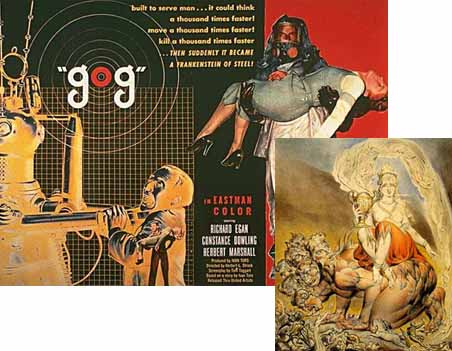
Apocalypse Watch: And It’s Gog Awful

Thus says the Lord GOD: It shall happen in that day, that things shall come into your mind, and you shall devise an evil device: and you shall say, I will go up to the land of unwalled villages; I will go to those who are at rest, who dwell securely, all of them dwelling without walls, and having neither bars nor gates; to take the spoil and to take the prey; to turn your hand against the waste places that are now inhabited, and against the people who are gathered out of the nations, who have gotten cattle and goods, who dwell in the middle of the earth. Ezekiel 38:10-12

Application of biblical prophecy to contemporary events is no doubt as old as the prophets themselves. The extraordinary literary success of the near-sited Left Behind series should not be taken lightly. There are many fundamentally sounding Christian apocalypticists out there and more coming online all the time, thanks to the freedom of website development. One site I recently came across is by a man named Ken Power, who describes himself as follows: Continue reading Apocalypse Watch: And It’s Gog Awful
The Land and the Book #1: Looking for an Omnibus?


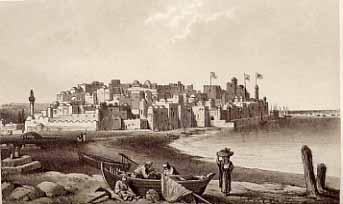
Jaffa from Thomson’s “The Land and the Book”

Almost 150 years ago one of the most popular travel accounts of the Holy Land was penned by an American missionary named William M. Thomson. Born in Ohio, my own home state, the 28-year old Thomson and his young bride arrived in Lebanon in 1834 as Protestant missionaries. This was a mere 15 or so years after the first American missionaries had made the Holy Land a mission field. At once an entertaining travel account and Sunday School commentary on the places and people of the Bible, this may have been one the most widely read books ever written by a Protestant missionary.

Reading Thomson is like reading one of the early English novels. The language is less familiar, although still thoroughly Yankee and the devotional tone has long since disappeared for a readership buying out The Da Vinci Code as soon as it hit the bookstores. The biblical exegesis, literalist yet frankly pragmatic at times, is intertwined with astute and at times humorous accounts of the people Thomson met along the way. But the style is not at all dry or discouragingly didactic. From the start Thomson engages in a dialogue with the reader, making the text (which stretches over 700 pages in the 1901 version) a rhetorical trip in itself.

Here is one of the forgotten books of a couple generations back. Easily dismissed as an Orientalist book, in the sense propounded and confounded by Edward Said, it is nevertheless a very good read. With this post I begin a series to sample the anecdotes and local color presented by Rev. Thomson. The times have indeed changed, but such textual forays into the night reading of a previous generation of Americans are well worth the effort. Let’s begin with the author’s own invitation. Continue reading The Land and the Book #1: Looking for an Omnibus?

The Gates of Gaza


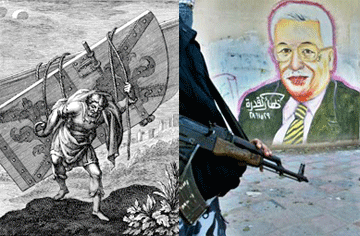
Illustration: left: “Samson carries gates” by Johann Christoph Weigel, 1695; right, Large mural of Palestinian presidential candidate Mahmoud Abbas in Gaza city, December 26, 2004, Reuters

The fragile and it seems futile political engagement of Fatah and Hamas has run into a veritable brick wall in Gaza, not surprising given all the mud slinging that has been going on. Hamas supporters have stormed what they see as the Bastille of President Mahmoud Abbas and in biblical terms carried away the gates. In reading the news reports today and looking at the pictures, especially the Hamas fighters gloating in Abbas’s former presidential office, it is as the baseball sage said “déjà vu all over again.” With fighting still continuing in Palestinian refugee camps in Lebanon, the agony of Palestinian suffering endures. Of course, this is not the first time that havoc has raged in Gaza. Since so little is held sacred in the “Holy Land,’ we might as well raid scripture and summon up an ancient moral tale that ended with a blind man’s suicide in which the temple walls came tumbling down. Today it is obvious there is no Samson in the heroic sense, and recent events confirm that the the blind still lead the blind, while much of the rest of the world simply turns a blind eye. In such times perhaps the only antidote to unstoppable tears is poetry… Continue reading The Gates of Gaza

The Butler Did it in Hebron

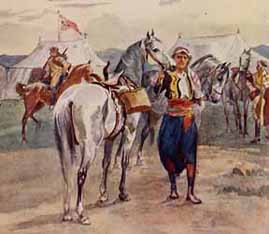
In the late 1890s a certain Elizabeth Butler, accompanying her British military husband, made one of those Protestant-style visits to Anglican nirvana, the Holy Land made somewhat less holy for her at the time by Ottoman Turkish troops. “The time of year chosen by my husband for our visit was one in which no religious festivals were being celebrated, so that we should be spared the sight of that distressing warring of creeds that one regrets at Jerusalem more than anywhere else,” she notes in the preface to her Letters from the Holy Land. Better to go in the off season, it seems, than face the reality of the individual Palestinian Arabs and Jews cluttering the biblical landscape. Her letters, written to her mother “lay no claim to literary worth,” as she humbly and astutely admits. The chief value of the work is, in her own ranking, her 16 color sketches, mostly pastoral pastiche, with the exception of an anonymous Arab attendant, shown here. Continue reading The Butler Did it in Hebron

Six Biblical Days of War

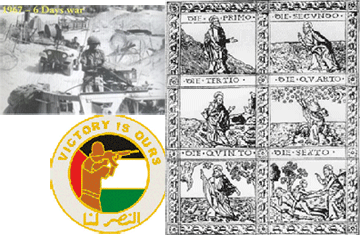
Quick, here’s a trivia question. How long did it take God to create the world, according to the book of Genesis? Six days, of course. If you miss this one, you may have been brought up in the backwaters of the Amazon, although it would not be the fault of Christian missionary translators who have tried to undo God’s rash Babeling of tongues to get the Bible into every known tongue. But what’s a day? Before the scientific revolution sealed by Darwin, the ordinary 24-hour variety day posed few problems for the devout. Once it seemed that the world must be older than Bishop Ussher’s supposed official date of 9 AM on October 23, 4004 BC, seeds of doubt grew into Enlightenment-nurtured forests. But is nothing sacred? it turns out that poor Bishop Ussher never ordained that God slept in late on Day One; the distinction of 9 AM goes to a certain Dr. John Lightfoot. But there’s still the problem of how to define a day, especially in a creation scenario in which the creation of light precedes the sun, moon and stars. Theologians in retreat (as distinguished from those who remained, and still do so, in denial) resorted to a semantic salvation of the scriptural record, arguing that with God a day is the same as a thousand years.

Tomorrow, June 5, is the 40th anniversary of a modern event on Holy Land soil of biblical proportions: the Six-Day War of 1967 in which Israel expanded its borders, took total control of Jerusalem and embroiled the region in the plight of the Palestinians. It only took six days for the overmatched armies of Egypt, Jordan and Syria to be effectively eliminated and since that war there has been little doubt that Israel as Zionist-revived David to a disorganized Arab Goliath lies only in myth. Only six days, but how long is a day? Continue reading Six Biblical Days of War

Apocalypse Watch: The Man Who Knows Squat

Most people find it hard to take cartoons seriously, apart from political satire and that can become a deadly issue, depending on the target. Given the recent Danish cartoon controversy it would seem that comics and religion do not mix well or at least settle well for the believers who see themselves as the target. But what about comic relief for the political struggle between Israel and the Palestinians? Fundamentalist tract artist Jack Chick, whose comic empire is dedicated to winning souls for Christ by drawing on God’s hate, has been using his pen to spread a rather sinister version of the fundamentally reduced Gospel for over 40 years. One of his more recent offerings is called “The Squatters” and it provides a virtual roadmap to apocalypse. Continue reading Apocalypse Watch: The Man Who Knows Squat

The Tirade against Tyre


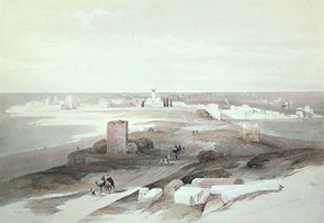
[Illustration: “Tyre, from the Isthmus” by David Roberts]

The Lebanese port city of Tyre has seen the wrath of the IDF. Many villagers fleeing the unrelenting bombing in the south fled to Tyre as a safe haven, only to find that the leaflets dropped from the sky lied. There is no peace in Tyre. Perhaps the message dropped should have been purely biblical, Psalm 83 for example. Most Christians in American can recite a line or two from the 23rd Psalm, the idyll of the good shepherd and a message of hope. It is oft read from the pulpit. But when was the last time you read Psalm 83. Continue reading The Tirade against Tyre

Is There a Middle East?

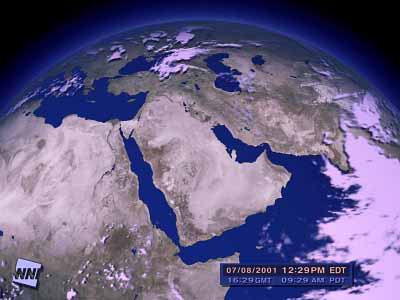
Is there a Middle East? At first glance we either have a very silly question or an occasion for an academic conference. In this case it was the latter at Yale University this past weekend. The Council for Middle East Studies of the Yale Center for International and Area Studies hosted a dozen scholars from various disciplines. Papers were given on the history of the term “Middle East,” its geographical borders in maps and mental templates, how the region implied has been imagined, colonially appropriated and the continuing relevance of the region in a world hooked on oil and stymied by regional terrorism. Continue reading Is There a Middle East?