Category Archives: Bible and Holy Land

Guns and Bibles


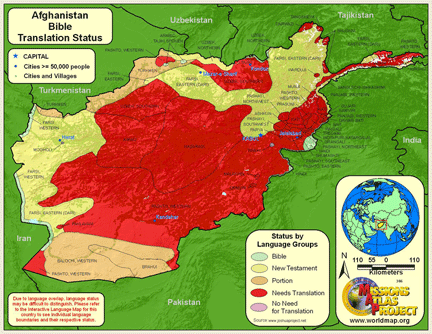
Bible Translation map for Afghanistan from Mission Atlas Project

So much for the secular state. When the founding fathers envisioned the transformation of the thirteen original colonies into the United States of America, the explosive baggage of a state religion was wisely foregone. Contemporary Fundamentalist preachers may bemoan the historical fact, but we do not live in a “Christian” nation. Other states have chosen to maintain a formal religious identity, with varying levels of tolerance for those who are not in the majority. Take Afghanistan, for example. Indeed, the Bush administration did just that, or at least did so partially. Although the Taliban were sent packing into the hills, much to the dismay of Pakistanis who value sovereignty in Swat, Afghanistan is still a solidly Muslim country. The American military is present in Afghanistan in order to ensure security and protect the development agenda. Obviously this takes guns. But the latest addition to the peace-on-earth-keeping mission arsenal appears to be Biblical.

A report on al-Jazeera reveals that an American military chaplain is exhorting evangelical men in the ranks to tote more than their rifles. “The Special Forces guys, they hunt men. Basically, we do the same things as Christians. We hunt people for Jesus. We do, we hunt them down. Get the hound of heaven after them, so we get them into the Kingdom. That’s what we do, that’s our business,” he said. Continue reading Guns and Bibles

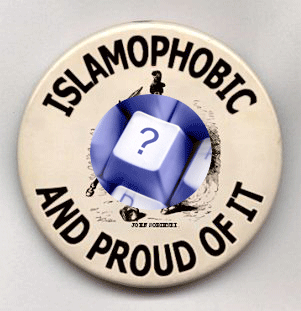
Islamophobia 101, A call to analyse

[Webshaykh’s Note: This is the start of a new blog thread dedicated to energizing scholarly and pedagogical attempts to combat, or at least mitigate, the ongoing volume of Islamophobia in the media, especially on the Internet. The question is simple: what can be done to respond to Islamophobia in the media by our efforts in the blogosphere, formal media outlets, classroom, community and scholarly forums? I invite fellow scholars, professors and teachers and anyone concerned with this issue to contribute to the discussion here at Tabsir.]

People of any particular religious faith are understandably offended when someone or something they hold to be sacred is dragged through the media-made mud of ridicule. There is no way to completely stop desecration, even when hate crime laws are in place. As long as there are synagogues with walls and anti-Semites with paint, swatstikas will be painted. As long as there are artists who stretch their creative energies to the limit of tolerance, animal dung will adorn the body of the Madonna. And as long as so many individuals in Western societies fear Islam through the veil of their own ignorance and historically constructed disdain, the Prophet Muhammad will be pictured as a profligate. The Danish cartoon controversy was only the tip of the iceberg, one that created a titanic rift in the Muslim community worldwide. The irony is that portraying Muhammad in any form is considered wrong in Islam, so that placing a stud missile in the turban of a caricatured Mahound (to drop a literary motif of the same controversial dimension) glosses over the level of misunderstanding motivating those who made and appreciated the cartoon images.

So what is the proper response to the volume of prophet bashing out there, not only in the case of Islam. Here are a few suggestions to jumpstart the process of analysis so that we as scholars can mitigate the paralysis created by an Islamophobia that is only a mouse click away.

• Identify resources (books, relevant articles, websites, speakers) which provide a scholarly and objective-as-possible perspective on Islamophobia
• Discuss the merits of whether or not to provide examples of Islamophobic writing, art and videos that are admittedly offensive to many Muslims
• Provide lesson and project ideas to encourage students to critically assess the Islamophobia in specific examples they are likely to find in the media and on the Internet
• Engage with fellow scholars and concerned Muslims about the most effective and least offensive ways to combat and mitigate Islamophobic writing and art
• Link examples of Islamophobia to other forms of verbal and artistic ridicule of sacred materials.
• Expose Islamophobic rhetoric by politicians, celebrities and other people in the news.

Having set out the goals, I invite colleagues contribute comments, commentaries and examples for and against Islamophobia for this series, please email the webshakh at daniel.m.varisco@hofstra.edu. I will post the first commentary tomorrow.

Daniel Martin Varisco
In Pursuit of the Exotic

Museum Exhibits

January 29 to March 29, 2009: Napoleon on the Nile: Soldiers, Artists and the Rediscovery of Egypt

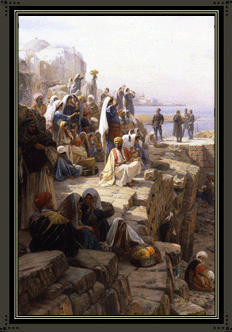
March 24 through April 30, 2009: In Pursuit of the Exotic: Artists Abroad in 19th Century Egypt and the Holy Land

New York, New York – The Dahesh Museum of Art and Syracuse University Art Galleries today announced the formation of a partnership, which will include the Museum’s organizing several exhibitions annually from its own collection of 19th-century art in the academic tradition, complemented by works in the University’s rich collection, for presentation at the SU Art Galleries in Syracuse, as well as The Palitz Gallery/ Lubin House, located on 11 East 61st Street, off Fifth Avenue. The Palitz Gallery has recently attracted artworld attention with the exhibition Michelangelo: the Man and the Myth on view through January 4th 2009. Continue reading In Pursuit of the Exotic

Lithographica Arabica 6: Rev. Wood’s Bible Animals, 3

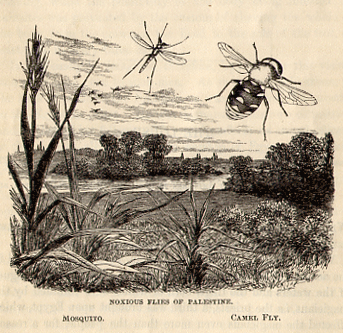
This is the third in a series on the illustrations in Rev. John George Wood’s Story of the Bible Animals. What do you get if you strain at a gnat? Read on…

Gnats

It has already been stated that only one species of fly is mentioned by name in the Scriptures. this is the Gnat, the name of which occurs in the familiar passage, “Ye blind guides, which strain at a ghat and swallow a camel” (Matt. xxiii. 24).

I may again mention here that the words “strain at” ought to have been printed “strain out,” the substitution of one for the other being only a typographical error. The allusion is made to a certain custom which is explained by reference to the preceding article on the fly. In order to avoid taking flies and other insects into the mouth, while drinking, a piece of thin linen stuff was placed over the cup, so that if any insects, as was usually the case, had got into the liquid, they would be “strained out” by the linen. Continue reading Lithographica Arabica 6: Rev. Wood’s Bible Animals, 3

Lithographica Arabica 5: Rev. Wood’s Bible Animals, 2

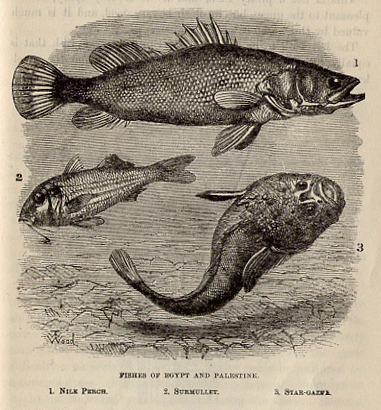
The illustrations provided in the books of Rev. John G. Wood are interesting not only for what they portray, but how they are described. Here is Wood’s folksy spin on three major fishes of Egypt and Palestine:

In order that the reader may see examples of the typical Fish which are to be found in Egypt and Palestine, I have added three more species, which are represented in the following illustration.

Continue reading Lithographica Arabica 5: Rev. Wood’s Bible Animals, 2

Lithographica Arabica 4: Rev. Wood’s Bible Animals, 1


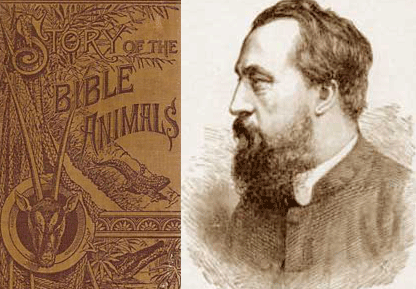
Rev. John George Wood, author of Story of the Bible Animals

Fascination with Bible Lands was so keen in the 19th century that illustrated volumes of scenes and objects were always in high demand. One of the treasures, in a figurative sense, of this age is the work of Rev. John George Wood (1827-1899), an English cleric and writer of popular books on natural history. One of the books passed on to me several years ago is Wood’s Story of the Bible Animals (Charles Foster Publishing Company, 1886), one of several editions of this popular work. The illustrations in my copy are not of the highest quality, but they can still mesmerize across their faded and fraying pages. Continue reading Lithographica Arabica 4: Rev. Wood’s Bible Animals, 1

Picturing the Exodus

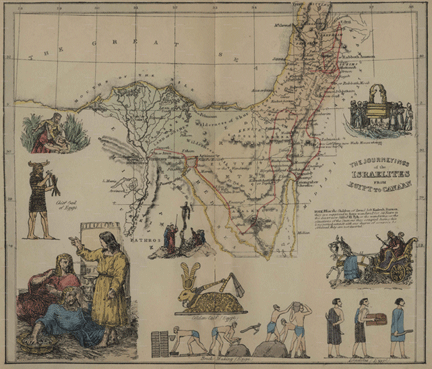
The ubiquity of GPS threatens to leave the old printed map out of the picture. This is a pity, for there is much to be learned from the way maps frame the world. As J. Z. Smith once remarked, map is not territory. True enough, but maps are the way we imagine not only territory but our place in it. When Edward Said wrote his critique of Orientalism in 1978, he cited novelists, travelers, poets and academics, but no mapmakers. But in a way Holy Land maps are what put the Holy Land on the map. Maps not only illustrated what was thought to be the lay of the land, but what people imagined was there.

A splendid example of this is an 1856 pictorial Bible map of the Journey of the Israelites from Egypt to Canaan. I reproduce the image above, but if you
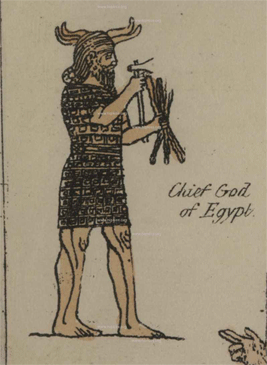
click here you can get a greatly enlarged view to see the details. Mind you, this was 1856, when few of the archeological discoveries in Bible territory had come to light. This is evident in the depiction of the “Chief God of Egypt,” (left side of map) who looks like a cross between an Assyrian and a Viking.

Continue reading Picturing the Exodus

Disproportional suffering


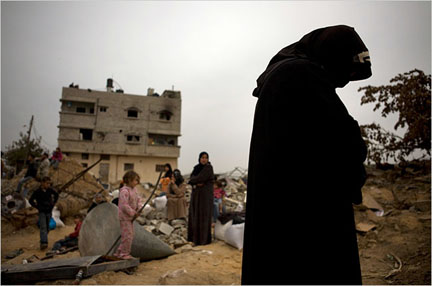
Residents returned to their homes around Gaza City on Friday. Tyler Hicks/The New York Times

Gaza is not history, nor is it likely to be soon. The bombs may have ceased on both sides, but the human toll presages a bleak future. Both sides have grievances, but the grief from death, maiming and sheer destruction of property and homes is incredibly disproportional. Even Independent observers must acknowlege this:

Up to 10 times as many Palestinians were killed as Israelis. The Palestinian Ministry of Health says 1,314 Palestinians were killed, of whom 412 were children or teenagers under 18, and 110 were women. On the Israeli side, there were 13 deaths between 27 December and 17 January, of whom three were civilians killed by rockets fired from Gaza. Of the 10 soldiers killed, four were lost to “friendly fire”.

Even if the Palestinian figure is disputed, it is clear that the death toll was massively higher for Palestinians than Israelis. Proportionality is not simply a matter of numbers, however. Continue reading Disproportional suffering