Category Archives: Bible and Holy Land

More Travels with Kitto

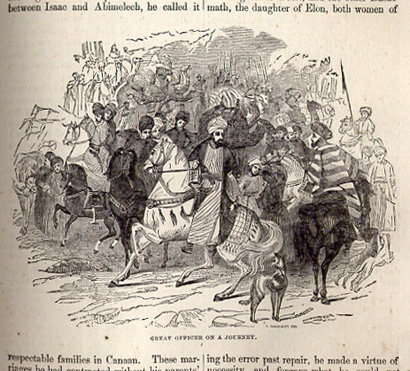
Following up on an earlier post, here is another illustration from John Kitto’s An Illustrated History of the Holy Bible (Social Circle, Georgia: E. Nebhut, 1871). The illustration above of a contemporary Arab scene illustrates the discussion of the patriarch Isaac receiving King Abimelech, “whom, with his attendants, he entertained with great liberality. The articles for a treaty of friendship were agreed on that same evening, and the next morning confirmed by a solemn and mutual oath; after which Abimelech took his leave, and returned home (pp. 118-119).

Now, if only Mahmoud Abbas and Benjamin Netanyahu could remake this scene with all its fanfare, the world would be a better place.

Following Seward’s Folly: #4 The Dome of the Rock


Illustration of Cairo from Seward’s Travels (1873)

William H. Seward, the American Secretary of State who is forever linked with the “folly” of acquiring Alaska from the Russians, spent a year traveling around the world near the end of his life. In three previous posts I posted the comments he and his daughter made about India and Aden, and Egypt. The journey continued to Palestine and the city of Jerusalem:

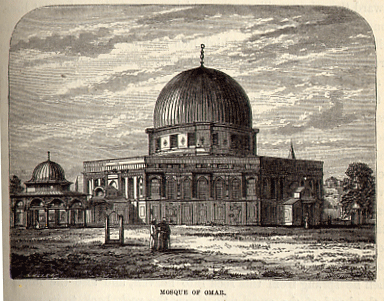
Yussef Effendi, with the brother and secretary of the pacha, attended us to the Mosque of Omar. It is only within the last five years that this mosque, scarcely less sacred in the eyes of Mussulmans than the Church of the Holy Sepulchre is in ours, has been opened to Christian travelers. Even now a careful, though somewhat disguised surveillance, is practiced over them. The mosque stands in an area enclosed with a high, parapeted wall, overlooking the vally of Jehoshaphat, and confronting the Mount of Olives. This occupies one-sixth of the land of the entire city. On the eastern side of this wall is a gate-way, built of marble, called by the Mussulmans the “Golden Gate,” which they are fond of representing as the “gate of the temple called Beautiful,” but its modern architecture does not support that claim. It is only interesting from the tradition that it was closed with the Roman conquest, and has never been reopened. The so-called Mosque of Omar is not single. It consists of two distinct mosques, placed at some distance from each other – the one here named Kubbet-es-Sukhrah, or “the Dome of the Rock,” commonly called the Mosque of Omar, and the Mosque-el-Aqsa. Though differing entirely from the Church of the Holy Sepulchre, the Mosque of Omar is not less unique and peculiar in its sacred antiquities. Twelve hundred years ago, on the surrender of the Greek Patriach, the Caliph Omar demanded to be shownt he site of the Jewish temple. He was taken to the sacred rock, he knelt and prayed over it, and he built over it a mosque, which, with subsequent repairs, is the present “Dome of the Rock,” or Mosque of Omar. In architectural design and execution it rivals the finest in Cairo and Constantinople. Continue reading Following Seward’s Folly: #4 The Dome of the Rock

God is my co-sniper

Not since Tammy Faye Baker embroidered Bible verses on her underwear has there been as eye-opening a scriptural scandal as the recent revelation that an American manufacturer routinely engraves Bible verses on U.S. military gun sights. As reported earlier this week, the Michigan-based corporation Trijicon has supplied the gun sights used by American marines to aim at and shoot the Taliban and their sympathizers in Afghanistan. The company may now be in quite a few critics’ sights given the new publicity. The Wikipedia entry already details the controversy. But the main company website has nothing to say. In the detailed descriptions of the gun sights on the website the biblical abbreviations are nowhere in sight. But it does say that “Trijicon self-luminous night sights are proven to give shooters five times greater night fire accuracy- with the same speed as instinctive shooting.” Five times, got it? Try MARK 6:38 (do look this up) and don’t forget the fishes. It may very well be that the procurement officers never noticed the addition of gospel acronyms after the serial numbers, but the company is not shy about its Christian views: “We believe that America is great when its people are good. This goodness has been based on biblical standards throughout our history and we will strive to follow those morals.”

The actual verses are not inscribed, only the chapter and verse in code. It appears that all of the verses are from the New Testament, so at least it cannot be claimed to be a Zionist plot (or perhaps it could be said to be a very clever Zionist plot…). I have no idea how many verses have appeared on the 800,000 units contracted for $660 million by the U.S. Marine Corps. I suspect that MATT 5:44 (do look it up) is not one of them. Perhaps the Sermon on the Mount is not part of what the company defines as “biblical standards.” Continue reading God is my co-sniper

With Kitto Illustrating Bible History

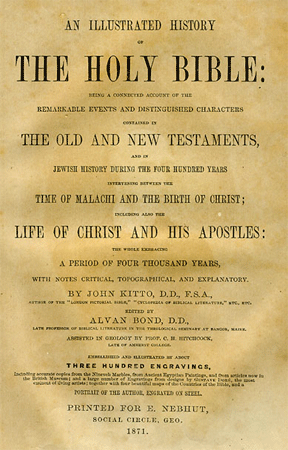
As a child I spent many inquisitive hours leafing through the books in my grandmother’s parlor bookcase. One that especially attracted my attention was John Kitto’s An Illustrated History of the Holy Bible (Social Circle, Georgia: E. Nebhut, 1871). Rev. John Kitto, recognized on the title page as author of the London Pictorial Bible, the Cyclopedia of Biblical Literature, ETC, ETC, retells the entire history of the Old and New Testament, from creation to the destruction of Jerusalem. Kitto was born into poverty in 1804 in Plymouth, England and due to an unfortunate accident ate age thirteen became entirely deaf and was forced into the poor house at the age of fifteen. This is quite an inauspicious beginning for a waif who went on to be a respected theological scholar. Through the local humanitarian efforts of several men in Plymouth, Kitto became a lay missionary to Malta and then for three and a half years in Baghdad. “While residing in that city,” writes Alvan Bond in the preface to Kitto’s book, Cairo “was visited by the plague, the terrific ravages of which swept off more than one-half the inhabitants in two months. Amidst this fearful desolation he remained calm and active at his post.” Once back in England he married and produced a travel account and several pictorial histories of the Holy Land. In 1844 the University of Giessen conferred upon him the degree of D.D. His ill health forced him to seek help in the spas of Germany, where he died after a mere half century in 1854. Continue reading With Kitto Illustrating Bible History

Burn those Scofield Bibles, baby


Cyrus Ingerson Scofield, 1843-1921

[Webshaykh’s Note: As someone who grew up on the Scofield Bible, I offer this critique from the peanut gallery.]

Zionism’s un-Christian Bible
Scofield Bible made uncompromising Zionists out of tens of millions of Americans.

By Maidhc O. Cathail, Middle East Online, November 25, 2009

The Boycott, Divestment, Sanctions for Palestine campaign should widen its scope to target non-Israeli companies who contribute significantly to the oppression of Palestinians. As part of this broader strategy, priority should be given to one of the most egregious offenders, the prestigious British publisher, Oxford University Press. As unlikely as it may seem, the world’s largest university press is responsible for one of the greatest obstacles to justice for Palestinians – The Scofield Bible.

Since it was first published in 1909, the Scofield Reference Bible has made uncompromising Zionists out of tens of millions of Americans. When John Hagee, the founder of Christians United for Israel, said that “50 million evangelical bible-believing Christians unite with five million American Jews standing together on behalf of Israel,” it was the Scofield Bible that he was talking about.

Although the Scofield Reference Bible contains the text of the King James Authorized Version, it is not the traditional Protestant bible but Cyrus I. Scofield’s annotated commentary that is the problem. More than any other factor, it is Scofield’s notes that induced generations of American evangelicals to believe that God demands their uncritical support for the modern State of Israel. Continue reading Burn those Scofield Bibles, baby

With Van-Lennep in Bible Lands: 3


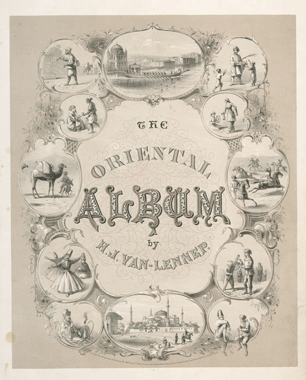
Van-Lennep’s album cover

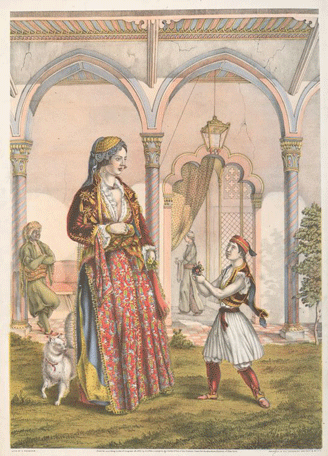
In 1862 Henry J. Van-Lennep published twenty original chromolithographs of life in Ottoman Turkey. These include two scenes of Jewish life in the Ottoman Empire, “A Turkish Effendi,” “Armenian Lady (at home),” “Turkish and Armenian Ladies (abroad),” “Turkish Scribe,” “Turkish Lady of Rank (at home),” “Turkish Cavass (police officer),” “Turkish Lady (unveiled),” “Armenian Piper,” “Armenian Ladies (at home),” “Armenian Marriage Procession,” “Armenian Bride,” “Albanian Guard,” “Armenian Peasant Woman,” “Bagdad Merchant (travelling),” “Jewish Marriage,” “Jewish Merchant,” “Gypsy Fortune Telling,” “Bandit Chief,” “Circassian Warrior,” and “Druse Girl.” The lithographer for Van-Lennep’s paintings was Charles R. Parsons (1821-1910).


Van-Lennep’s illustration of a Turkish Lady of Rank (At Home)

Continue reading With Van-Lennep in Bible Lands: 3

With Van-Lennep in Bible Lands: 2


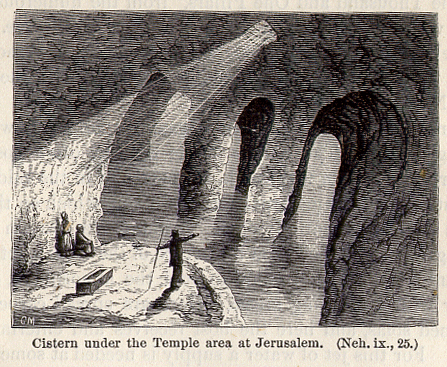
Van-Lennep’s illustration of a Easterner with outstretched arm in awe at the scenes under the Temple mount at Jerusalem

Heny J. Van-Lennep, missionary, author and artist of the Holy land, has no doubt that the “remarkable reproduction of Biblical life in the East of our day is an unanswerable argument for the authenticity of the sacred writings.” While the bias of this Christian writer is clear, it would appear to flow more from a sense of sectarian and cultural superiority rather than an innate desire to denigrate the people being studied. Because writers like Van-Lennep believed that current customs of the Arabs, in particular, had been preserved by God as a testimony to the truth of scripture, these customs were held in high regard. While I hesitate to label the efforts of these texts as “ethnography” in the contemporary sense, Van-Lennep (1875:6) is proud of the fact that he “enjoyed unrivaled opportunities of intercourse with all classes of people.”

Rather than using his text to criticize the “Orientals,” Van-Lennep (1875:7) is at pains to counter existing stereotypes of his day. Thus, he used “Mohammed” rather than “Mahomet”, “Bedawy” rather than “Bedouin.” Consider the rationale for recognizing how Muslims saw themselves: “On the other hand, we have not called the religion of Mohammed Mohammedanism, but Islam, its universal name in the East (not Islamism, nor the religion of Islam); and his followers not Mohammedans, but, as they call themselves, Muslims (not Mussulmans); Muslimin is the plural of Muslim.” To the extent that Van-Lennep believed that God had preserved these customs as a testimony, it was important to describe them as accurately as he could. Continue reading With Van-Lennep in Bible Lands: 2

With Van-Lennep in Bible Lands: 1

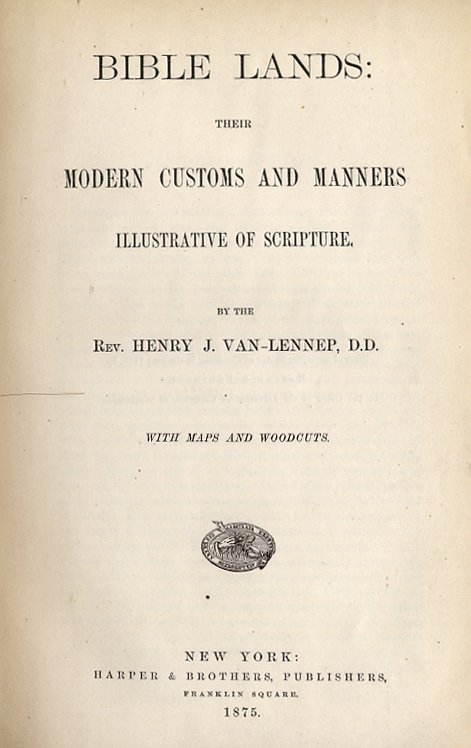
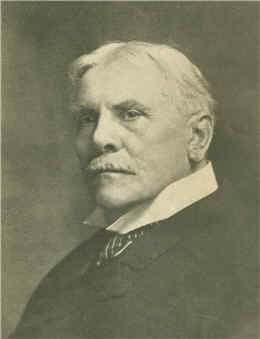
The nineteenth century Rev. Henry J. Van-Lennep provided one of the most exhaustive (832 pages) compilations of contemporary customs of “Holy Land” peoples said to be “illustrative of scripture.” In a sense the popularity of the “Bible customs” genre, which included many of the travel accounts of ministers, missionaries and lay Christians, served as an antidote to the Higher and Lower Criticism of the Bible. To the extent the Bible was treated as a literary text, the divine luster wore thin for conservative Christians. By the mid-nineteenth century archaeological discoveries in the Holy Land seemed to vindicate aspects of recorded biblical history. Van-Lennep, however, was less concerned about the spoils beneath the soil than the customs of contemporary Arabs and other indigenous people in what he thought of as Bible lands. Continue reading With Van-Lennep in Bible Lands: 1