Category Archives: Bible and Holy Land

Leaves from an old Bible Atlas #8


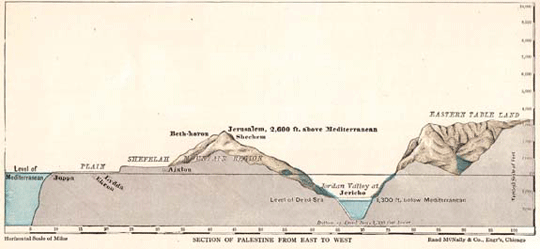
Hurlbutt’s Atlas, p. 16

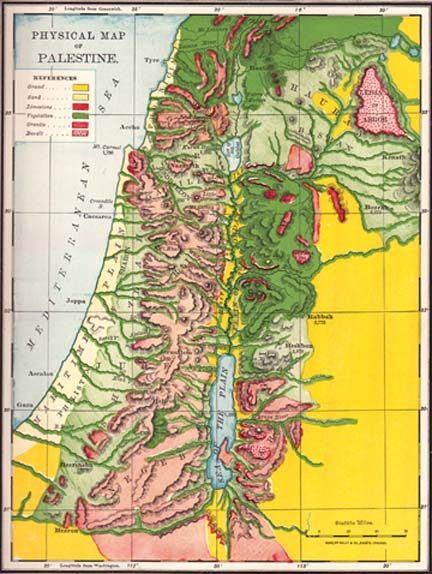
The Christian fascination with the Holy Land as a window into interpretation of the Bible has a long and indeed fascinating history of its own. Here I continue the thread on Jesse Lyman Hurlbutt’s A Bible Atlas (New York: Rand McNally & Company, 1947, first published in 1882). Hurlbutt includes two diagrams showing cross-sections across Palestine. That shown above is an east-west transect, showing the Dead Sea level at 1,300 feet below sea level. These were indeed better times, more than a century ago. Today the Dead Sea has dropped at least another 85 feet and continues at an alarming rate. The north-south transect is shown below. In order to be able to read it here, I have split it, but originally it was a single horizontal diagram. Continue reading Leaves from an old Bible Atlas #8

Guardians of the Sacred

by F. E. Peters, NYPL Website, October 18, 20120

For very long time, Jews, Christians and Muslims have behaved toward one another like members of a dysfunctional family, like the competitors for an immense inheritance, the favor of Almighty God. But the current exhibition at the New York Public Library uncovers quite another strain of familiarity among the three, their devotion to the book.

Many cultures value the written word, the art of writing and a reverence for books, but Jews Christians and Muslims are unique in their devotion not merely to books – the scribe was always among their elite members before the age of printing – but to the Book. Continue reading Guardians of the Sacred

Leaves from an old Bible Atlas #7


Hurlbutt’s Atlas, p. 137


Hurlbutt’s Atlas, p. 133

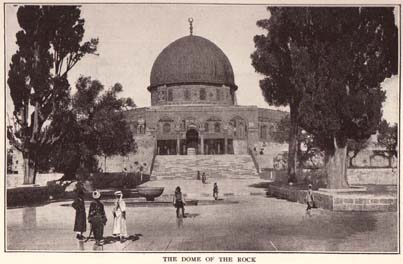
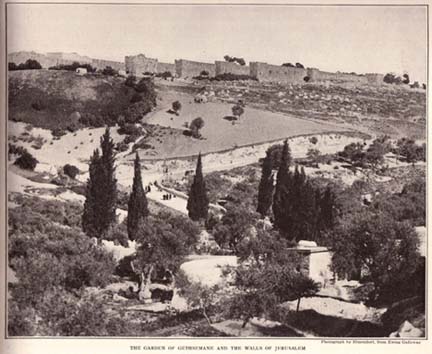
The Christian fascination with the Holy Land as a window into interpretation of the Bible has a long and indeed fascinating history of its own. Here I continue the thread on Jesse Lyman Hurlbutt’s A Bible Atlas (New York: Rand McNally & Company, 1947, first published in 1882). As might be expected, a large part of the atlas is devoted to Jerusalem. Here are two century old pictures, one of the Dome of the Rock and the other a view of the Garden of Gethsemane looking toward an uncluttered landscape beneath the old city walls of Jerusalem.

Let’s Play Spot the Muslim


left, Muslim Moroccan-French actor Said Taghmaoui does not care much for shirts; right, scary Muslim garb

The recent debate over remarks by NPR reporter Juan Williams on the Bill O’Reilly Show is quite revealing, although not in terms of fashion. Of late NPR has gone public with its No Partisan Reporting image, placing comments on Fox News atop the same perch as Jon Stewart’s Rally to Restore Sanity. Lost in the shuffle is the ultimate bottom line in media as business: Williams has just signed a multi-year contract with Fox News. In commenting on his statement that he personally feels uncomfortable traveling on an airplane with fashionably coded devout Muslims, Williams is quoted on the Fox News website (with the typographical error intact):

“They take something totally out of context,” Williams said Thursday night, adding that his point was that Americans must come to grips with their prejudices.

“I have always thought of journalism, in a way, as a priesthood. you honor it you protect it,” he said, before criticizing his former employer. “These people don’t have ay sense of righteousness, of what’s right here. They’re self righteous.”

Of course, we all know that Fox News, especially someone like O’Reilly is not at all “self-righteous.” Continue reading Let’s Play Spot the Muslim

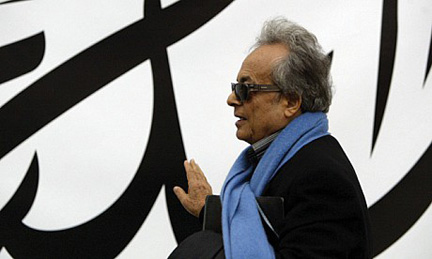
The Poet Adonis


A Revolutionary of Arabic Verse
By CHARLES McGRATH, The New York Times, October 17. 2010

ANN ARBOR, Mich. — Every year around this time the name of the Syrian poet Adonis pops up in newspapers and in betting shops. Adonis (pronounced ah-doh-NEES), a pseudonym adopted by Ali Ahmad Said Esber in his teens as an attention getter, is a perennial favorite to win the Nobel Prize in Literature. This year Ladbrokes, the British bookmaking firm, had his chances at 8-1, which made him seem a surer bet than the eventual winner, Mario Vargas Llosa, a 25-1 long shot. Why Adonis appeals to the oddsmakers, presumably, is that he’s a poet, and poets have been under-represented among Nobelists lately; that he writes in Arabic, the language of only one Nobel winner, Naguib Mahfouz; and that as is the case with so many recent winners, most Americans have never heard of him.

In the Arab world it’s a very different matter. There he is a renowned figure, if not everywhere a beloved one. He is an outspoken secularist, equally critical of the East and West, and a poetic revolutionary of sorts who has tried to liberate Arabic verse from its traditional forms and subject matter. Some of his poems are immensely long and immensely difficult and resemble Pound’s Cantos at their most impenetrable. Others reveal a Paul Muldoonish playfulness, a Jorie Graham-like expansiveness and fascination with blank space. His poems are as apt to cite Jim Morrison as the Sufi mystics, and his 2003 volume “Prophesy, O Blind One” includes some long, leggy lines about traveling that could have been written by Whitman, if only Whitman had spent more time in airports. Continue reading The Poet Adonis

Leaves from an old Bible Atlas #6


Hurlbutt’s Atlas, p. 118

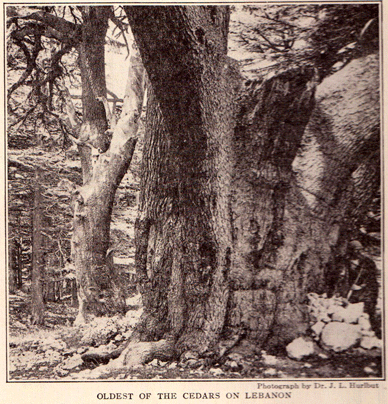
The Christian fascination with the Holy Land as a window into interpretation of the Bible has a long and indeed fascinating history of its own. Here I continue the thread on Jesse Lyman Hurlbutt’s A Bible Atlas (New York: Rand McNally & Company, 1947, first published in 1882). Ah, those cedars of Lebanon, hewn for Solomon’s temple but a few being left for the intrepid explorer, in this case Rev. Hurlbutt himself. Here is his sketch of that temple. Continue reading Leaves from an old Bible Atlas #6

Leaves from an old Bible Atlas #5


Hurlbutt’s Atlas, p. 118


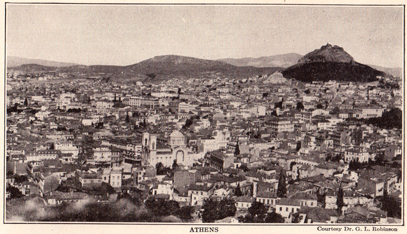
Athens, Hurlbutt’s Atlas, p. 119

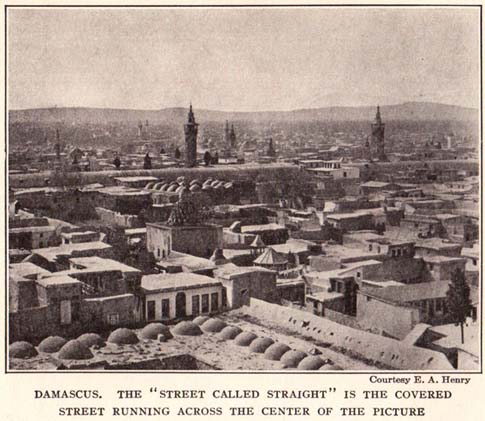
The Christian fascination with the Holy Land as a window into interpretation of the Bible has a long and indeed fascinating history of its own. Here I continue the thread on Jesse Lyman Hurlbutt’s A Bible Atlas (New York: Rand McNally & Company, 1947, first published in 1882). One of the interesting aspects of the accompanying illustrations is the sense that what you see in the photograph is essentially unchanged from the days of Paul’s missionary journeys. Both these images appear to have been taken before the turn of the 20th century.

To be continued …