Category Archives: Ethics

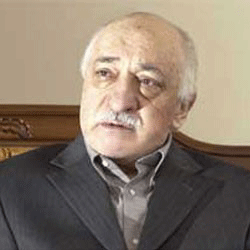
Georgetown Conference on Alternative Perspectives of the Gülen Movement


CALL FOR PAPERS
ISLAM IN THE AGE OF GLOBAL CHALLENGES:
Alternative Perspectives of the Gülen Movement
October 17 – 18, 2008
Georgetown University

Conference Website

Georgetown University President’s Office, Alwaleed bin Talal Center for Muslim Christian Understanding at Georgetown University, The Institute of Turkish Studies, and Rumi Forum would like to invite you to participate in a conference that explores alternative perspectives of the Gülen Movement within the larger framework of Islam in the Age of Global Challenges. The conference will take place at the Georgetown University on October 17 – 18, 2008. Continue reading Georgetown Conference on Alternative Perspectives of the Gülen Movement


Deoband’s Anti-Terrorism Convention: Some Reflections

by Yoginder Sikand, March 11, MADRASA REFORMS IN INDIA

The mammoth ‘Anti-Terrorism Convention’ organised at Deoband late last month, which brought together ulema from all over the country, has received wide media coverage. While smaller conventions of this sort have been organized by other ulema bodies in recent years, this one, unlike others, caught the attention of the media particularly because it was organized by the Dar ul-Ulum Deoband, probably the largest traditional madrasa in the world, which large sections of the media have been unfairly berating as the ‘hub’ of ‘terrorism’.

The speeches delivered at the convention have been considerably commented on in the press. By and large, the non-Muslim press has focused almost wholly on the resolutions that were passed that labeled ‘terrorism’ as ‘anti-Islamic’, leaving out other crucial issues that were raised by numerous ulema who spoke on the occasion, particularly about Western Imperialism and Zionism as major factors behind global ‘terrorism’, and the hounding of Muslim youth and mounting Islamophobic offensives across the world, including India, in the name of countering ‘terror’. Muslim papers have dealt with these issues fairly extensively, but, following most of the speakers at the convention, they have placed the blame for ‘terrorism’ almost entirely on what they identify as ‘enemies of Islam’, thus presenting a very one-sided picture. In short, media reporting about the convention, by both the Muslim and non-Muslim media, has been inadequate and somewhat imbalanced. The same can be said of several of the speeches made at the convention. Continue reading Deoband’s Anti-Terrorism Convention: Some Reflections

So if it’s not about religion …

The War on Terror, upon which the GOP presidential candidates (minus libertarian Ron Paul) have been feasting, is promoted as a clash of civilizations masquerading as religions. In this pop culture scenario there is the secular West, which promises freedom of religion and only tolerates freedom from religion, vs. the fanatically religious non-West currently reduced to mad mullahs and Islamic Jihadists. We are told it is not about religion. That is true. It is, however, about religions. The West assumes it has tamed its religious impulse to crusade and colonize the Gospel to the ends of the commercially driven earth. Our religious wars are in the history books. Or are they?

Inquistors with holy orders have been replaced by mega-church preachers with rock-music intros. Witch trials have been overturned by a mentality that still thinks the 10 Commandments trump the U.S. Constitution. The United States is in legal theory not allowed by law to prohibit religious worship (although it did so against Native Americans). But America has only a veneer of secularism. Religious organizations no doubt take in more money than the IRS and not all that goes to charity. Much of this freedom of religion is an invitation to convert others or to promote outmoded notions such as biblical creation and Noah’s flood. The fact that half of the population in the U.S. still holds on to the myth of Adam and Eve as an explanation for human origins, despite the evidence from scientific research, says we are not yet free of irrational thinking.

Then there is “their” religions. Continue reading So if it’s not about religion …

Raw Footage


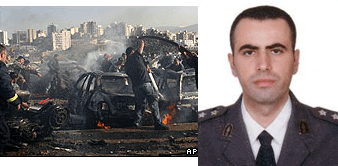
Blast site in Beirut, left; Wissam Eid, right

Another city, another bomb, more deaths. It could be anywhere in the Middle East these days, but I am referring to a bomb that went off in a Christian neighborhood of Beirut yesterday. If you lived in Beirut you would see the devastation without media cleansing. An Arabic report is viewable at http://www.liveleak.com/view?i=70b_1201323034 and needs no translation, but the BBC also has a video report at http://www.liveleak.com/view?i=fc6_1201258935. For the raw footage of the aftermath another video is also on the net at http://www.liveleak.com/view?i=010_1201257690.

According to the latest reports at least five people died, including Wissam Eid, a senior intelligence officer, as well as more than 40 wounded. It was shocking enough in a country that has witnessed so many bombings and bloodshed, most recently the loss of Major General Francois al-Hajj, who was killed on Wednesday by a car bomb. Prime Minister Fouad Siniora has declared today, Saturday, a national day of mourning in Lebanon.

Look at the picture of Wissam Eid, posted above. Look beyond this one face to the mutilated bodies of thousands that die each year from bombs and guns, not just in the Middle East. Are there any tears in your eyes today or is this just somebody else’s problem because it is somebody else’s face? Continue reading Raw Footage

Cannons of the Past


Woman and a Fish, Asma al Fayoumi, Syria 1993

by Najeeb Nusair. Translated by Christa Salamandra and Suhail Shadoud
from Artenews, October, 2007

However much we moan and groan, however much we lament, reminisce, mull over, write, dig up, represent, glorify, venerate—even if we use the entire vocabulary of literature and science to conjure it up, the past will not return. Even if we cry, kick the ground with our feet like temperamental children, beg people, societies and nations, even if we consult scholars, historians, doctors, and feminists… the past will not return.

Instinctively we remember, as we practice our everyday cultural life, lavishly praising the past, and seeking to retrieve it in any possible way. But the past is within us; it has not and will not leave us. Asking for it to return is asking for what has fallen away, is gone, because it no longer works and has expired. The past is a gigantic mass, some of which is relatively good, and remains within us, and much of which time has consumed and flung aside, like lines in an arcane, long forgotten book. Continue reading Cannons of the Past

Iraq: The Hidden Human Costs

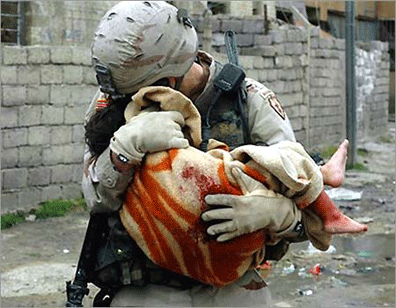
[Note: The following excerpt is from a book review published in the latest New York Review of Books by Michael Massing. The full article is available free online and describes two compelling memoirs of the invasion of Iraq, one by a Marine and one by a reporter embedded with the Marine’s unit. It is well worth reading for a side of the fighting usually sanitized out of reports.]

by Michael Massing, New York Review of Books, December 20, 2007

As the Marines fall back, some are clearly exhilarated at this first exposure to battle; others express remorse. “Before we crossed into Iraq, I fucking hated Arabs,” says Antonio Espera, a thirty-year-old sergeant from California. “I don’t know why…. But as soon as we got here, it’s just gone. I just feel sorry for them. I miss my little girl. Dog, I don’t want to kill nobody’s children.” Coming under heavy fire for the first time, Wright is surprised to find himself calm, but he is astonished at the fierceness of the barrage being directed at Nasiriyah. It includes high-explosive rounds that can blast through steel and concrete as well as DPICMs (Dual-Purpose Improved Conventional Munitions), cluster shells that burst overhead, dispersing dozens of bomblets designed to shred people. Continue reading Iraq: The Hidden Human Costs

Mass-Mediated Violence in Morocco and the US: Suicide Bombing and Shooting Sprees


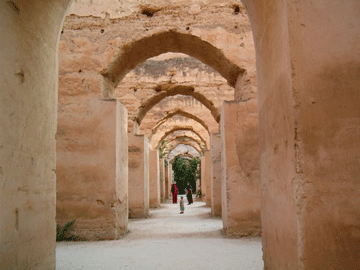
Scene in Meknes, Morocco

by Emilio Spadola
Colgate University
Dept of Sociology and Anthropology

Recently, my efforts to think on Moroccans’ quality of modern (i.e., mass-mediated) life have turned on violence both there and in the US, and, especially, to two forms of youth violence: suicide bombings and suicide shootings. In 2007 Moroccans witnessed separate bombings in Casablanca and Meknes; in separate cases Moroccan state intelligence traced other accused suicide bombers to one neighborhood in Tetouan. In the US in December an Omaha teenager with an automatic weapon shot and killed eight mall goers, then himself; four deaths shortly after in Colorado added to the long year of suicide sprees by young men: six deaths in a Utah mall in February, 33 deaths on the Virginia Tech campus in April.

Emphasizing putative differences, cultural pundits habitually link suicide bombings to the Middle East, and, specifically, to an Islamic culture of violence. And shooting sprees seem typically, if pathologically, American. They are nonetheless strikingly redolent. Yet to compare them, that is, to abstract them from their separate contexts, takes special care. In so doing one faces what Benedict Anderson calls the “specter of comparisons,” that is, the distinctly modern moment in which persons appear, like commodities and print, as serial copies. Yet it is precisely this imagined quality of commensurability—when “anyone” rather than a specific someone can be a target (of mass-mediated messages)—that marks as contemporary suicide bombing and suicide shooting. Continue reading Mass-Mediated Violence in Morocco and the US: Suicide Bombing and Shooting Sprees

Tenure Affirmed, not Bulldozed

[Note: The recent tenure case of Dr. Nadia Abu el-Haj generated a great deal of heat in the blogosphere, but I am pleased to report that she was granted tenure based on the internal reviews and despite the external attempts to bulldoze her voice out of the academy. I had reported on this case in a post here on September 13. The details are provided in a blog item by Richard Silverstein, which I include here to bring closure to this case.]

by Richard Silverstein, Tikkun Olam, November 2, 2007

The long, arduous journey of Nadia Abu El-Haj, Barnard professor of anthropology, to tenure is finally over. The Columbia administration has approved Barnard’s recommendation and she will become tenured faculty on approval of both institutions’ boards of trustees. Thanks to Sol Salbe for noting the JTA report on this from earlier today. However, a Jewish journalist friend of mine has pointed out a typical JTA error in the copy for the story:

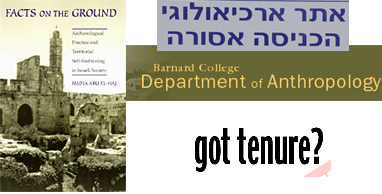
El-Haj is the author of “Facts on the Ground,” a book that attacks the Israeli archaeological establishment for fabricating material used to legitimize Israeli policies.

My friend called this sentence:

a complete and utter distortion of the book, which, of course, the journalist, whoever he/she might be, has not read. What he/she has read is Paula Stern’s petition or Gabrielle Berkner’s New York Sun story. On deadline, people [just] WRITE STUFF. It’s a pity The Sun gets to set the template.

Continue reading Tenure Affirmed, not Bulldozed