Category Archives: Ethics

A Timely Lesson from Ibn Yaqzan

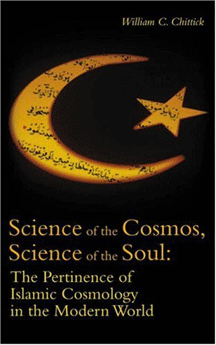
[In a recent and provocatively stimulating book. Bill Chittick examines the relevance of centuries of intellectual pursuit of Islamic cosmology for Muslims in the modern world. This is a fascinating book that is worth reading by Muslims and non-Muslims alike. It is a welcome relief from the constant drumbeat of Islam and politics. Order a copy today… Webshaykh.]

by William C. Chittick

It is commonly imagined that if our ancestors could be brought from the past in a time machine, they would be amazed and dumbfounded by the feats of modern science and civilization. But how would a Muslim intellectual of the past react to the modern world, and in particular to its intellectual ambiance? What would an al-Farabi, or an Avicenna, or a Mulla Sadra think of contemporary science and scholarship?

For the purpose of this experiment, I will borrow the name of our time-traveler from the famous philosophical novel of Ibn Tufayl, Hayy ibn Yaqzan, “Alive, son of Awake.” The name refers to the soul that has been reborn by actualizing the intellect. I will simply call him Ibn Yaqzan.

No doubt Ibn Yaqzan would be astonished by the ready availability of an enormous amount of information. However, he would be much more astonished by the fact that people have no idea that all this information is irrelevant to the goals of human life. He would see that people’s understanding of their true situation has decreased roughly in proportion to the amount of information they have gathered. The more “facts” they know, the less they grasp the significance of the facts and the nature of their own selves and the world around them. Continue reading A Timely Lesson from Ibn Yaqzan
A Secular State Must Deliver

by Mohammed Bamyeh, The Immanent Flame, SSRC Blogs, June 20, 2008

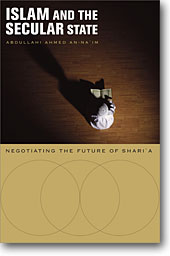
It is hard to disagree with the main arguments of Abdullahi an-Na’im’s impeccable book: a healthy religious life requires a secular state, even as political life may remain infused with the religious values of the population. And the historical examples provide added credence to the point. An Islamic state as such never existed historically, even though pre-modern states cannot be regarded as secular in the contemporary sense of the word. But there has never been a state in Islamic history that fused entirely religious and political authority after Muhammad, and it is far from obvious that Muhammad’s own Medina community constituted a state or was meant as a model for any state. All states in Islamic history had a more clearly defined political than religious character, even as they used religion for their purposes or were expected to fulfill some religious roles. In effect, they were political entities that survived to the extent that they accommodated themselves to the diversity (including legal diversity) of Islam and other local traditions. Colonial rule is to blame for rigidifying the sense of what Islam meant, namely by codifying diverse, flexible religious traditions into standard legal formats and ignoring the fluidity of communal boundaries between Muslims and non-Muslims. However, this rigid colonial perspective on the meaning of religiosity and identity was inherited by contemporary Islamic political movements and states claiming to be Islamic. Continue reading A Secular State Must Deliver

Despair Drives Suicide Attacks by Iraqi Women

By ALISSA J. RUBIN, The New York Times, July 5, 2008

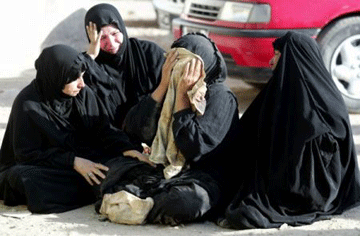
BAQUBA, Iraq — Wenza Ali Mutlaq walked a bit uncertainly up the long street near the main government offices here on June 22, the hot wind stirring her heavy black abaya. She passed the concrete barricades put up to ward off suicide car bombers and made her way alone, almost haphazardly.

Suddenly, a police car zoomed in. A policeman got out to talk with her. And then their lives were over — torn apart, along with 14 other people, by the huge blast of fire from her concealed explosive vest.

Ms. Mutlaq, who was in her 30s and whose attack was captured on a security video, was the 18th female suicide bomber of the war to strike in Diyala Province, which has been hit by female attackers much more frequently than any other province of Iraq, according to Iraqi police records and the American military. So far, 11 of the 20 suicide bombings carried out by women in Iraq this year have occurred in Diyala. Continue reading Despair Drives Suicide Attacks by Iraqi Women

Darfur Crisis


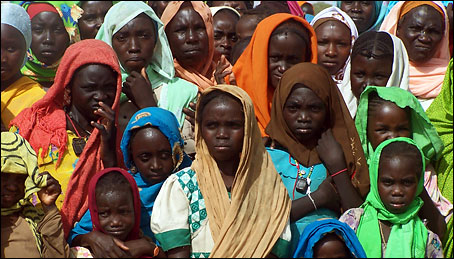
Freshly displaced Darfuris await the arrival of the UN relief coordinator Jan Egeland in the rebel held town of Gereida in southern Darfur, 07 May 2006.
AFP/Getty

The Washington Post has an informative and easy to use web presentation on the crisis in Darfur. Click here to start the tour.

Deoband first: A fatwa against terror

The Times of India, June 1, 2008

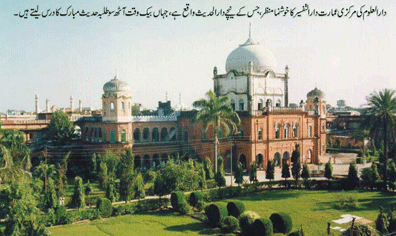
NEW DELHI: For the first time ever, Islamic seminary Darul-Uloom Deoband issued a fatwa against terrorism on Saturday, stating Islam had come to wipe out all kinds of terrorism and to spread the message of global peace. The Darul-Uloom had denounced terrorism for the first time in February, but had not issued a fatwa so far.

Saturday’s fatwa, signed by Darul-Uloom’s grand mufti Habibur Rehman, asserts that “Islam rejects all kinds of unjust violence, breach of peace, bloodshed, murder and plunder and does not allow it in any form”.

Citing the “sinister campaign” to malign “Islamic faith…by linking terrorism with Islam and distorting the meanings of Quranic Verses and Prophet traditions”, Mahmood Asad Madani, leader of Jamiat Ulema-e-Hind, had wanted Deoband to spell out the stand of Islam on world peace.

The fatwa, issued before a huge gathering of Muslims in Delhi’s Ramlila Ground for the Anti-Terrorism and Global Peace Conference, went on to say, “It is proved from clear guidelines provided in the Holy Quran that allegations of terrorism against a religion which preaches and guarantees world peace is nothing but a lie. The religion of Islam has come to wipe out all kinds of terrorism and to spread the message of global peace. Allah knows the best.” Continue reading Deoband first: A fatwa against terror

God is Green

“O Children of Adam: Beautify yourselves for every act of worship, and eat and drink [freely], but do not waste: truly, He loves not the wasteful.” (Qur’an: 7:31)

by Ayesha Mattu for Religion Dispatches, April 22, 2008

In Islamic tradition it is considered that humans were created as khalifas (trustees) of the earth and of its animal, mineral and plant resources. As caretakers, it is said, we may utilize these resources as long as we respect the balance that must be maintained in all aspects of our lives –spiritual, physical and mental.

There is extensive support for environmental protection in Islamic theology – from the Prophet Muhammad’s self-practice and repeated exhortations to plant trees or to not waste water, to the stern limitations on military engagement stating that civilians, animals, trees and water sources were not to be harmed. And this theology was regularly put into official practice over the centuries. As American Muslim scholar Zaid Shakir has said: “The protection of natural habitat, the well-being of animals, and related responsibilities were often overseen by appointed officials, members of the world’s first environmental protection agencies.”

Dr. Derek Wall of the UK’s Green Party has remarked (in an article for the UK’s Guardian titled “Green Islam”) that contemporary Muslim scholars like George Washington University’s Seyyed Hossein Nasr have been advocating Islamic environmentalism since the 1970s while Swiss academic Tariq Ramadan has been evolving a thoughtful understanding of “spiritual ecology”.

Some might say, rightly, that our green legacy has been forgotten as the race to industrialization has created environmental devastation and dead zones in more- and less-developed countries alike. Some may even suspect the environmental movement of being another Western initiative to impede the progress of Muslim nations. In spite of this, we are beginning to see Muslim community-based organizations in the global North and non-governmental organizations in the global South reviving these deep-rooted green practices in a manner informed both by modern realities and Islamic principles.

For the rest of this article, click here.

Human rights violations in the name of religion

by Wazhma Frogh, from Persian Mirror

As the world is witness of Afghanistan stepping into development and rehabilitation phase, but experiences have revealed that no country can ever develop without a sound base for human rights issues. Afghans are suffering from a very harsh situation and human values are worthless in many parts of the region. As I am a researcher on women issues in Afghanistan and I travel frequently to different parts of the region to find out the living circumstances of women.

Some three months before I has a visit to an eastern south province of Afghanistan and observed the situation of women and children, their rights have been massacred entirely under the shadow of ignorance those who call themselves Muslims. In this province, in every 10 families , 9 of them have sold their daughters at a value equivalent to 300 US $. Continue reading Human rights violations in the name of religion

Who’s a Muslim Heretic?


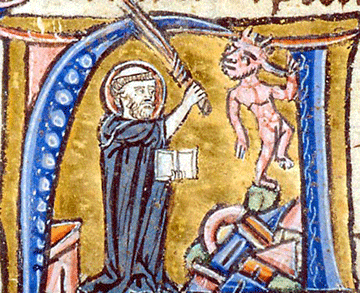
“Augustine of Hippo Refuting Heretic,” (Illuminated manuscript, thirteenth century, from Morgan Library, New York, M. 92, ©Morgan Library)

The history of Islam, like that of any religion, is littered with heretics. When you start with a divine revelation, revealed only in an Arabic dialect understandable to a seventh century illiterate Prophet alone in a cave with an archangel, add a cult of personality adoration for this Prophet and then acknowledge a cycle of violence and assassinations within the emerging Muslim community, heresy is inevitable. So who were the heretics over the fourteen centuries of the Islamic ummah? In a sense, everybody. Certainly every single sect calling itself Muslim has been attacked by some other sect. It is not just the majority Sunni vs. the marginalized Shi’a, nor the rational Mutazilites vs. the hardline literalists, nor the Arabs vs. the non-Arab converts, nor the trained clerics vs. the itinerant dervishes, nor simply the women-can’t drive Wahhabis of Saudi Arabia, the Buddha-bashing Taliban or those brave souls who pursue Queer Jihad. Simply put, the heretic is the person who does not take your truth as his or her own. Continue reading Who’s a Muslim Heretic?