Category Archives: Ethics

Reduced to a four-letter word


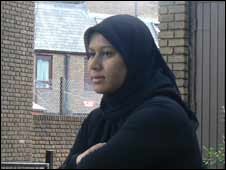
Tamanna Rahman: Even at home in Manchester, Tamanna is now wary of attacks

Tamanna Rahman spent two months living on a Bristol housing estate for the BBC’s Panorama programme Undercover: Hate on the Doorstep.

Here she explains her reasons for agreeing to take part in the programme and describes how it felt to be a daily target of racist abuse, both physical and verbal. Her report contains details of racial abuse.

by Tamanna Rahman, BBC Panorama, October 19, 2009

In 2000, as a 16-year-old at my culturally and racially diverse Manchester secondary school, I was asked by a local television news team examining the hopes and aspirations of the first class of the new millennium if I felt that racism in Britain was a thing of the past.

Fresh-faced, naïve and optimistic, I answered yes; racism is dead.

Fast-forward to the summer of 2009 and my answer is very different.

What changed? As part of a Panorama programme, I spent two months working undercover on a Bristol housing estate.

Over the course of our investigation I would have glass, a can, a bottle and stones thrown at me. Continue reading Reduced to a four-letter word
Sex, flies and videotape: the secret lives of Harun Yahya

by Halil Arda, The New Humanist, Volume 124, Issue 5, September/October 2009

Inspired by the high profile of its Christian American counterpart, Muslim creationism is becoming increasingly visible and confident. On scores of websites and in dozens of books with titles like The Evolution Deceit and The Dark Face of Darwinism, a new and well-funded version of evolution-denialism, carefully calibrated to exploit the current fashion for religiously inspired attacks on scientific orthodoxy and “militant” atheism, seems to have found its voice. In a recent interview with The Times Richard Dawkins himself recognises the impact of this new phenomenon: “There has been a sharp upturn in hostility to teaching evolution in the classroom and it’s mostly coming from Islamic students.”

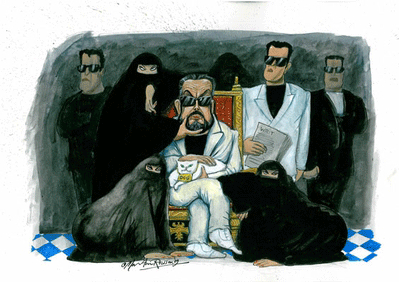
The patron saint of this new movement, the ubiquitous “expert” cited and referenced by those eager to demonstrate the superiority of “Koranic science” over “the evolution lie”, is the larger-than-life figure of Harun Yahya. Continue reading Sex, flies and videotape: the secret lives of Harun Yahya

Acid Pain


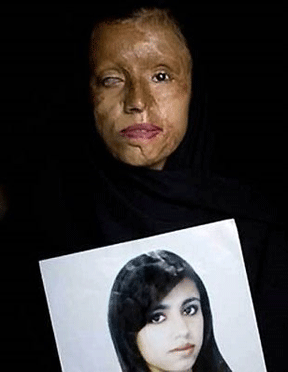
Twenty six year old Saira Liaqat poses for the camera, while holding a picture of her former self before her betrothed doused her face with acid.


Scarred by acid in Bangladesh

By Nicolas Haque in Dhaka, Bangladesh, Al-Jazeera, July 11, 2009

Rahima Begum, a young woman in the village of Kaligonj in the northwest of Bangladesh, turned down the romantic advances of a neighbour and paid dearly for it.

In the dead of night, while she was asleep, her neighbour poured acid over her face, leaving her disfigured for life.

“I may be still alive but he took my life away, I have become the shame of my family and of my village. I have no where to go,” she says.

According to official figures, there are only around 200 acid-related crimes reported every year in Bangladesh. Continue reading Acid Pain

Rape and Shariah Law

HOW SHARIA LAW PUNISHES RAPED WOMEN

by Hasan Mahmud, Mudugnet.com, November 20, 2008.

On October 30, 2008, the United Nations condemned the stoning to death of Aisha Duhulow, a 13-year-old girl who had been gang-raped and then sentenced to death by a Sharia court for fornication (Zina). She was screaming and begging for mercy, but when some family members attempted to intervene, shots were fired by the Islamic militia and a baby was killed.

Local Sharia courts in Bangladesh regularly punish raped minor girls and women by flogging and beating them with shoes.[1] Similar cases of punishing raped women are Mina v. the State, Bibi v. the State and Bahadur v. the State.[2] Sharia courts in Pakistan have punished thousands of raped women by long term imprisonment.[3]

You might think that such horrific barbarity cannot be the real Sharia law; that it is a misapplication of the law by ignorant clergy. Sadly, neither is true. Continue reading Rape and Shariah Law

Islam gets a Saudi facelift

Under the Veil, Nip and Tuck Makes New Saudi Faces

Asharq Alawsat, March 8, 2009

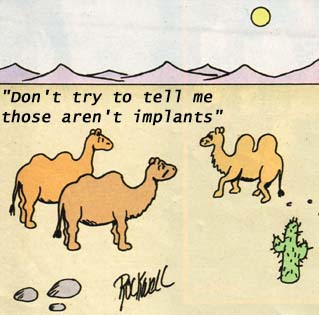
RIYADH, Saudi Arabia, (AP) — Does Islam frown on nose jobs? Chemical peels? How about breast implants?

One of the clerics with the answers is Sheik Mohammed al-Nujaimi, and Saudi women flock to him for guidance about going under the knife. The results may not see much light of day in a kingdom where women cover up from head to toe, yet cosmetic surgery is booming.

Religion covers every facet of life in Saudi Arabia, including plastic surgery. Al-Nujaimi draws his guidelines from the consensus that was reached three years ago when clergymen and plastic surgeons met in Riyadh to determine whether cosmetic procedures violate the Islamic tenet against tampering God’s creation. Continue reading Islam gets a Saudi facelift

Hashish in the Muslim World

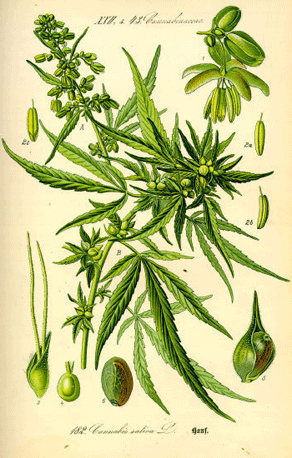
Webshaykh’s note: In the process of researching the medical aspects of the chewing of qât (Catha edulis) leaves in Yemen, I consulted an important study published almost forty years by the distinguished historian Orientalist (in the best sense — and there is a best sense — of the word) Franz Rosenthal. This was his The Herb: Hashish versus Medieval Muslim Society (Leiden: Brill, 1971). Appearing at a time when hashish had become a household word in America, Rosenthal sorts through legal, medical and literary sources to provide a historical overview of the issues surrounding the use of hashish, the plant known as qinnab in Arabic (Cannabis sp). This is a valuable resource, but also worth a good read to get a sense of how an addictive socially popular drug was viewed for almost the last full millennium. Fortunately for those of us who cannot afford massive libraries, this book is available as a Google Book online. I quote from the conclusion.]

Hashish, the Individual, and Society

In conclusion we must state again that our knowledge is very limited. The gaps are tremendous. The nature of the information we do have is not easily assessed. Its applicability to the realities prevailing over the immense extension in time and space of medieval Islam is often suspect. Partisanship pro or con, coupled with a seemingly widespread ignorance of hard facts, obscures everything. Statistics naturally are non-existent.

Our sources give the impression of a westward march of hashish that had its serious beginnings int he twelfth century and gathered speed during the thirteenth century. Continue reading Hashish in the Muslim World

A Stink Bomb in Georgia

GSU Professor Resigns over “Bomb” Comments to Muslim-American Student

Atlanta, Georgia – July 1, 2009 – The Director of the Middle East Institute at Georgia State University, Dona J. Stewart, has resigned citing the university’s failure to address incidents of anti-Muslim bias.

In August 2008 a Muslim-American doctoral student, Ms. Slma Shelbayah, was repeatedly asked by a senior faculty member, Dr. Mary Stuckey, if she was ‘carrying any bombs’ underneath her Islamic headscarf, or hijab. Ms Shelbayah was also employed as a Visiting Instructor of Arabic in the Middle East Institute. She holds Bachelor and Masters degrees from Georgia State University.

Dr. Stewart’s resignation cited retaliatory actions taken by the Dean of the College of Arts and Sciences, Dr. Lauren Adamson, following Ms. Shelbayah’s request that the incidents cease. Continue reading A Stink Bomb in Georgia

Islam and the Power of Kindness

[Note: The following excerpt by a Muslim intellectual is perhaps the best antidote for the ongoing violence of mosque bombings, Taliban and Basij brutality towards Muslim women and vitriolic sermons.]

Islamic Perspectives of Inter-Community Relations

by Maulvi Yahya Nomani (Translated from Urdu by Yoginder Sikand) TwoCircles.net

The issue of what Islam has to say about inter-community relations is one about which much misunderstanding exists. Anti-Muslim propagandists claim that Islam preaches hatred for non-Muslims, and that the Quran is a menace to world peace. They go so far as to argue that world peace is simply impossible as long as the Quran exists. In order to back their propaganda, they have deliberately twisted and misinterpreted certain verses of the Quran. Many people with little knowledge have fallen prey to this poisonous propaganda, which has been aggressively spread on an enormous scale through the media. Continue reading Islam and the Power of Kindness