Category Archives: Ethics

Jihad for Jesus?

Those Americans who feel compelled to rewrite our collective history as the emergence of an avowedly Christian nation are fond of quoting scripture. Take the seemingly noble sentiment in John 15:13, where Jesus said, “Greater love hath no man than this, that a man lay down his life for his friends.” I say “seemingly noble” because even the Devil is good at quoting scripture. Consider the fringe Christian apocalyptic group called the Hutaree; there this motto blazes their website just above the image shown above. Yesterday, the U.S. Attorney General announced the arrests of nine individuals accused of “plotting to kill law enforcement officers in hopes of inciting an antigovernment uprising, the latest in a recent surge in right-wing militia activity,” as the New York Times reports. The plan is right out of what is often called the Al-Qaeda playbook, one played out in Pakistan, Iraq and Afghanistan on almost a daily basis: kill a police officer and then when there is a funeral procession, set off an i.e.d. Were these Muslim extremists, the word “jihad” would be on every television newscast. But, no, these are individuals who claim to be following a commandment of Christ. So why not face the fact that rhetorically it is possible to jihad for Jesus?

Speaking of those who believe in a literal Devil and do not recognize they are doing his work, earlier today I happened to be leafing through The Devil’s Dictionary by the Ohio-born American journalist Ambrose Bierce. Here is what Bierce had to say a century ago about the real-world definition of “Scriptures”:

“The sacred books of our holy religion, as distinguished from the false and profane writings on which all other faiths are based.”

Continue reading Jihad for Jesus?

What do Pakistanis want?

Secularism vs Islamism

By Iqbal Akhund, Dawn.com, 22 Feb, 2010

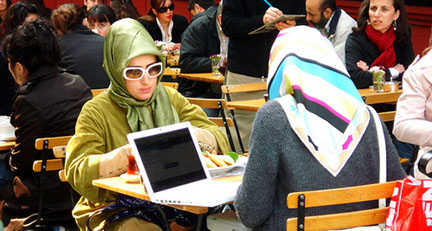
In a recent TV debate on this subject, the applause meter would have given the win to Islamism. The debaters, three on each side, faced a small mixed audience — quite a few girls, many wearing hijabs, also young men in jeans and a handful of beards.

The ‘secularists’ appealed, in measured tones, to the intellect, made references to European history, called for tolerance, pluralism and progress. The ‘Islamists’ were assertive, emotional and received applause when they spoke of the ‘moral decadence’ of the West and condemned, to louder applause, the West’s aggression against Muslims in Palestine, Chechnya and Iraq.

So do the people of Pakistan want an Islamist state? Well, yes and no. Continue reading What do Pakistanis want?

Smashing the Silence Around FGM


Mona Eltahawy

by Mona Eltahawy, The Huffington Post, February 9, 2010

Imagine if 3 million boys had their penises cut off every year.

Imagine that despite accounts of the unfathomable pain boys endure to ensure chastity and passage into manhood, religious leaders for decades taught their communities that God had decreed such mutilation.

A world tongue-tied by cultural relativism says nothing.

Sounds absurd, doesn’t it?

It’s a painful reality for at least 3 million girls who each year have parts or all of their clitorises cut off in a procedure known as female genital mutilation (FGM). The clitoris has double the nerve endings of a penis so my analogy to chopping off little boys’ organs isn’t too far off.

This past weekend marked International Day of Zero Tolerance of FGM, so allow me to shake you out of oblivion by reminding you that 6,000 girls a day are subjected to one of four types of FGM. Continue reading Smashing the Silence Around FGM

Broken Taboos in Post-Election Iran

by Ziba Mir-Hosseini, Middle East Report Online, December 17, 2009

The on-camera martyrdom of Neda Agha-Soltan, the 26-year old philosophy student shot dead during the protests after the fraudulent presidential election in Iran in June, caught the imagination of the world. But the post-election crackdown has two other victims whose fates better capture the radical shift in the country’s political culture. One victim was the protester Taraneh Mousavi, detained, reportedly raped and murdered in prison, and her body burned and discarded. The other is Majid Tavakoli, the student leader arrested on December 8, after a fiery speech denouncing dictatorship during the demonstrations on National Student Day.

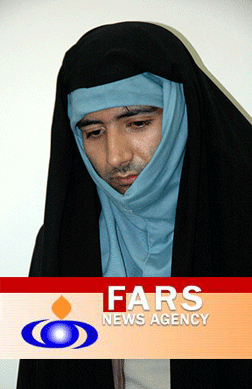
Following his arrest, pro-government news agencies claimed Tavakoli had been caught trying to escape dressed as a woman and published a series of photographs showing him wearing a headscarf and chador — a common version of the “modest” garb (hejab) mandated for women by the Islamic Republic. Attempts at flight in such gender-bending disguises are a classic trope in Iranian political history. The best-known instance was when the first president of the Islamic Republic, Abol-Hasan Bani-Sadr, after his deposition in 1981, allegedly fled the country in women’s dress — the Fars News Agency put a photo of him in a scarf next to that of Tavakoli. But in pre-revolutionary Iran clerics, too, such as Ayatollah Bayat, are said to have evaded the Shah’s authorities by concealing themselves beneath chadors, which pro-government media outlets now choose to ignore. Continue reading Broken Taboos in Post-Election Iran

More than just (a) war


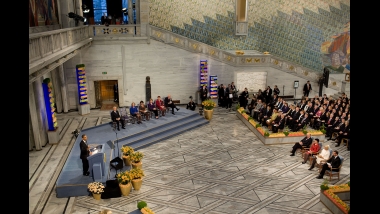
President Obama speaking to the Nobel Prize Committee

As the season has arrived in which “Peace on Earth” fills the airwaves and resonates from church choirs, the recent choice of President Obama for the Nobel Peace Prize becomes ironic as well as iconic. The icon is obvious, as no president since John F. Kennedy has elicited such fanfare at his entry into office. As the chairman of the Nobel committee, Thorbjorn Jagland, introduced President Obama, it was clear that in part the real choice was the man who pledged to reverse the isolationist and publicly entrenched private sectoring of George W. Bush. Had our previous president not been the bearer of two made-for-Hollywood wars in the guise of a nebulous “War on Terror,” Obama would have had to wait his turn. The irony is manifold. American dissatisfaction with the costly war in Iraq led to a political surge for the Democrats for a change; the man who pledged to end the war mongering is still saddled with the two wars he did not start. On the home front, the financial tsunami he inherited now tarnishes virtually every attempt to pull the economy out of its cross-the-boards harm from the combustable engine of Wall Street to the reckless drivers on Main Street.

The liberals and centrists who voted to give hope a chance have all too soon decided not to give it much of a chance. Those who actually prefer to call themselves liberals no doubt hoped that Obama was just politicking when he touted centrist positions to secure some of those Red State votes. But the man from Illinois, who kicked off his run with the symbolic capital of an earlier president-to-be from Illinois, is decidedly centrist, the mad ravings of vanity pouting Glenn Beck and publicity whoring Sarah Palin notwithstanding. If you want to probe the postmodern meaning of irony, just listen to what President Obama said about war in being honored as a man of peace: Continue reading More than just (a) war

Amir Hussain at Fordham

Loyola Marymount Professor Amir Hussain will be responding to the inaugural lecture of Rev. Patrick J. Ryan at Fordham this coming Thursday. Details below for all those in the New York Metropolitan area.

Annual Fall McGinley Lecture: “Faith and the Possibility of Jewish-Christian-Muslim Trialogue”

Inaugural lecture of Rev. Patrick J. Ryan, S.J., as Fordham’s Laurence J. McGinley Professor of Religion and Society.

Thursday, 19 November 2009 | 8 p.m.
Keating First Auditorium | Rose Hill Campus

The inaugural lecture of Rev. Patrick J. Ryan, S.J., as Fordham’s Laurence J. McGinley Professor of Religion and Society, is titled “Faith and the Possibility of Jewish-Christian-Muslim Trialogue.” The lecture will be followed by responses by Professor Amir Hussain of Loyola Marymount University in Los Angeles and Rabbi Daniel F. Polish, spiritual leader of Congregation Shir Chadash in Poughkeepsie, New York. A reception will follow the lecture, which is open to the public without charge.

For more information, contact Sister Anne-Marie Kirmse, O.P., Ph.D., at (718) 817-4746 or kirmse@fordham.edu.

Contesting Islamism

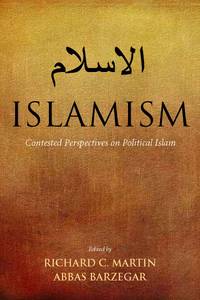
Stanford University Press has just published Islamism: Contested Perspectives on Political Islam, edited by Richard C. Martin and Abbas Barzegar. In this book Political Scientist Donald Emmerson argues for an inclusive use of the term “Islamism” in order to rescue the term from its misappropriation in the media. This is followed by my essay, in which I argue that the term “Islamism” is as tainted as “Mohammedanism” and should be avoided as a replacement for fundamentalist and political Islam. Our two essays are followed by twelve short responses from a variety of perspectives, Muslim and non-Muslim. The contributors include Feisal Abdul Rauf, Syed Farid Alatas, Hillel Fradkin, Graham Fuller, Hasan Hanafi, Amir Hussain, Ziba Mir-Hosseini and Richard Tapper, M. Zuhdi Jasser, Bruce Lawrence, Anouar Majid, Angel Rebasa and Nadia Yassine. Given the range of perspectives on one of the hot topics of the day, this volume will be a great addition to courses on Islam or the Middle East.

The publisher’s description is presented below: Continue reading Contesting Islamism

Islam, Sufism and the Heart of Compassion


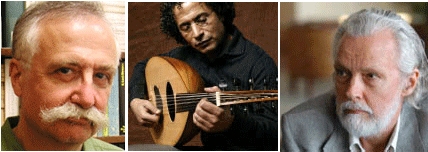
left to right: Michael Sells, John Henry Barrows Professor of Islamic History and Literature in the Divinity School at the University of Chicago; Taoufiq Ben Amor,a Tunisian vocalist, percussionist, oud player and Professor of Arabic at Columbia University; William C. Chittick, Professor of Religious Studies in the Asian and Asian American Studies Dept. at Stony Brook


Islam, Sufism and the Heart of Compassion: Living the Teachings of Muhyiddin Ibn ‘Arabi

The New York Open Center and the Muhyiddin Ibn ‘Arabi Society will co-present a conference titled “Islam, Sufism and the Heart of Compassion: Living the Teachings of Muhyiddin Ibn ‘Arabi” on November 6,7, 2009

This conference will examine the heart of Ibn ‘Arabi’s teachings and in the process seek to deepen understanding of Islam here in the West in the light of one of its most profound, original and universally relevant thinkers.The conference will open with a series of talks on Friday evening and Saturday morning and will be followed by afternoon workshops, ending with a concluding presentation including a music ensemble. The presentations will cover such themes as: Ibn ’Arabi and the Quest for Human Perfection; Suffering and Spiritual Growth in Ibn ‘Arabi’s Futuhat; The Wisdom of the Heart; Ibn ‘Arabi in Dialogue with the Confucian Tradition; and more. The presenters include some of the leading Ibn ‘Arabi scholars in the world from the U.S., Europe and the Middle East. Confirmed speakers include:

• Salman Bashier
• William Chittick
• Sashiko Murata
• Mohamed Haj Yousef
• Stephen Hirtenstein

You can download the symposium brochure here. (This is an Acrobat pdf file, 3.5mb.) Continue reading Islam, Sufism and the Heart of Compassion