Category Archives: Ethics

Fallujah Fallout


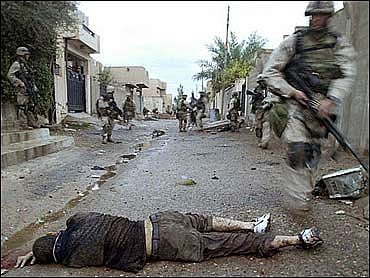
Genetic damage and health in Fallujah Iraq worse than Hiroshima

Brussels Tribunal, Press release
July 2, 2010

Results of a population-based epidemiological study organized by Malak Hamdan* and Chris Busby are published on 03 July 2010 in the International Journal of Environmental Studies and Public Health (IJERPH) based in Basle, Switzerland. They show increases in cancer, leukemia and infant mortality and perturbations of the normal human population birth sex ratio significantly greater than those reported for the survivors of the A-Bombs at Hiroshima and Nagasaki in 1945.

Results of a survey in Jan/Feb 2010 of 711 houses and more than 4000 individuals in Fallujah show that in the five years following the 2004 attacks by USA-led forces there has been a 4-fold increase in all cancer. Interestingly, the spectrum of cancer is similar to that in the Hiroshima survivors who were exposed to ionizing radiation from the bomb and uranium in the fallout. By comparing the sample population rates to the cancer rates in Egypt and Jordan, researchers found there has been a 38-fold increase in leukemia (20 cases) almost a 10-fold increase in female breast cancer (12 cases) and significant increases in lymphoma and brain tumours in adults. Continue reading Fallujah Fallout
Divorcing fundamentalism


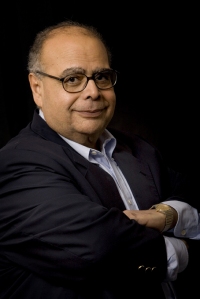
Nasr Abu Zaid was a brave and honest scholar disgracefully persecuted for his attempts to read the Quran historically

by Brian Whitaker, The Guardian, July 6

The divorce case was what made him famous, though it wasn’t the usual kind of celebrity divorce and Nasr Abu Zayd was still in love with his wife.

Abu Zayd, the liberal Muslim thinker who died yesterday, first came to the attention of Islamists while teaching Arabic literature at Cairo university in the early 1990s. They decided that his research contained “clear affronts to the Islamic faith” and accused him of apostasy.

That in turn inspired a group of Islamist lawyers to file a third-party (“hesba”) case, seeking to divorce him from his wife on the grounds that a Muslim woman cannot be married to an apostate – and after a series of court hearings his marriage was declared null and void.

Such was the controversy after the verdict that Cairo university was “turned into a military fortress” to protect him the next time he made an appearance there. Realising that it was impractical to continue teaching under those conditions, and after one of his guards was heard describing him as “the infidel”, Abu Zayd and his “ex-wife” left Egypt and settled in the Netherlands. Continue reading Divorcing fundamentalism

From Islamist Watch to Islamic Mimbar: The Politics of Hypocrisy


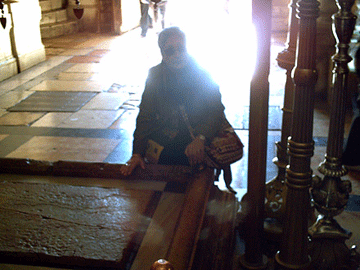
Raheel Raza at the Church of the Holy Sepulchre in Bethlehem

by Huma Dar, Dept. of South and Southeast Asian Studies, University of California at Berkeley

On Thursday, June 10, 2010, Jerome Taylor, the Religious Affairs Correspondent of The Independent posted an article headlined, “First Woman to Lead Friday Prayers in UK.” Two-thirds of the way down this article, we find that:

“Ms Raza’s appearance in Oxford is a repeat of a similar prayer session in 2008 which was led by Amina Wadud, an American-born convert and Muslim feminist. But this is the first time a Muslim-born woman will lead a mixed prayer service in Britain.”

Taylor’s differentiation between “American-born convert” and “Muslim-born woman” and labeling of the latter as the “first woman” in the headline create a false hierarchy and subtly delegitimize Dr. Wadud, a leading Muslim scholar and author of Qur’an and Woman: Rereading the Sacred Text from a Woman’s Perspective, a path-breaking text in the study of gender and Islam. Taylor’s late admission of “repeat” after the (mis)leading announcement of “First” in the headline does not quite cover up for the critical sins of omission and commission, especially as Raheel Raza, the Pakistani-Canadian woman leading the prayer at Oxford, is neither an ‘Alima or a scholar of Islam nor is she known for her advocacy of Muslims at large.

In fact Raza is a rather polarizing figure amongst Muslims in North America and her record does not indicate much learning in the letter or spirit of Islam, as in speaking truth to power and standing with the oppressed. Continue reading From Islamist Watch to Islamic Mimbar: The Politics of Hypocrisy

Satire is Religion


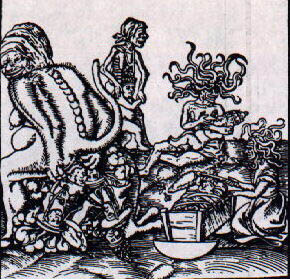
Birth and Origin of the Pope by Lucas Cranach, illustration for Martin Luther’s “Against the Papacy at Rome, Founded by the Devil,” 1545

Satire is Religion

By Austin Dacey, Religion Dispatches, May 12

Scatological humor. Crude drawings mocking revered religious figures. I am speaking, of course, of Lucas Cranach’s Birth and Origin of the Pope [image above], one in a series of woodcuts commissioned by Martin Luther in the 1540s under the title “The True Depiction of the Papacy.” In it, an enormous grinning she-devil squats in the foreground, excreting the Pope along with a heap of bishops while in the background another infant pontiff suckles at the teat of a serpent-haired wet nurse.

Forget the South Park dust up; forget Everybody Draw Muhammad Day. If you want to see truly shocking anti-religious cartoons, you have to go back to the sixteenth century. Near the end of Luther’s life, his propaganda campaign against Rome grew increasingly vitriolic and his language grotesquely pungent. He took to calling his ecclesiastical enemies ‘asses,’ ‘dogs,’ ‘pigs,’ ‘blockheads,’ ‘basilisks,’ and ‘pupils of Satan,’ and the Pope himself ‘Her Sodomitical Hellishness’ and ‘fart-ass’ (no, it doesn’t sound much more dignified in German—fartz-Esel). Eric Cartman would be in awe. Continue reading Satire is Religion

Islam and Feminism


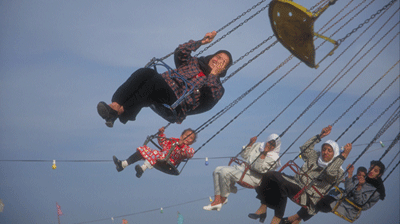
Photograph by Tom Hartwell

Islam and Feminism

by Hania Sholkamy, Contestations, Issue #1

Islam and feminism have had a troubled relationship. Over the last two decades, scholars and activists have questioned the western credentials of feminism and claimed justice as a purpose and possibility that can be captured via religious routes. Religion provides women with an ethical framework and a moral foundation that recognizes their rights as individuals and as a collective, albeit redefining equality in the process. The mosque movement in Egypt has empowered women to find dignity, companionship and comfort through piety and conformity to a religious ideal and challenge the less-than-perfect world around them. Moreover by engaging with religion, Muslim women are able to redefine the tenets that have endowed Islam with an unnecessary bias for men; one which feminist scholars of Islam are certain is antithetical to the spirit and philosophy of our religion.

Such serious engagements are, however, quite separate and distinct from the popularization of religion as a veneer that enables anyone to get away with anything! Continue reading Islam and Feminism

Hate, Times Squared


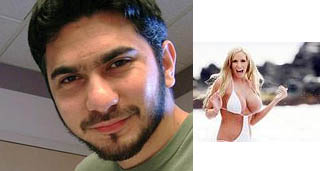
Photos juxtaposed on May 6 by the New York Post, tabloid journalism at its most blatant

Faisal Shahzad, not your typical terrorist: unless you think being a Pakistani Muslim makes you a typical terrorist. Anyone reading yesterday’s New York Post (Wednesday, May 5) and taking the blustered and bloated tabloid rhetoric seriously could easily make such an assumption. I do not, as a rule, read tabloids, although seeing what many others do read is a useful reality check from time to time. But on the train home from Manhattan yesterday there was a crumpled up newspaper under the train seat and at least 45 minutes to unwind. The cover was, for a change, not a pun. It might be called a revelation, as it read: “REVEALED: WHY HE DID IT. EXCLUSIVE. Revenge for US drone attacks on Taliban terrorists.” Six pages (and more) were devoted to the story, although there was little that I found exclusive in the shoddy news reporting and vengeful commentary by the tabloid’s stalking heads.

Let’s start with the cover and what the tabloid pictures for us. Continue reading Hate, Times Squared

The Baraka 500

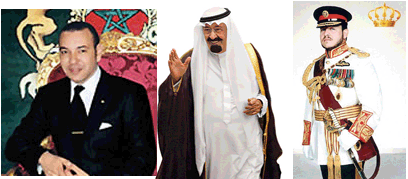
Every good capitalist knows about the Fortune 500, the annual ranking of the top grossing corporations in the United States. Now Muslims who read English have their own ranking of the top 500 most influential Muslims. The Royal Islamic Strategic Studies Center in Amman and Prince Alwaleed Bin Talal Center for Muslim-Christian Understanding have jointly issued a new book, edited by John Esposito and Ibrahim Kalin of Georgetown University. This is scheduled as the first in an annual series that will provide short biographies of prominent Muslims in a variety of fields. According to the editors, the aim is to “highlight people who are influential as Muslims, that is, people whose influence is derived from their practice of Islam or from the fact that they are Muslim.” So who tops the list?

As fortune would have it, this effort should probably be dubbed the Baraka 500, but more for the politics of the sponsors than the demonstrated holiness of the individuals. Deciding who are the influential individuals that happen to be Muslim is no easy task, especially considering that most Muslims have not been consulted in the process. So before you read any further, jot down who you think are the top ten Muslims in the world. I suspect that you will not duplicate the “official” list provided by Esposito and Kalin for their Saudi and Jordanian sponsors. Continue reading The Baraka 500

May you never be uncovered


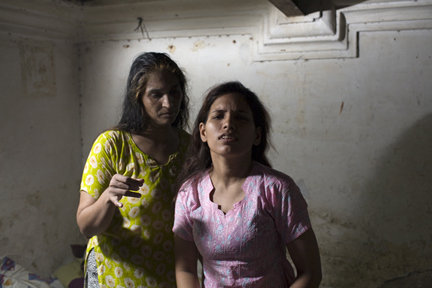
Photograph in a brothel in Pakistan by Kate Orne

Prostitution in Pakistan? Yes it exists, despite the most dire consequences if discovered. Photographer Kate Orne has been documenting the underworld of Pakistani prostitution since 2005 and has formed a website to bring attention to the plight of these women. Prints can be purchased at the website with benefits going to two schools for children and a clinic. Check out the presentation and gallery at http://www.mayyouneverbeuncovered.org/