Category Archives: Ethics

The Arab Spring

By Rashid Khalidi, The Nation, March 21, 2011 and Institute for Palestine Studies, March 3, 2011

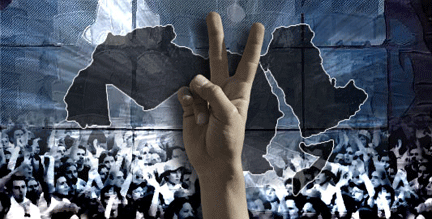
Suddenly, to be an Arab has become a good thing. People all over the Arab world feel a sense of pride in shaking off decades of cowed passivity under dictatorships that ruled with no deference to popular wishes. And it has become respectable in the West as well. Egypt is now thought of as an exciting and progressive place; its people’s expressions of solidarity are welcomed by demonstrators in Madison, Wisconsin; and its bright young activists are seen as models for a new kind of twenty-first-century mobilization. Events in the Arab world are being covered by the Western media more extensively than ever before and are being talked about positively in a fashion that is unprecedented. Before, when anything Muslim or Middle Eastern or Arab was reported on, it was almost always with a heavy negative connotation. Now, during this Arab spring, this has ceased to be the case. An area that was a byword for political stagnation is witnessing a rapid transformation that has caught the attention of the world.

Three things should be said about this sea change in perceptions about Arabs, Muslims and Middle Easterners. The first is that it shows how superficial, and how false, were most Western media images of this region. Virtually all we heard about were the ubiquitous terrorists, the omnipresent bearded radicals and their veiled companions trying to impose Sharia and the corrupt, brutal despots who were the only option for control of such undesirables. In US government-speak, faithfully repeated by the mainstream media, most of that corruption and brutality was airbrushed out through the use of mendacious terms like “moderates” (i.e., those who do and say what we want). That locution, and the one used to denigrate the people of the region, “the Arab street,” should now be permanently retired. The second feature of this shift in perceptions is that it is very fragile. Even if all the Arab despots are overthrown, there is an enormous investment in the “us versus them” view of the region. This includes not only entire bureaucratic empires engaged in fighting the “war on terror,” not only the industries that supply this war and the battalions of contractors and consultants so generously rewarded for their services in it; it also includes a large ideological archipelago of faux expertise, with vast shoals of “terrorologists” deeply committed to propagating this caricature of the Middle East. These talking heads who pass for experts have ceaselessly affirmed that terrorists and Islamists are the only thing to look for or see. They are the ones who systematically taught Americans not to see the real Arab world: the unions, those with a commitment to the rule of law, the tech-savvy young people, the feminists, the artists and intellectuals, those with a reasonable knowledge of Western culture and values, the ordinary people who simply want decent opportunities and a voice in how they are governed. The “experts” taught us instead that this was a fanatical people, a people without dignity, a people that deserved its terrible American-supported rulers. Those with power and influence who hold these borderline-racist views are not going to change them quickly, if at all: for proof, one needs only a brief exposure to the sewer that is Fox News. Continue reading The Arab Spring

Guns don’t kill, neither do guns die


For the past week the American media has been fixated on an act of violence that has left six dead and wounded fourteen, including Arizona representative Gabrielle Giffords. Last night President Obama, in a stirring and emotional speech at a memorial service for the victims, urged Americans not to use this tragedy as a staging ground for the usual politics of blame:

But what we can’t do is use this tragedy as one more occasion to turn on one another. As we discuss these issues, let each of us do so with a good dose of humility. Rather than pointing fingers or assigning blame, let us use this occasion to expand our moral imaginations, to listen to each other more carefully, to sharpen our instincts for empathy, and remind ourselves of all the ways our hopes and dreams are bound together.

Beneath the brief aura of civility in this tragedy’s aftermath there lingers an ongoing current of uncivil rhetoric, fueled in large part by media pundits eager to gain an audience. The blame has already been assigned over and over again. In this particular case it appears that the killer, Jared Lee Loughner, was an emotionally disturbed individual who acted on his own. Thus, it is no surprise that a Tea Party icon like Kentucky’s newly elected senator Rand Paul would go on Fox News and remind us all: “But the weapons don’t kill people. It’s the individual that killed these people.”

It certainly is true that the Glock 9 mm pistol did not go off on its own, so obviously there is no need to punish the gun involved in this case, nor even the bullets used. The problem is that if we claim that guns don’t kill, we must also admit that guns don’t die either. Continue reading Guns don’t kill, neither do guns die

Ablution Pollution


A report in yesterday’s Los Angeles Times is a chilling reminder of the utter absurdity of out-of-control sectarian violence in Afghanistan.

Reporting from Kabul, Afghanistan —
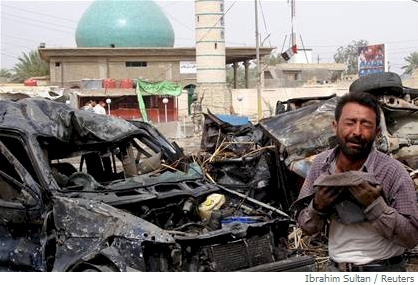
A suicide bomber blew himself up Friday at a public bathhouse in southern Afghanistan that was filled with men washing themselves before the main prayers of the Muslim week. At least 17 were killed and 23 injured, provincial officials said.

The Taliban claimed responsibility for the attack in Spin Boldak, in Kandahar province. The district, a main crossing point to and from Pakistan, is a longtime nexus of drug and weapons smuggling. Continue reading Ablution Pollution

Grease-Monkeys and Bedouin Girls


Grease-Monkeys and Bedouin Girls: The Rhetorical Fate of Arabs and Muslims in Nadine Gordimer’s The Pickup.
By Daniel Martin Varisco, Tingis Redux, December 11, 2010

Novels tell Stories, allowing readers to fantasize about reality but with no obligation to represent that reality as anything other than fantasy. Good novels, at least the kind that garner a Nobel prize for their author, capture the imagination through creative engagement and style. The South African author Nadine Gordimer has been writing about the shame of apartheid in her native land for more than half a century. Her focus on the moral and psychological tensions of racial inequality provides a welcome political stamp to her fiction. Yet, sometimes in telling one kind of story, especially teasing out the relationships of lovers across cultural boundaries, another story can be read between the lines. The Pickup, Gordimer’s acclaimed novel which pairs a privileged South African white girl named Julie with an Arab Muslim and illegal alien named Abdu, traces an unlikely love story but leaves the identity of Abdu literarily in the dust, the dust of a stereotyped Orientalist denigration of his homeland and his religion. One need not follow Edward Said’s controversial contrapuntal reading to find in this novel a generic image of Arab and Muslim that serves the plot only in its unrelenting negative portrayal. The Pickup, whatever its merits as a close study of personal dislocation, succeeds by picking on distorted images of Arab and Muslim.

For the rest of this essay, read it on Tingis Redux.

Islam and the Goal of Love


Islam and the Goal of Love

by William C. Chittick, The Huffington Post, November 6, 2010 08:20 PM

Muslim scholars who claimed that Islam specifically and religion generally are based on love were not simply talking through their hats, as many readers of my previous post seem to think. They offered plenty of evidence. In order to see its logic, however, we need to remember the two axioms upon which all Islamic thought is built: the reality of God and the messengerhood of Muhammad.

The first axiom does not depend on the Quran. It needs to be accepted before there is any reason to consider Muhammad and the message. If God is not real, then God’s “messages” will be even less real.

This first axiom states that there is only one true reality. Everything else — the universe and all it contains — derives from it. What we call “realities” are in fact non-realities dressed up in fancy clothes.

In the language of Islamic theology, this axiomatic notion is called tawhid (pronounced “toe-heed”), meaning “the assertion of unity,” that is, the unity of the ultimate reality, which is commonly called “God.” Any close reading of the Quran (and the works of practically any Muslim theologian, Sufi or philosopher) will show that tawhid is taken as self-evident to any healthy intelligence. If people miss it, the problem is “forgetfulness,” the outstanding characteristic of the human race. According to the Quran, Adam did not “sin”; rather, “He forgot” (20:115). Continue reading Islam and the Goal of Love

Sanity through Inanity

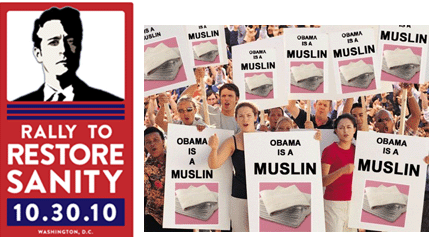
Yes, sanity through inanity, and certainly not with a talking (but brainless) head like Hannity. Yesterday comedians Jon Stewart and Stephen Colbert brought a few hours of utter sanity almost to the steps of Congress in their Rally to Restore Sanity. Fear and hate, the fuel of electoral robo-calling, were ridiculed. If, as Glenn Beck not long before sermonized, people in America have turned their back on God, perhaps they should back off a bit and act more like the Jesus of the beatitudes than Joshua at the battle of Jericho. All it takes to get back on track is for everyone to tone down the rhetoric and hear the laughter. For one sunny afternoon in our nation’s capital God finally had a reason to laugh, given the mess we humans have been making of things and each other. At least this time the stage featured two jesters who know they are jesters rather than Fox News’ gift to incivility. No one was compared to a Nazi, nor a Communist. As Stewart noted in an eloquent speech at the end of the show:

“This was not a rally to ridicule people of faith, or people of activism, or to look down our noses at the heartland, or passionate argument, or to suggest that times are not difficult and we have nothing to fear.”

It was, contrary to those steeped in Tea Party rhetoric, a clarion call for the values that have become antithetical to our political system: being calm, civil and accepting of differences. Stewart has not only read Rousseau’s “social contract,” but reminds us through humor of the central importance of tolerance for democracy to work. If the world was watching yesterday, they finally had something to smile about: I do not only mean the jokes but an American proud of his country for the right reasons.

One of the right reasons is the beauty of a Jewish comedian defending the right of Muslims to be American too. Continue reading Sanity through Inanity

The Surprising Effect of Religious Devotion on Suicide Attacks


2007 suicide blast at Baghdad hotel

by Matt J. Rossano, The Huffington Post, September 27, 2010

We all have our personal “theories” about what motivates religious terrorists. To go from personal theories to real ones, we need to study the issue scientifically. One recent study draws the provocative conclusion that ritual participation more than religious belief may be behind suicide attacks.

From a scientific standpoint a suicide attack represents an extreme form of parochial altruism — a self-sacrificial act made on behalf of one’s in-group, involving aggression against an out-group. Religious belief, some have argued, is the prime motivator for such an attack. The attacker believes that his or her sacrifice will lead to a glorious reward in the afterlife (e.g., Islam’s famous 70-some-odd virgins-awaiting). This explanation can be called the “belief hypothesis,” and it would predict that those who demonstrate increased devotion to religious beliefs or deities would be more supportive of suicide attacks. In the context of a recent study (Ginges et al., Psychological Science, 20, p. 224), devotion was measured by prayer frequency. Thus, those who prayed more were assumed to be more devoted, and some preliminary analyses confirmed that this was indeed the case. Continue reading The Surprising Effect of Religious Devotion on Suicide Attacks

Blogging Islamophobia


Blogger Pamela Geller and Imam Feisal Abdul Rauf

How the “ground zero mosque” fear mongering began

BY JUSTIN ELLIOTT, Salon.com

A group of progressive Muslim-Americans plans to build an Islamic community center two and a half blocks from ground zero in lower Manhattan. They have had a mosque in the same neighborhood for many years. There’s another mosque two blocks away from the site. City officials support the project. Muslims have been praying at the Pentagon, the other building hit on Sept. 11, for many years.

In short, there is no good reason that the Cordoba House project should have been a major national news story, let alone controversy. And yet it has become just that, dominating the political conversation for weeks and prompting such a backlash that, according to a new poll, nearly 7 in 10 Americans now say they oppose the project. How did the Cordoba House become so? Continue reading Blogging Islamophobia