Category Archives: Ethics

Babel: A New Post-Occupation Translation


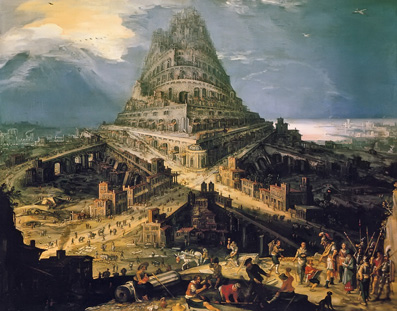
Tower of Babel artwork in Pinacoteca Nazionale in Bologna, c. 1500

The beginning of a year that is yet again an apocalyptic venue is as good a time as any to quote from the biblical book of Genesis. Many of the events in Genesis took place in the legendary space that we now call Iraq, a space that the United States military is unoccupying after a prolonged mission that appears to have accomplished more mayhem than a lasting peace (at least in the recent holiday “peace on earth” spirit). Remember the story of the Tower of Babel; well here is my take of a new translation, being as faithful as I dare to the original King James English:

Genesis 11: The Tower of Babel
1 And the whole earth outside the Axis of Evil was of one mind, and of one resolve about the WMD of King Saddam.
2 And it came to pass, as the coalition troops journeyed to the east, that they found a plain in the land of Shinar, but no WMD; and they dwelt there for almost a decade.
3 And they said one to another, Go to, let us make bombs, and burn them thoroughly. And they had billions of dollars in weapons for battle, and slime had they in mind for talking about the party of the king.
4 And they said, Go to, let us build us a democracy, and a puppet regime, who will sell us oil that reaches unto the ports of Texas; and let us make us a name to be feared, lest we not have economic hegemony upon the face of the whole earth.
5 And the ones who lorded over came down to see the democracy and the puppet regime, which the children of the founding fathers builded.
6 And the ones who lorded over said, Behold, the people is one, and they have all one dangerous religion; and this they begin to do: and now nothing will be restrained from them, which they have imagined in their sharia to do.
7 Go to, let us go down, and there stoke their differences, that they may attack each other because of one another’s sectarian speech.
8 So the ones who lorded over scattered them with superior air power from thence upon the face of all the earth: and they left off to build the democracy.
9 Therefore is the name of it called Babel; because the ones who lorded over did there confound themselves, not knowing what they needed to know about Islam, Iraqi culture or the Arabic language.

A problem in the translation, you say? Continue reading Babel: A New Post-Occupation Translation
Welcome to America?


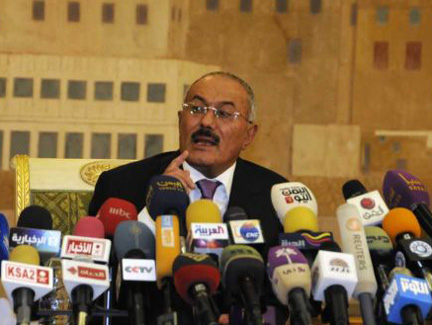
Photo credit: AP | Yemen’s President Ali Abdullah Saleh speaks to reporters during a press conference at the Presidential Palace in Sanaa, Yemen. (Dec. 24, 2011)

Yemen rarely makes the front page of The New York Times, but today it did. The seesaw political succession game underway in Yemen has seen President Ali Abdullah Salih’s head bobbing up and down in the power vacuum like a bobblehead doll in the hands of a Little Leaguer on opening day in Yankee Stadium. According to the article, Salih requested a visa to receive medical attention at New York’s Columbia Presbyterian hospital. Why it is not sufficient to return to Saudi Arabia, where he first underwent surgery and medical attention for major burns and other complications, is not clear. To complicate matters, and Salih has a knack for complicating matters, Salih told the Yemeni public in a recent televised address that he was not seeking medical treatment in the United States but simply wanted to allow the political process to evolve with him on the sidelines.

The Statue of Liberty still holds the beacon of hope aloft. So what does Salih hope to get from this visit. The Obama administration is keen to insist that Salih is welcome only for medical assistance, not for refuge. There is a glaring precedent that urges such caution: when Jimmy Carter allowed the former Shah of Iran entry to the United States for treatment, the pre-nuclear revolutionaries back in Iran went ballistic and stormed the U.S. Embassy. The rest, as they say, is history, but not the kind one likes to repeat. Continue reading Welcome to America?

Are you Whiggish?


[One of my favorite works on the philosophy of history is Herbert Butterfield’s prescient 1931 The Whig Interpretation of History. While most people today probably have no clue what a “Whig” is, his reflections on how we look at and write about history are as relevant today as when he wrote them eight decades ago. The whole text is available online, but I provide some excerpts from the Introduction here to whet your appetite.]

1. INTRODUCTION

It has been said that the historian is the avenger, and that standing as a judge between the parties and rivalries and causes of bygone generations he can lift up the fallen and beat down the proud, and by his exposures and his verdicts, his satire and his moral indignation, can punish unrighteousness, avenge the injured or reward the innocent. One may be forgiven for not being too happy about any division of mankind into good and evil, progressive and reactionary, black and white; and it is not clear that moral indignation is not a dispersion of one’s energies to the great confusion of one’s judgement. There can be no complaint against the historian who personally and privately has his preferences and antipathies, and who as a human being merely has a fancy to take part in the game that he is describing; it is pleasant to see him give way to his prejudices and take them emotionally, so that they splash into colour as he writes; provided that when he steps in this way into the arena he recognizes that he is stepping into a world of partial judgements and purely personal appreciations and does not imagine that he is speaking ex cathedra. But if the historian can rear himself up like a god and judge, or stand as the official avenger of the crimes of the past, then one can require that he shall be still more godlike and regard himself rather as the reconciler than as the avenger; taking it that his aim is to achieve the understanding of the men and parties and causes of the past, and that in this understanding, if it can be complete, all things will ultimately be reconciled. It seems to be assumed that in history we can have something more than the private points of view of particular historian; that there are “verdicts of history” and that history itself, considered impersonally, has something to say to men. Continue reading Are you Whiggish?

A plot against all the Yemen people


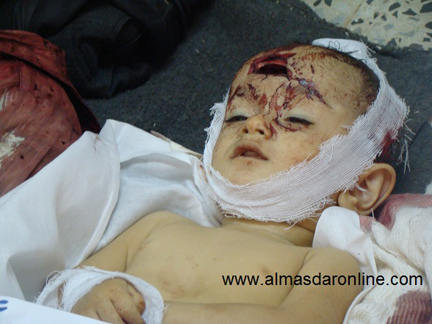
One of the victims in Sanaa

The protests against the regime of Ali Abdullah Salih have persevered in Yemen for some nine months with no end in sight that does not result in the past tense of “Irhal” for Salih. Hundreds of thousands of ordinary Yemeni citizens have joined the protest, some living in tents in a makeshift Freedom Triangle. For the most part, given the length and extent of the protests, there has been no violence from the protesters and limited attacks on them. The times that troops loyal to Salih have fired on protesters have only encouraged more protests. But the past couple of days have become ugly. As reported today, at least 21 have been killed a day after 26 were shot dead in Sanaa. Here is the report in Al Jazeera:

According to reports, Monday’s deaths occurred as snipers fired upon passers-by and peaceful protesters demonstrating at Change Square.

“Help me, oh my God look at his slaughter!” said the father of a boy who died from a gunshot wound to the head.

“We were just in the car on Hayel Street (near the fighting). I stepped out to get some food and left my two boys in the car and I heard the older one scream. The little one was shot straight through the head.”

The clashes came as protesters tried to push further into territory held by government forces after extending their camp overnight.

The opposition had earlier vowed to press ahead with demonstrations despite Sunday’s crackdown.

A freelance journalist stationed in Yemen, told Al Jazeera, “Everything points to more protest”.

Meanwhile, Abdu al-Janadi, Yemen’s deputy information minister, rejected accusations that the regime had planned attacks on the protesters and accused what he described as “unknown assailants” of carrying out the acts.

“This attack was prepared so as to kill as many people as they could. … This is a plot against all the Yemeni people,” al-Janadi told a British television station.

A boy sitting in his car as his father is getting food. All deaths in this situation are to be condemned, because all could be avoided if the greed of political foes did not rule out the honorable virtue of compassion. But there is something about the killing of innocent bystanders, whether intentional or not, that galvanizes the moment. The perpetrators are not “unknown assailants,” but clearly individuals told to do all in their power to sabotage the transition to a new government. Their names do not matter because their motives are so clear. Continue reading A plot against all the Yemen people

Montesquieu, St. Augustine and Libya


Photograph by Murad Sezer/Reuters

A Man of God and Technology, Trying to Steady Libya
By ANNE BARNARD, The New York Times, September 16, 2011

Tripoli, Libya

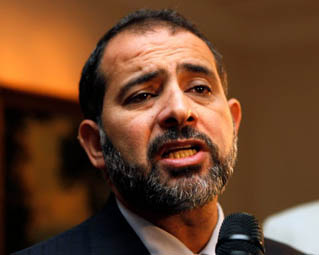
AREF NAYED was sipping cappuccino in the soaring marble lobby of the Corinthia Hotel near Tripoli’s seafront, quoting Montesquieu on law and Augustine on forgiveness in a conversation that had begun with earthier subjects, like the challenges of restoring Libya’s water supply and counting its dead.

He held forth on how Bedouin poetry shaped a moderate Islam in Libya, and he was just starting to explain the relevance to Libyan politics of the mathematical theory of complexity — it had to do with something called “flocking phenomena” — when his cellphone rang.

“I have to take this,” he said, glancing at the number. “Somebody wants to surrender.”

An associate of Col. Muammar el-Qaddafi, the deposed Libyan leader, wanted safety guarantees before turning himself in. Mr. Nayed wanted to make it happen, and not just because fostering reconciliation is one of his many jobs for Libya’s de facto government.

He is also a Muslim theologian who, in addition to running a technology business, spent his time before the Libyan rebellion writing erudite papers arguing that compassion is the paramount value in Islam, that pious Muslims can thrive within a liberal secular state and that even the most righteous ones should adopt a “humble recognition” of their own fallibility.

Now, as the Transitional National Council’s coordinator of a Libyan stabilization team being asked to solve problems like fuel shortages and human rights abuses, he suddenly finds himself in an ideal laboratory to test his signature theological propositions — and to try to make them government policy.

“I don’t think there should be a witch hunt, purges or cleansings,” he said Monday at the hotel cafe, adding that those who committed crimes under Colonel Qaddafi should be tried. “Any time you deal with human beings with that kind of terminology, you end up with unfairness and persecution.” Continue reading Montesquieu, St. Augustine and Libya

The Latino Ummah


Latino Muslims Define Their Identity 10 Years After 9/11

by Jorge Luis Macias, The Huffington Post, September 9, 2011

It has been 10 years since the Sept. 11 terror attacks, but many Latino Muslims say there is still a lack of understanding about their religion and its practices.

A 2007 study conducted by the Pew Research Center showed that Latino Muslims accounted for an estimated 4 percent out of a total of about 2.5 million Muslims living in the U.S. But a look at the individuals behind those numbers reveals a group of people who say they have become ambassadors for Islam despite the common stereotypes they say are still leveled by many in the U.S.

According to the Pew findings recounted in a 2011 report, while 40 percent of the U.S. population believed Muslims in the U.S. support extremism, only 21 percent of U.S. Muslims said there is support for extremism among them in the U.S.

“The first misconception is to associate violence with Islam,” said Wilfredo Amr Ruiz, a Muslim chaplain and attorney born in Puerto Rico. “Another misconception is that somehow Islam aspires to some sort of world domination, and that his followers want to impose Islamic Law in the countries in which they live, which couldn’t be further from the truth.” Continue reading The Latino Ummah

By their books, ye shall know them


For 10 years, we’ve lied to ourselves to avoid asking the one real question

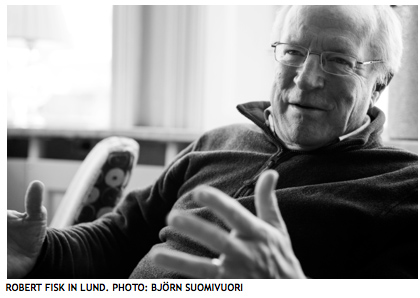
by Robert Fisk, The Independent, Saturday, 3 September 2011

By their books, ye shall know them.

I’m talking about the volumes, the libraries – nay, the very halls of literature – which the international crimes against humanity of 11 September 2001 have spawned. Many are spavined with pseudo-patriotism and self-regard, others rotten with the hopeless mythology of CIA/Mossad culprits, a few (from the Muslim world, alas) even referring to the killers as “boys”, almost all avoiding the one thing which any cop looks for after a street crime: the motive.

Why so, I ask myself, after 10 years of war, hundreds of thousands of innocent deaths, lies and hypocrisy and betrayal and sadistic torture by the Americans – our MI5 chaps just heard, understood, maybe looked, of course no touchy-touchy nonsense – and the Taliban? Have we managed to silence ourselves as well as the world with our own fears? Are we still not able to say those three sentences: The 19 murderers of 9/11 claimed they were Muslims. They came from a place called the Middle East. Is there a problem out there?

American publishers first went to war in 2001 with massive photo-memorial volumes. Their titles spoke for themselves: Above Hallowed Ground, So Others Might Live, Strong of Heart, What We Saw, The Final Frontier, A Fury for God, The Shadow of Swords… Seeing this stuff piled on newsstands across America, who could doubt that the US was going to go to war? And long before the 2003 invasion of Iraq, another pile of tomes arrived to justify the war after the war. Most prominent among them was ex-CIA spook Kenneth Pollack’s The Threatening Storm – and didn’t we all remember Churchill’s The Gathering Storm? – which, needless to say, compared the forthcoming battle against Saddam with the crisis faced by Britain and France in 1938.

There were two themes to this work by Pollack – “one of the world’s leading experts on Iraq,” the blurb told readers, among whom was Fareed Zakaria (“one of the most important books on American foreign policy in years,” he drivelled) – the first of which was a detailed account of Saddam’s weapons of mass destruction; none of which, as we know, actually existed. The second theme was the opportunity to sever the “linkage” between “the Iraq issue and the Arab-Israeli conflict”.

The Palestinians, deprived of the support of powerful Iraq, went the narrative, would be further weakened in their struggle against Israeli occupation. Pollack referred to the Palestinians’ “vicious terrorist campaign” – but without any criticism of Israel. He wrote of “weekly terrorist attacks followed by Israeli responses (sic)”, the standard Israeli version of events. America’s bias towards Israel was no more than an Arab “belief”. Well, at least the egregious Pollack had worked out, in however slovenly a fashion, that the Israeli-Palestinian conflict had something to do with 9/11, even if Saddam had not. Continue reading By their books, ye shall know them

Muslims of Color


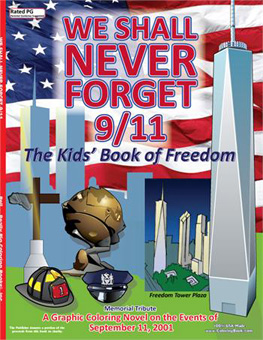
press release says it all:

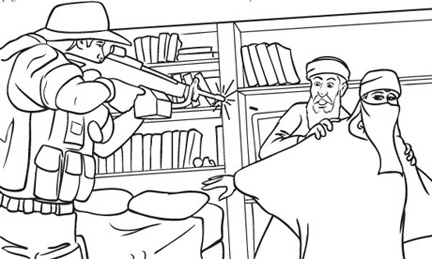
To the American people and all others who may read this child’s coloring book, We Shall Never Forget is designed to be a tool that parents can use to help teach children about the facts surrounding 9/11. This book also describes basic freedoms in America. We suggest parental guidance. As the 9/11 events are shown countless times on national media, this book will help children understand the meaning of these events. The book was created with honesty, integrity, reverence, respect and does not shy away from the truth. In this book you will see what happens to a terrorist who orders others to bomb our peace loving wonderful nation.

Here is propaganda so blatant and smiley gross that it deserves a place alongside the insidious emulation of Lenin by the Soviets and idolization of dictators the world over. The cover image is an interesting spin on the separation of church and state in our land of the free: here we see the tattered American flag flying above a cross illuminated by a beam of light from above, at the feet of which lie a firefighter’s helmet and police hat. To label the libel in this colorfully designed “Kid’s Book of Freedom” a “Graphic Coloring Novel” strikes me as a misspelling; is it not more aptly named a “Pornographic Coloring Novel,” to be rated so for the sensational violence mongering rather than any out-of-place showing of body parts?


Continue reading Muslims of Color