Category Archives: Ethics

On Drones


The Center for Civilians in Conflict and Columbia Law School’s Human rights Clinic have recently produced a report on the impact of drones on civilians. Below is the abstract; the full report can be found in pdf format here.

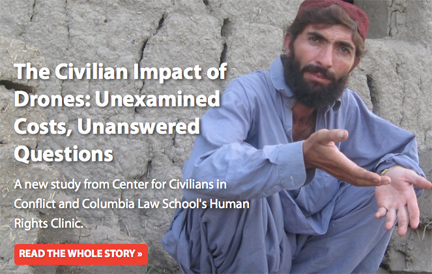
The Civilian Impact of Drones: Unexamined Costs, Unanswered Questions
Publication | 29 Sep 2012

This joint report from the Center for Civilians in Conflict and Columbia Law School’s Human Rights Clinic is an in-depth look at the US government’s covert drone program and its impact on civilian populations. Our objective is to critically assess US government procedures and standards for ensuring civilian protection and responding to civilian harm from drone strikes conducted both outside of full-scale military operations and with a degree of secrecy. The study is based on a review of publicly available materials, interviews with current and former government officials, responses to requests for information from agencies, and previous field interviews by Center for Civilians in Conflict.

Drones are touted as the most precise and humane weapons platform in the history of warfare. The technological advance is significant, but covert drone strikes carry costs for civilians and local communities even as they become a policy norm. Blinded by the promise of this technology and reports of short-term effectiveness in killing militants, policymakers are failing to ask hard questions of the drones program, including whether other tactics or strategies are more appropriate to counterterrorism strategy, and whether US expansion of strikes to new places and against new groups is truly justified.
Malala and malevolence

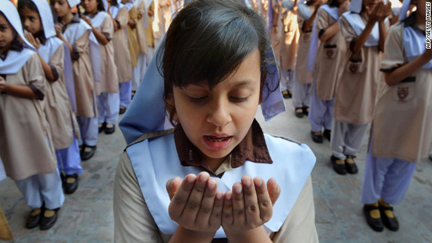
Pakistani school girls pray for the recovery of teen activist Malala Yousufzai at their school in Peshawar on Friday.

A fourteen-year old girl is shot in the head for wanting to be educated. It is hard to imagine a more sadistic premeditated attack on innocence. Her name is Malala and her attackers are Taliban extremists who have so perverted the teachings of Islam that they commit the ultimate modern-day shirk: assuming that their cowardly act has divine sanction. The assassination attempt on a school bus is now one of those shots heard across the world. To be sure, the gunshots that have ripped through bodies in Muslim countries number in the thousands these days. The attack on Malala does not override the horrific bloodshed taking place in Syria, the continuing violence in Afghanistan and Iraq and elsewhere. But it stands out as a symbol of what goes terribly wrong when partisan religious fervor enters the political arena.

Pakistan’s president, Asif Ali Zardari, recognizes this: “”The Taliban attack on the 14-year-old girl, who from the age of 11 was involved in the struggle for education for girls, is an attack on all girls in Pakistan, an attack on education, and on all civilised people.” He recognizes that such malevolence puts every young girl in Pakistan in danger and threatens to further divide debates in his country into violent conflict. But this is not only an attack on “all civilised people”; this is an assault on all people. And, as the photograph of a young Muslim girl praying above shows so well, an attack on the very idea of the merciful God she prays to.

I have never met Malala and probably never will. But Malala is my daughter, my wife and my mother. Shooting her is an attack on my family and yours. If the shooters dared to whisper bi-ism-Allah-al-rahman-al-rahim before they pulled the trigger against a child of God, may that same God have mercy on their souls, because they never learned the true meaning of the words they spoke. Continue reading Malala and malevolence

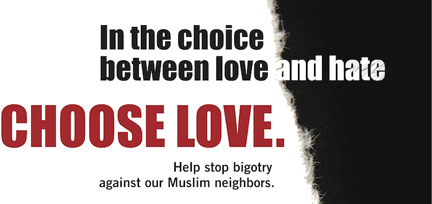
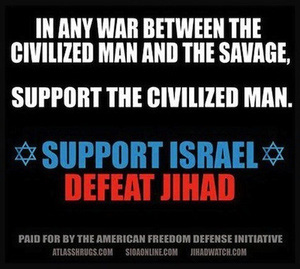
Poster War on the New York Subway


Poster from American Freedom Defense Initiative


Poster from Rabbis for Human Rights

[The following commentary has just appeared on Anthropology News in my blog there called “Middle East Muddle.: I provide the first paragraph, and the rest of the commentary can be read here.]

In the late 19th century there was little doubt about the gulf between “civilized man” and the “savage,” as anyone reading John Lubbock or Edward Tylor or Lewis Henry Morgan would readily note. Anthropology has come a long way since the cultural evolution scenarios that followed immediately upon the Darwinian revolution in biology. By the time Claude Lévi-Strauss penned Tristes Tropiques in 1955, the tables had turned, with so-called “civilized man” seen as acting the “savage.” Anyone reading Bartolemé de las Casas on the Spanish atrocities in the New World in the early 16th century could have come to the same conclusion. So it is quite un-anthropological today to encounter a poster in the New York subway system about the “war between the civilized man and the savage,” let alone to be urged to “support the civilized man.” Yet, this is the message paid for by the “American Freedom Defense Initiative.”

For the rest of this post, click here.

Since writing this, several groups are now running counter ads in the subways. For more on this, see the commentary by Omid Safi.

How to Defend the Prophet?


Supporters of Lebanon’s Hezbollah leader Sayyed Hassan Nasrallah wave Hezbollah flags and shout slogans at a protest against a film made in the US that mocks the Prophet Mohammad, in southern Lebanon, Sept. 19, 2012. The Arabic on the headscarves read, “In your name prophet of God.” (photo by REUTERS/Ali Hashisho)

by Alaa al-Aswany, Al-Monitor, September 19, 2012

Whether you are Muslim, Christian or follow any other religion, you have the right to practice your faith, and others must respect your religious convictions without anybody mocking or degrading your beliefs. Thus, every Muslim has the right to feel angry upon watching a pathetic and badly made movie that depicts their prophet in a shameful, deceitful and insulting manner. Muslims were also within their rights when they felt angered by the cartoons that mocked the Prophet that were published in Denmark a few years ago. Furthermore, they were right to be angered by the movie Fitna (strife) — a film produced by right-wing Dutchman Geert Wilders in 2006 — which derided the Muslim faith and considered it the source of all the world’s terrorism. In all of these instances, Muslims were justifiably angered, and they had the legitimate right to embark on a campaign aimed at convincing the world that they were entitled, as human beings, to see their religious beliefs respected without prejudice. But, unfortunately, and as a result of these campaigns, Muslims lost that aforementioned right, and themselves contributed in distorting the image of Islam and Muslims because they let their anger get the best of them by overlooking the following facts:

First: The nature of freedom of expression in the West Continue reading How to Defend the Prophet?

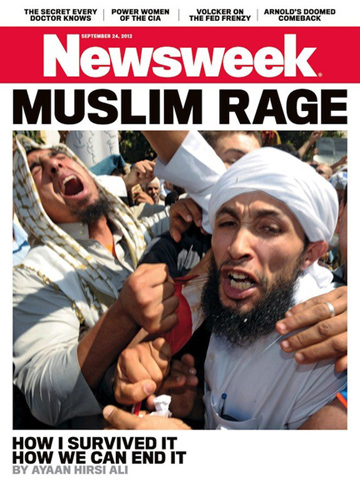
Newsweak


Edward Said wrote a poignant critique of media coverage of the Iranian hostage crisis just over three decades ago. He called it “Covering Islam.” The subtitle was “How the Media and the Experts Determine How We See the Rest of the World.” Once again Islam is being covered, the latest being the “cover” on Newsweek Magazine. Said’s [Covering Islam (1997 edition), p. lv.] assessment is as relevant as ever today:

For the right, Islam represents barbarism; for the left, medieval theocracy; for the center, a kind of distasteful exoticism. In all camps there is agreement that even though little enough is known about the Islamic world there is not much to be approved of there.

The latest Newsweek cover demonstrates just how weak its sense of responsible news reporting is. The trope of “Muslim Rage” conflates the cultural dimensions of politics with a religious faith. When Israeli planes bomb Hamas in Gaza, no major newspaper calls this “Jewish Rage.” When Terry Jones burns a Quran or when Anders Behring Breivik shoots fellow Norwegians, I have yet to see a headline of this act as one of “Christian Rage.” Rage is almost always political at base and the events subsumed under a blanket umbrella of “Muslim Rage” are local politics to the core. The fact that we see these images on CNN and the Internet tells us more about the audience than it does about those engaged in the activities.

The photograph captures “rage” to be sure, but the choice of turbaned and bearded protesters (when the majority in Cairo at least are young clean-shaven men in Western clothing lobbing rocks at the police) identifies rage with a style of dress and a style of dress with a violent religion. Ironically, the voices of those who are enraged are not to be heard anywhere inside the story. Instead, the cover boasts an article inside by Aayan Hirsi Ali, a controversial Somali whose claim to fame was posing naked with Quranic verses on her body and then becoming a darling of the Islamophobic mob. Her knowledge of Islam is so immature and biased that the very idea she might have something to contribute to the issue staggers my imagination.

I see little difference between this cover photo and that on the French tabloid Closer, which brandished the privately bared royal breasts of British princess Kate Middleton. Continue reading Newsweak

The “Muslim” Problem


The past week has seen a dramatic punctuation in the political present. This present is one in which several countries in North Africa and the Middle East are emerging from years of “stable” dictatorial rule in which human rights were ignored by the Western countries who philosophize how important human rights (or at least the right kind of rights) are. There is also a presidential election looming in the most powerful nation on earth, a nation divided in a partisan way with few realistic ideas on how to frame a way out of the greatest economic downturn since the Great Depression. It is raining politics and that is fire and brimstone in the current climate.

The drama starts with the anniversary of the 9/11 tragedy, which like the abduction of Helen of Troy, prodded the United States to engage in two decade-long wars that have resulted in the deaths of former figure-head foes (Saddam and Bin Laden) but which are unwinnable in the old-fashioned “sign a peace treaty and let trade make us friends” sense after World War II. The spark, a most surreal one at that, is a pathetic trailer for the kind of film no one would ever pay money to see. Before Youtube, before the Internet, this would have been yet another throw-away on the huge cinematic rubbish pile already brimming with porn. But in a scenario that a producer would probably laugh away, an Islamophobic individual dubs intentionally hateful dialogue denigrating the Prophet Muhammad. For non-Muslims the main thing offended is taste; for Muslims this is hateful and hurtful, akin to throwing something sacred into a toilet.

The politics has exploded all over the media, not in spits but a massive vomit. Continue reading The “Muslim” Problem

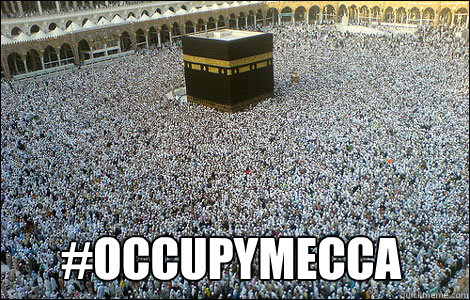
Occupy Mecca


by Omid Safi, Religion News Service, August 28, 2012

It is time, and past time, to Occupy Mecca.

I am adamantly not talking about a disaster US occupation, a la Iraq and Afghanistan.

What I am calling for is nothing less than millions of faithful pilgrims saving Mecca from destruction.

I would call the destruction imminent, except that it is not imminent. It has already happened.

No, it’s not the Americans, or the Israelis, who would be destroying Mecca.
It’s the so-called Guardians of the two holy sites (Mecca and Medina), the Saudi royal elites, who have negligently stood by over the last two decades as the majority of holy sites in these two most sacred Muslim cities have been destroyed, sacrificed to the false gods of modernization, capitalism, and progress.

Saudi Wahhabis have a long history of destroying shrines, including those of the family of the Prophet in Saudi Arabia and Iraq. Continue reading Occupy Mecca

Revealing the News


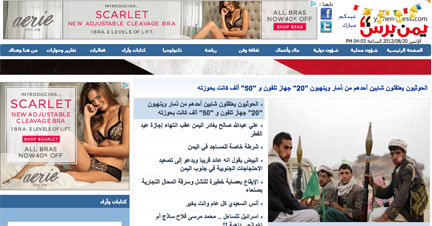
In attempting to keep up with the news in Yemen, I surf a number of Yemeni news sites. When I tried the usually reliable almasdaronline.com this morning, I was redirected to a commercial site called Mojo Pages. So I switched to yemen-press.com, where the top story was about the Huthi forces arresting two individuals in Sa‘da. While reading the article I realized that it was impossible to ignore the Gestalt of the total screen page, which I reproduce above. Here is a scene of several Yemeni fighters, clearly in a qat-chewing mode, and holding what I suspect (not being a military expert) are grenade launchers. What struck my attention was the advertisement adorning the banner and taking a prominent space on the left of the screen: Scarlet, the new adjustable cleavage bra. I have not been in the market for a bra, so I do not think the ad showed up due to any sophisticated Facebook-style marketing strategy. But I am male, so perhaps the assumption is that any Western viewer is in the market for a bra, since the ad is in English after all. And ten minutes later a new ad took its place: this time for a car rental place in New York.

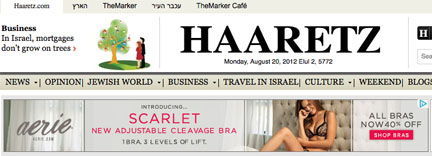
Then a couple of hours later I happened across an article on Haaretz and there she was again: dear Scarlet hawking her gawking adjustable discount bra. Perhaps I am a victim of cookies twisting, but what a coincidence that is probably not a coincidence. Criss-crossing the endemic violence in the Middle East, the ongoing plight of the Palestinians and the voices in the Zionist wilderness of left-leaning Israelis there is the seductive power of an ad, as if politics did not really matter. In this case the bra fits all sizes of religious persuasions and the model is available to be ogled by anyone, at least from a Western computer. How ecumenical can commercial immodesty get.

It is the multifarious irony of these pages that weighs me down. I will focus on the Yemen website, since that was the first encounter with Scarlet. First, how ironic that I devour news by scouring multiple websites, most of which do not explicitly state their de facto bias. While there are a couple of Yemen News sites that are available in English (like Yemen Times and Yemen Post), they tend to be days old and in need of better English editing. Yemen Times, for example has a most recent post of August 15, five days ago, which is hardly Time Magazine timely. Yemen Post has a story only a day old, but its presentation is nowhere near as slick as any of the major Yemeni sites in Arabic. Irony #1 is that what is available but not in Arabic is old and out-of-date internet-wise. This is only an irony for the hubris with which English-speakers assume that news must be packaged in their native language.

The second irony is the critical crux. Where else can you find images of a seductive woman in a bra revealing cleavage (and at 40% off) counterposed with a truckload of qat-chewing Yemenis holding grenade launchers or on a major Israeli online newspaper in English? Continue reading Revealing the News