Category Archives: Ethics

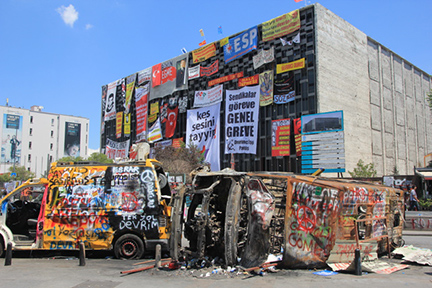
The Gezi Occupation: for a democracy of public spaces


Occupied Taksim, June 10

by Nilufer Gole, Open Democracy, June 11, 2013

“Respect” has become a new slogan tagged on walls all over the cities, and expressing the need for a return to civility and call for politeness in Turkish public life. Gezi occupation reveals to us all, how “public square” becomes literally vital for our democracies.

Over the past week, protest movements have spread across Turkey’s largest cities, and appear to become widespread urban uprisings. Despite often violent police intervention, people have not hesitated to take to the streets and block avenues, neighbourhoods, and their cities’ central spaces. Others participate from their balconies, with whole families chiming in to the protesters’ chorus, banging on pots and pans. They have found pacifist means of protest that require no arms or political slogans to express their discontent and frustrations with the Erdogan regime.

This urban movement, started by young people, supported by the middle classes and featuring a strong female presence, has not weakened in the face of impressive displays of force by riot police who use tear gas without hesitation. Clouds of gas cover the sky in town centres, making breathing difficult; but these clouds, symbols of pollution and the abuse of power, have only bolstered the anger of ordinary citizens.

The public sphere has been suffocating for some time in Turkey. Restrictions on freedom of expression and the crackdown on the opposition, particularly journalists who have lost their jobs and the mass media which has changed its editorial line, have put a muzzle on public discourse. The most recent protests in Taksim, which were not covered by the major television stations, are ample proof of this. Continue reading The Gezi Occupation: for a democracy of public spaces

Islam minus “Theism”

[Webshaykh’s note: There are many Christians and Jews who still find spiritual and moral value in their faiths while rejecting literalist interpretations, especially those that preach exclusivity rather than tolerance. This same holds for many Muslims, although their voice are seldom given a chance to be heard or else are gobbled up with relish by Islamophobes. The following commentary by Ali A. Rizvi is well worth reading.]

An Atheist Muslim’s Perspective on the ‘Root Causes’ of Islamist Jihadism and the Politics of Islamophobia

by Ali A. Rizvi, Huntington Post, May 3, 2013

The ambassador answered us that [their right] was founded on the Laws of the Prophet, that it was written in their Koran, that all nations who should not have answered their authority were sinners, that it was their right and duty to make war upon them wherever they could be found, and to make slaves of all they could take as prisoners, and that every Mussulman who should be slain in battle was sure to go to Paradise.

The above passage is not a reference to a declaration by al Qaeda or some Iranian fatwa. They are the words of Thomas Jefferson, then the U.S. ambassador to France, reporting to Secretary of State John Jay a conversation he’d had with Sidi Haji Abdul Rahman Adja, Tripoli’s envoy to London, in 1786 — more than two and a quarter centuries ago.

That is before al Qaeda and the Taliban, before the creation of Israel or the Arab-Israeli conflict, before Khomeini, before Saudi Arabia, before drones, before most Americans even knew what jihad or Islam was, and, most importantly, well before the United States had engaged in a single military incursion overseas or even had an established foreign policy.

At the time, thousands of American and European trade ships entering the Mediterranean had been targeted by pirates from the Muslim Barbary states (modern-day North Africa). More than a million Westerners had been kidnapped, imprisoned and enslaved. Tripoli was the nexus for these operations. Jefferson’s attempts to negotiate resulted in deadlock, and he was told simply that the kidnapping and enslavement of the infidels would continue, tersely articulated by Adja in the exchange paraphrased above.

Adja’s position wasn’t a random one-off. This conflict continued for years, seminally resulting in the Treaty of Tripoli, signed into law by President John Adams in 1797. Article 11 of the document, a direct product of the United States’ first-ever overseas conflict, contained these famous words, cementing America’s fundamental commitment to secularism:

As the Government of the United States of America is not, in any sense, founded on the Christian religion; as it has in itself no character of enmity against the laws, religion, or tranquility, of Mussulmen; and, as the said States never entered into any war, or act of hostility against any Mahometan nation, it is declared by the parties, that no pretext, arising from religious opinions, shall ever produce an interruption of the harmony existing between the two countries.

Yes, the establishment of secularism in America back in the 18th century was largely related to a conflict with Islamist jihadism.

So where did Abdul Rahman Adja’s bin Laden-esque words come from?

They couldn’t have been a response to American imperialism (the start of the conflict precedes the presidency of George Washington), U.S. foreign policy, globalization, AIPAC or Islamophobia. Yet his words are virtually identical to those spouted ad nauseum by jihadists today who justify their bellicosity as a reaction to these U.S.-centric factors, which were nonexistent in Adja’s time.

How do we make sense of this? Well, the common denominator here just happens to be the elephant in the room. Continue reading Islam minus “Theism”

Bipolar Religion

The trendy 19th century Protestant philosophical theologian Søren Kiergekaard published a Danish book in 1843 entitled Either/Or. His faith-based binary is not the the standard good vs evil, God vs. Satan model that had long been enshrined in Christianity, but rather a dialogue between an aesthetic hedonist and a duty-bound ethicist. His point, or at least one of them, is that by rigidly following either life trajectory one can simply go too far and not realize one’s true self. He was aware of the binary bind that haunts many, if not most, religions and worldviews. In politics the mantra would be “my country, love it or leave it,” or more crudely, “my way or the highway.” In economics, capitalism vs communism. In all cases binaries bind us to intolerance and the hubris that I am right and you are wrong.

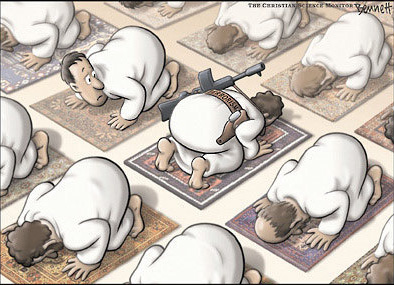
At least the Manicheans dared to assert the obvious that good and evil, like light and darkness, are locked in an eternal duel rather than an ultimate triumph of good. But this was deemed a heresy. The simple solution, what might be called the Salafi fix in Islam, is the fixation on a single standard of truth. Even if one takes the Quran as the literal word of Allah, it must still be interpreted. The history of Islamic exegesis demonstrates that very little is obvious in a text that was not originally written down as it was received in a linguistic idiom now fourteen centuries past. Yet, like the Bible thumpers in American Fundamentalism, there are always those who think they have the right interpretation and that alone must be followed. Continue reading Bipolar Religion

Hezbollah and Bashar: Another Unholy Alliance


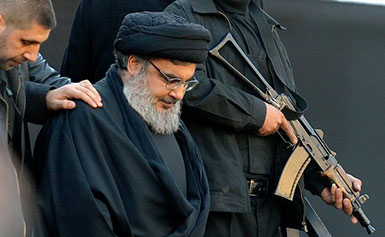
Hezbollah leader Hassan Nasrallah; Photograph by Wael Hamzeh/European Pressphoto Agency

My friend Omid Safi has created a provocative blog entitled What Would Muhammad do? Today I would like to ratchet up the commentary game to an approach which may, at first glance, seem sacrilegious. Given that the Lebanese “Party of God” (Hezbollah) is now known to be sending its fighters to support the Syrian dictator Bashar al-Asad, it is time to ask “What Would Allah do?” As much as I admire the spiritual sentiment of the crucified mystic al-Hallaj, I am not advocating oneness with the Supreme Being. But if I were to try and imagine what Allah would say about the current trials besetting his umma, I think I might begin by insisting that those who spread messages of hate and turn jihad into an excuse for political gain stop using my name. The Shi’a at least had the common decency to call themselves shi’at Ali, rather than presume from the start that they exclusively spoke for me. If these partisans of the hundreds of sects that have evolved since the Prophet Muhammad received the Quran want to hear me, they should stop selecting isolated verses from my message for their own agendas. Submission to Allah is the message of Islam, not submission to any party claiming to be Allah’s party.

Muslims should remember the history not only of their faith, but also the religions founded by other of my prophets. Jews and Christians are not infidels; their lives are as precious to Allah as those of Muslims. Muhammad was sent as the “seal” of the prophets, not to brag that he was superior to my other prophets. Each prophet was sent for a specific purpose, to guide people at different times in history. Muhammad received the Quran not so everyone after that could stop time and live as though it was still 7th century Mecca and Medina. Look at his life and you will see that he was a mediator, who preached salam and knew full well that the greater jihad took place within the individual. Jews and Christians heard from their prophets that humans are not divine, not perfect, and easily seduced to go astray. But Moses gave commandments to run society, Jesus showed the power of love to conquer hatred and Muhammad was a living example of how to live, but not an icon to follow blindly because of the recorded faulty memories of his companions. Continue reading Hezbollah and Bashar: Another Unholy Alliance

Do We Care?


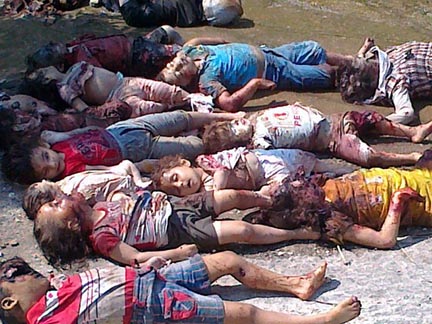
Scene after a massacre in a coastal Syrian village on May 4

Do we care? When the news media report yet another attack on civilians in Syria (or Iraq or Afghanistan or anywhere outside of Boston and New York), do we really care? It is hard to be sympathetic to the picture above without feeling the pain caused by imagining your own child’s body bloodied and lifeless. It is not easy for those of us in the fabled “land of the free” to admit that in war and civil strife everyone is presumed guilty by being in the way of a bomb and only proven innocent as a victim. These are bodies that have stopped growing, faces forever locked into expressions of horror. There can be no rest for these children in the grave for there can be no end to the grief of those who knew them.

But what do we care? It did not happen here. We make sure of that by sending arms to our erstwhile allies and droning anyone abroad who looks like a terrorist. As long as we proclaim our rhetorical support for human dignity, who can blame us? This was the act of a vicious dictator struggling to hold on to absolute power. Asad is Russia’s bastard, not ours. The weapons used to rip apart these childrens’ lives were Cold-War-forged Soviet, not Free World. Thank God, our God of course, there is no “Made in the USA” trademark on any of the bombs used here. But our’s will soon be in play here, as they are in Iraq and Afghanistan and Pakistan and Yemen, and even more children will never be able to play again.

Should we care? We did not know them. There are seven billion of us living and dying on this planet. What does it matter if a few children do not have a chance to live? Perhaps they would die of cancer before their teens or be run over by a car? What if one of these children had grown up to be a violent terrorist and take some of our lives? There are many ways not to look at these dead bodies, not to count them as our own. You can ignore what you see here, quickly click your mouse to escape caring. But tomorrow there will be another picture just like this, perhaps with women or men. Perhaps with soldiers who have little choice but to follow orders or risk their own lives. You need not worry, though, because you will not know any of them, not their names, not the sound of their laughter, not their dreams, not the goodness that shines through in every corner of our globally disconnected world.

So go ahead. Ignore what you see. Thank your God it’s not about you. Life goes on here no matter how many lives end over there. They say a picture is worth a thousand words. I have said what I want to say in less than 500. The rest is up to you.

Pew Survey on World’s Muslims

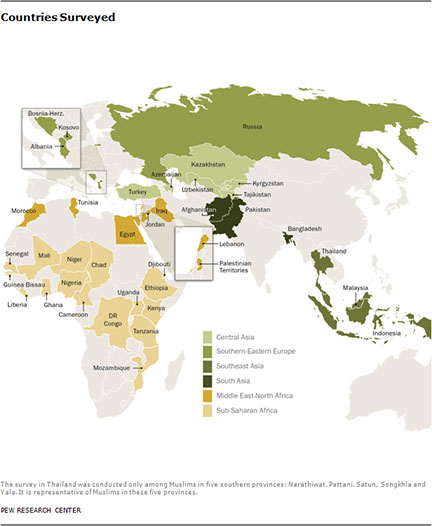
The World’s Muslims: Religion, Politics and Society

The Pew Forum on Religion and Public Life, April 30, 2013

Executive Summary

A new Pew Research Center survey of Muslims around the globe finds that most adherents of the world’s second-largest religion are deeply committed to their faith and want its teachings to shape not only their personal lives but also their societies and politics. In all but a handful of the 39 countries surveyed, a majority of Muslims say that Islam is the one true faith leading to eternal life in heaven and that belief in God is necessary to be a moral person. Many also think that their religious leaders should have at least some influence over political matters. And many express a desire for sharia – traditional Islamic law – to be recognized as the official law of their country.

The percentage of Muslims who say they want sharia to be “the official law of the land” varies widely around the world, from fewer than one-in-ten in Azerbaijan (8%) to near unanimity in Afghanistan (99%). But solid majorities in most of the countries surveyed across the Middle East and North Africa, sub-Saharan Africa, South Asia and Southeast Asia favor the establishment of sharia, including 71% of Muslims in Nigeria, 72% in Indonesia, 74% in Egypt and 89% in the Palestinian territories. Continue reading Pew Survey on World’s Muslims

Bedtime for Bibi

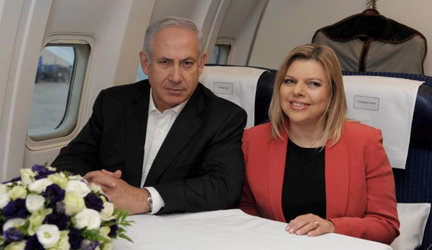
Austerity and sequestration are the dismal economic buzzwords of the day. While thousands of airline passengers in the United States waited for late flights due to a lack of air traffic controllers, and while tens of thousands of Israelis protested the latest cutbacks, Prime Minister Benjamin Netanyahu of Israel had his own solution. He flew to the funeral of Margaret Thatcher last month in a specially fitted plane. There are obvious perks to being a leader, especially a sleepy one. So why not rent a retrofitted El Al superliner to take 75 guests to London for a mere $427,000 from the national treasury. It was not the latest in security secrets that upped the price, but rather a newly installed rest cabin in which a $127,000 bed was installed for his wife and himself for a five hour trip. I am not sure if Bibi has ever watched the Lialda ad that warns a man to consult his physician if he experiences an erection lasting over four hours. No doubt some Israelis feel as though Israel has suffered enough from electoral dysfunction throughout his tenure.

Drone Policy in Yemen

For anyone in the NYC region, I will be giving a talk at the COLUMBIA UNIVERSITY SEMINAR on KNOWLEDGE, TECHNOLOGY, and SOCIAL SYSTEMS on Wednesday, May 15, 7 pm (at Columbia University’s Faculty House). The title of the talk is: “Drone Strikes in the War on Terror: The Case of Post-Arab-Spring Yemen.” Unmanned drones have been used by the US military against terrorism in many areas of the world. In particular, these drones have become the US military’s weapon of choice in targeting terrorists in Yemen, where strikes quadrupled in 2012 from the previous year. This talk addresses the impact of these strikes on the political context within Yemen and the effectiveness of the strategy in combating Al Qaeda recruitment. The talk builds on a commentary published in the Middle East Muddle blog of the Anthropology News website.

For information on the talk, please contact me directly by email at daniel.m.varisco@hofstra.edu.