Category Archives: Film and Video

Hope and Fear Documentary

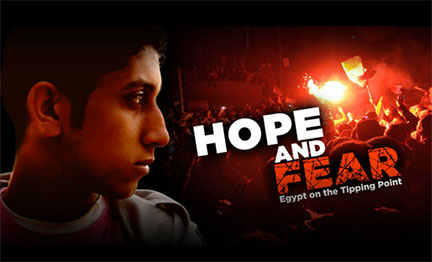
Hope and Fear: Egypt on the Tipping Point

Kickstart the post-production of this Film!

Go Deep: View Director’s Cut Trailer – HOPE & FEAR Long Trailer
Get Deeper: HOPE & FEAR website – www.HOPEandFEARmovie.com

HOPE & FEAR is unlike any documentary you’ve ever seen – providing a rare glimpse into the lives of four young liberal-minded Egyptians as they struggle to reshape their nation. Their story is one of aspiration and empowerment in the face of fear and chaos which dominates Egypt’s ongoing revolution.

Hi Kickstarters!

I’m Hosam Khedr, co-director and producer of HOPE & FEAR. Along with my partner Anjuli Bedi and our crazy dedicated team we set out on an audacious and dangerous quest to tell a more personal and timeless story.

HOPE & FEAR presents an insider’s-perspective on the lives of four young Egyptian activists who are pushing for freedom of expression through their art and community activism. We follow Salman, Nada, Ammar, and Reham beyond the idealism, euphoria and revolution of Tahrir Square as they struggle to navigate the difficult terrain of an Egypt hindered by an oppressive security force, corruption, political and economic instability, and religious intolerance under the new Islamist government.

HOPE & FEAR’s characters along with our special guest appearances, give a broader view of the challenges and implications of Egypt’s revolution. Will the homeland of civilization maintain civility? Nothing less than the future of the region hangs in the balance. With the outcome of Egypt’s liberal youth movement, HOPE & FEAR’s intimate portrayal of its characters shows the common thread that unites all humanity: the human spirit’s refusal to capitulate to oppression despite the costs.

Harun’s Harem Prime Time


From left, the women of Turkey’s Building Bridges: Ebru, Ece, Aysegul (who occasionally joins the four hosts on their show), Aylin, and Ceylan; Courtesy of A9 TV

[Webshaykh’s Note: I previously posted a blog commentary on the media beauties of Harun Yahya. A recent article in Slate is on the same group, and I post the start of the article below.]

The Versace Harem
A group of Muslim women with tight shirts, bright lipstick, a feminist mission, and total devotion to a creationist guru.

By Jenna Krajeski. Slate, Thursday, May 2, 2013

I first agreed to meet Ece, Ceylan, Aylin, and Ebru because I didn’t really believe they existed. They host the Turkish talk show Building Bridges and had recently gotten some attention, but not for the interviews. The women look astonishing. They are mostly bottle blonds, save for Ece, who has raven hair. Neon lipstick gives their lips a whole extra dimension. They coordinate outfits. At one of our meetings, they wore brightly colored satin pantsuits and T-shirts with designer brand names that stretched over their chests. What they talk about on Building Bridges—interfaith dialogue, women and Islam, the greatness of Turkey—isn’t particularly sexy, but their outfits are designed to make up for that. They are also devout Muslims—conservative, even—a supposed contradiction that is also the show’s allure.

Guests often appear—usually by Skype—with their eyebrows arched in the manner of a serious person certain he is the victim of a practical joke. But they proceed. The women sweetly dare the guests to suggest the hosts are anything but what they claim to be—activists, political commentators, Muslims—because of how they dress. During one interview, which I observed in the studio, Ceylan right away asked a German diplomat if a “true religious education” could “combat bigotry.” Continue reading Harun’s Harem Prime Time

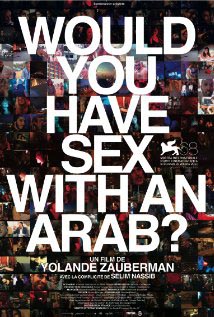
Would You Have Sex With an Arab?

Sleeping With the Enemy? Review of “”Would You Have Sex With an Arab?
By Clara Abdulaziz,http://ta3beer.blogspot.com, April, 19

“One in five Israelis is an Arab, but it is difficult to find places where they touch fingertips.”

In her latest feature-length documentary, French filmmaker Yolande Zauberman ventures out into the nightlife of Tel Aviv and asks the people she meets a deceptively simple question: “Would you have sex with an Arab?” It is clear that sex serves merely as a proxy to grapple with a much larger question: can individuals transcend identities rooted in long histories of conflict, or is identity so rigidly constructed that it in fact defines one’s humanity?

Zauberman has said that she produced the film to “give space for awareness.” It is meant to be “a little bit sexy, a little bit funny.”

It is also, quite frankly, pretty depressing.

Zauberman’s choice of Tel Aviv for her film was not arbitrary. It is famous for its non-stop club scene, and is one of the most LGBT and queer-friendly cities in the world. She shows that even here, where most young residents seem more concerned with partying than religion and politics, the boundaries of Jewish and Arab identity remain stubbornly situated within the larger Arab-Israeli conflict. Continue reading Would You Have Sex With an Arab?

Interpreting Shariah Law Across The Centuries


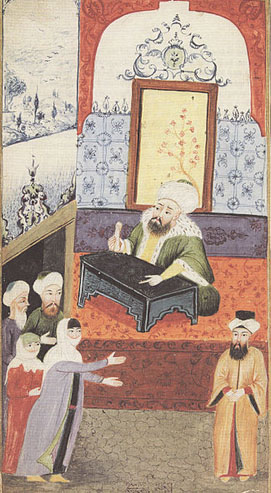
An unhappy wife is complaining to the Qadi about her husband’s impotence, 18th century.

Fresh Air, NPR, April 16, 2012

Sadakat Kadri is an English barrister, a Muslim by birth and a historian. His first book, The Trial, was an extensive survey of the Western criminal judicial system, detailing more than 4,000 years of courtroom antics.

In his new book, Heaven on Earth, Kadri turns his sights east, to centuries of Shariah law. The first parts of his book describe how early Islamic scholars codified — and then modified — the code that would govern how people lead their daily lives. Kadri then turns to the modern day, reflecting on the lawmakers who are trying to prohibit Shariah law in a dozen states, as well as his encounters with scholars and imams in India, Pakistan, Syria, Egypt, Turkey and Iran — the very people who strictly interpret the religious and moral code of Islam today. And some of those modern interpretations, he says, are much more rigid — and much more draconian — than the code set forth during the early years of Islamic law. Continue reading Interpreting Shariah Law Across The Centuries

History Channeling “The Bible”

Hollywood loves making biblical movies and once in awhile there is one worth watching. Last night the so-called “History Channel” premiered a 10-part series with the novel title of “The Bible.” To cut to the chase, this is a really awful cinematic flop. It is definitely not worth watching, no matter what you think about the Bible as history. The first episode starts with Noah brandishing a Scottish accent in a leaky ark with pairs of animals, like giraffes, in the background. How giraffes migrated to Mesopotamia where Noah lived is, for historical accuracy, better left unmentioned. In between plugging up holes in the shittim wood, with water swirling in the air around the inside of the box-like ark, Noah tells the story of creation, day by day. We get a glimpse of Adam and Eve, but not with any full body frontal nudity. Our first sight of Adam is a guy literally caked with mud, not the dust of the ground. How Eve got there is left out. The bashed-in head of Abel is shown, but no one delivers the classic line “Am I my brother’s keeper?”

The story jumps from Noah to Abraham, who convinces Lot to drag his wife along as the “tribe” moves to the promised land. The actor for Abraham could have taken lessons from Mel Brooks, who had Moses down pat in History of the World, Part One. There is a lot of hugging, but for the most part God is absent from the life of Abraham. Why anyone would want to believe in this bullying absentee creator is a mystery. Then one day three messengers appear, one looking Asian and another looking African and all three with full body armor. When Abraham hears that wicked Sodom is about to be destroyed, he asks the messengers to save Lot and his family. Sodom is a steamy and seedy place with little evidence that the young looking Lot was actually made into a judge and sat at the city gate. Good King Melchizedek of Sodom, who was saved by Abraham, is left out of the cast. Nor is the command for Abraham to circumcise, the sign of the covenant and a rather important part of the story, included. Beyond the drunken street carousing in Sodom, Lot’s willlingness to send out his virgin daughter rather than give up the messengers he had given shelter to is missing. He hardly needed to offer his daughter, as in this film the Asian looking messenger is a martial arts specialist and slices his way through the streets with Lot and family, after letting Jehovah (it is hard to tell because God is off camera much of the time) blind the evil doers. Lot’s wife turns into a pillar of salt, a historical item one should probably take with a pillar of salt, but the incest of Lot with his daughters in the case is conveniently omitted. Continue reading History Channeling “The Bible”

iOrientalism: Fooling around with Arab princesses


The late Edward Said lamented the biased representation of the “Oriental” in his influential Orientalism, published 35 years ago. Most of the scholarly and voyeuristic tomes he critiqued are rarely read these days, although his intellectual nemesis Bernard Lewis is well represented in your local Barnes and Noble bookstore (in part thanks to a desire for selling books rather than seriously vetting them by some of the editors at Oxford University Press). Few students of the Middle East or Islamic studies these days have ever heard of Lord Cromer or William Muir or Raphael Patai, let alone would read and be influenced by their aged volumes. The ugly ethnocentrism, racism and sexism that once could be found in the broad (far too broad) discourse labeled “Orientalism” is still quite evident, although moreso in the media, political punditry on the right and rantings of career Islamophobes than by serious scholars. But we are now in the digital age and iOrientalism is now propelled through Facebook, Twitter and Youtube via iphones, ipods and their technological clones.

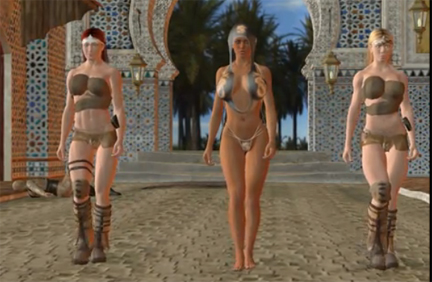
One Youtube video that recently appeared on a Youtube search that had nothing to do with the subject I was searching is a mock video-game fight between three hefty-bosomed and bursting-at-the-bra-straps Arab princesses and a swarthy Mike Tysonish evil guy. This appears to be a promo for Poser Pro Animation rather than a cultural statement per se. The three Arab princesses are so scantily clad that it is more the tile-glazed architecture and palm trees that orientalize than the costume or look. Of the three kung-fu trained ladies, one has red hair, one is a blond and the other is wearing what looks to me like the kind of aviator helmet worn by Amelia Earhart in the 1930s. The bully wears a leather waist band, but otherwise the shaft he was endowed with by nature is visible to the three princesses, but not to those of us viewing the video. Ironically, this parallels Said’s choice of the Gérôme’s painting that graced the cover of the original paperback of Orientalism: this features a naked boy with a snake wrapped around him and a group of grizzled Walnetto perverts staring at his organ, while we voyeuristic viewers can only see the glistening buttocks of the youth. Continue reading iOrientalism: Fooling around with Arab princesses