Category Archives: Film and Video

Goodbye, Lawrence, Goodbye Mr Chips

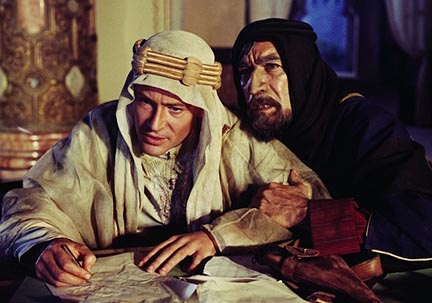
The extraordinary British actor Peter O’Toole died yesterday at the age of 81. His most famous movie, without question, was Lawrence of Arabia. But he made many other performances, including Becket (1964) with Richard Burton, a remake of Goodbye Mr Chips in 1969 and the hilarious spoof, The Ruling Class (1972). I had the privilege of meeting O’Toole at the Chicago Humanities Festival in 1997, when he gave a stirring reading of his latest autobiography. You will find numerous obituaries, but here is the one in The Guardian.

Burqa Avenger

Most of the debate over a Muslim woman who wears the burqa, niqab or hijab centers on how this restricts her freedom of choice. Those who are against the burqa argue that it is a preeminent icon of patriarchy and that societal pressure, valorized with religious rhetoric, does not give a Muslim woman a true sense of choice. The issue is hottest in Western contexts, where a woman wearing a burqa or niqab stands out almost as much as if she was walking around naked. On the other side, there are Muslim women who insist they are exercising free choice and choosing to dress in the conservative manner they want. Regardless of where you stand on the issue, the burqa is inevitably seen as an item that limits a woman’s movement or protects her, not one of empowerment.

So here comes Burqa Avenger to the rescue. This is a video cartoon series in which the star is a female Superwoman/Spiderwoman/Batwoman takeoff, a contemporary way of commanding the right and forbidding the wrong. The series itself is state-of-the-art in its cinematic presentation. You can even get a free app for a Burqa Avenger game on your iphone. As in all cartoons, the characters tend to be stereotypes. Of course, this makes the good stand out from the evil in a stark way that is seldom the case in real life. But the inspiration for the series is to provide young Muslim girls with a positive role model. Continue reading Burqa Avenger

In the steps of Ibn Battuta


Mackintosh-Smith in China

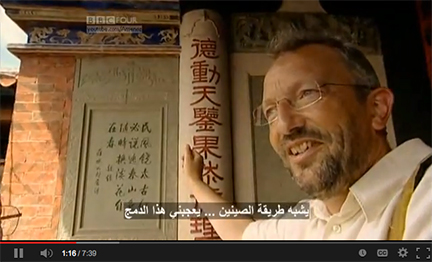
One of the most celebrated Arab travelers was the 14th century Ibn Battuta. For a book on the travels of Ibn Battuta, Timothy Mackintosh-Smith literally followed in the footsteps that the Arab savant had taken some seven centuries earlier. In addition to the book, a documentary film was made. An excerpt of the film on Tim’s experience int he Chinese city of Zaytun is available on Youtube and well worth watching. Other Youtube excerpts are on an Ibn Battuta shopping mall in Dubai and on Turkey. Vimeo provides access to the entire first part of the three-part series. For more information on the work of Mackintosh-Smith, check out his website. An earlier documentary on the English Sheikh and the Arab Gentleman by Bader Ben Hirsi is available in its entirely on Youtube.

Muslim Journeys

The National Endowment for the Humanities has a fantastic website on Islam with a variety of resources, especially valuable for teaching about Islam, but also just for browsing. The outreach part of the project is “The Muslim Journeys Bookshelf,” a collection of 25 books and 3 films, noted as “a collection of resources carefully curated to present to the American public new and diverse perspectives on the people, places, histories, beliefs, practices, and cultures of Muslims in the United States and around the world.” American libraries can apply for receipt of this collection. Available on the site are images, samples from texts, audio recordings and short film clips, web links and a bibliography.This website is worth spending a few hours on and coming back to; it is precisely what a virtual museum should be.

Here is a sample text excerpt to whet your appetite. This is from al-Jahiz, who died in 869 CE, on “The Disadvantages of Parchment”
Continue reading Muslim Journeys

Displaced in Yemen: A Life on Hold

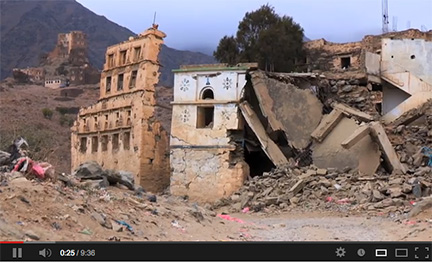
IRIN’s film, A Life on Hold, tells the story of Qasim and his family, who for the past three years have been living in a camp for internally displaced people (IDPs) in northwestern Yemen.

Years of conflict in the region between the Houthi tribe and government forces has led to the displacement of more than 300,000 civilians, who have to cope with a decline in health and educational services. Malnutrition is common in the IDPs camps, as well as in the apartments, mosques and schools where many have found shelter.

Authorities have tried to encourage the displaced to go back to their homes, but renewed clashes in 2012 actually increased the IDP numbers in the north. Extensive damage to houses and infrastructure, continuing insecurity, fear of reprisals and the lack of livelihood opportunities and basic services all serve as deterrents to return.

For more information on the situation in Yemen, please visit:

http://www.irinnews.org/Country/YE/Yemen