Category Archives: Film and Video

Misreading the Arab Media

By LAWRENCE PINTAK, JEREMY GINGES and NICHOLAS FELTON, The New York Times, May 25, 2008

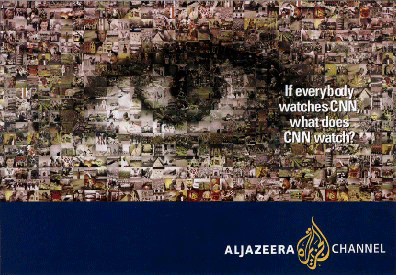
“ARABIC TV does not do our country justice,” President Bush complained in early 2006, calling it a purveyor of “propaganda” that “just isn’t right, it isn’t fair, and it doesn’t give people the impression of what we’re about.”

The president’s statement, along with the decision by the New York Stock Exchange to ban Al Jazeera’s reporters in 2003, is a prime example of how the Arab news media have been demonized since the 9/11 attacks. As a result, America has failed to make use of what is potentially one of its most powerful weapons in the war of ideas against terrorism.

For proof, in the last year we surveyed 601 journalists in 13 Arab countries in North Africa, the Levant and the Arabian Peninsula. The results, to be published in The International Journal of Press/Politics in July, shatter many of the myths upon which American public diplomacy strategy has been based.

Rather than being the enemy, most Arab journalists are potential allies whose agenda broadly tracks the stated goals of United States Middle East policy and who can be a valuable conduit for explaining American policy to their audiences. Many see themselves as agents of political and social change who believe it is their mission to reform the antidemocratic regimes they live under. When asked to name the top 10 missions of Arab journalism, they cited political reform, human rights, poverty and education as the most important issues facing the region, trumping Palestinian statehood and the war in Iraq. Overwhelmingly, they wanted the clergy to stay out of politics. And, aside from the ever-present issue of Israel, they ranked “lack of political change” alongside American policy as the greatest threats to the Arab world.

Though many Arab journalists dislike the United States government, more than 60 percent say they have a favorable view of the American people. They just don’t believe the United States is sincere when it calls for Arab democratic reform or a Palestinian state, as President Bush did again this month in Egypt.

Make no mistake, the Arab press has many flaws, including being subject to state control; only 26 percent of our respondents said they felt their fellow Arab journalists “act professionally” and only 11 percent said they were truly independent in their work. Nevertheless, Arab news outlets are more powerful and free today than at any time in history. If the next administration is going to try to reach out to the Arab people, it won’t get far by blaming the messenger.

Lawrence Pintak is the director of the Kamal Adham Center for Journalism Training and Research at the American University in Cairo and the author of “Reflections in a Bloodshot Lens: America, Islam and the War of Ideas.” Jeremy Ginges is an assistant professor of psychology at the New School for Social Research. Nicholas Felton is a graphic designer in Brooklyn.
Hometown Baghdad

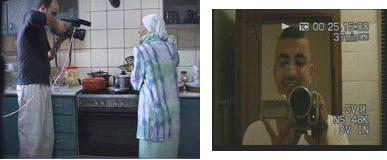
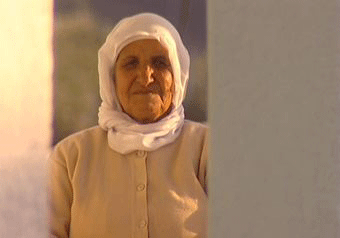
Hometown Baghdad is an online web series about life in Baghdad. It tells the stories of three young Iraqis struggling to survive during the war.

The series premiered on March 19th 2007 and the final episode went live on June 17. All episodes are viewable here.

The series was acclaimed in press throughout the world. See the press page for more.

Hometown Baghdad was produced by global youth dialogue company, Chat the Planet. Find out more about Chat here.

The Bad Business of Badal

A Palestinian filmmaker, Ibtisam Mara’ana, has recently made a film on badal (exchange) marriage from her own personal experience. Although in Arabic, it has English subtitles. To watch a five-minute clip from the film, click here.

Director Ibstisam Mara’ana was predestined, like most of her relatives, to be married off through the badal, a kind of package deal in which a brother and sister from one family marry a sister and brother from another. This marriage exchange is mainly aimed at providing less marriageable daughters with a husband. Mara’ana was told that she was too old and dark, and too ugly due to a scar on her hand, and that without the godsend of the badal, she would fall by the wayside. She refused to cooperate. Instead, she made this award-winning documentary to show how women oppress women. Continue reading The Bad Business of Badal

Sufi Film on Link TV


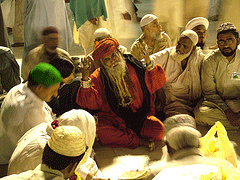
A Sufi qawall offering his devotional music in Lahore

Sufi Soul – The Mystic Music of Islam
U.K., 50 minutes

Director: Simon Broughton

Appearing on Link TV, Saturday, February 23. Visit the site for a preview.

With a dogmatic and fundamentalist view of Muslims increasingly predominant in the Western media, there has never been a more important time to show an alternative view of Islam. Sufism is the mystical dimension of Islam that preaches peace, tolerance and pluralism, while encouraging music as a way of deepening one’s relationship with God. This documentary explores Sufism and its music in different parts of the Islamic world, including Syria, Turkey, Pakistan and Morocco.

Sufi Soul reveals the views and beliefs of devotees while examining the growing threat from fundamentalist Islam and showcasing fantastic performances from some of the world’s greatest Sufi musicians.

For a review of the film, click here.

The Sheik Comes to NPR


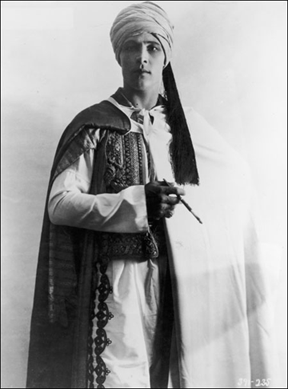
Italian-born actor Rudolph Valentino poses in costume in The Sheik.
Hulton Archive/Getty Images

NPR, Morning Edition, February 4, 2008

In 1921, a silent film transported American audiences to a mysterious, faraway place — and introduced an exotic, erotic character to millions of fans.

The Sheik starred a smoldering Italian immigrant named Rudolph Valentino and featured a title character who bore little resemblance to the venerated Arab leaders commonly known as sheiks. Instead, the character was drawn from the pages of a best-selling romance novel by the wife of a British farmer.

Written in 1919, Edith Maude Hull’s fictional The Sheik inspired a whole subgenre of desert romance, in which hot, swarthy Arabs kidnap reckless white women.

Valentino’s playful treatment of the character captivated female audiences and established him as Hollywood’s first male sex symbol. Mary Brewer Barkley, who was 13 years old when the film was released, recalls newspaper reports that young women were running off to the Middle East in the hope of being abducted by handsome Arabs. Continue reading The Sheik Comes to NPR

Veiled Voices


Brigid Maher, Director of “Veiled Voices”

Veiled Voices is a one-hour documentary that investigates the grassroots movement of Muslim women in the Middle East who act as religious leaders. It introduces the viewer to a world rarely seen by outsiders: the world of devout Arab Muslim women leading other women in prayers and lessons. Veiled Voices concentrates primarily on Ghina Hammoud, a divorced mother separated from her children, who has a television program and a charitable foundation in Lebanon, and Huda al-Habash, who has a loving and supportive husband and children, and runs lessons and programs in a mosque in Syria. Veiled Voices also travels to Egypt, where women struggle for public recognition in roles of authority over men; this is contrasted with Syria, where some male religious authorities, such as the Grand Mufti, are encouraging of women in leadership roles. The film shows women empowered, while exploring the struggles they face on both a personal and a public level. Continue reading Veiled Voices

Exiting Through the ‘Alley Gate’

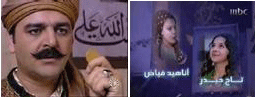
[Note: Numerous excerpts of this popular Syrian Ramadan serial can be found on Youtube, starting with episode 1. The following is a commentary in Asharq Alawsat.]

by Mshari Al-Zaydi, Asharq Alawsat, Saturday 20 October 2007

I will admit to watching the Bab al Hara (Alley Gate) series with the same fervor normally reserved for football finals. Moving from one café to another on Jeddah’s al Tahlia Street, I watched this session’s last episode. The young crowd present, dressed in t-shirts and baggy jeans, burst into a warm round of applause at the end of the show – which is quite a rare reaction among Saudi viewers.

This second-part sequel to the Syrian television series is, in fact, an undeniable phenomenon; some in Saudi even exchanged Eid ul-Fitr felicitations that were inspired by stories in the series.

But this phenomenon has reached farther and wider than just Saudi alone, many viewers in various Arab states; even Arabs living abroad, regularly tuned in and set their alarm clocks to the show’s airing time.

Perhaps this huge success is what prompted the show’s producers to make a third series for next year. Such was its popularity that even some clerics were involved in this commotion; among them was Sheikh Salah Kuftaro, son of the former late Syrian Grand Mufti Ahmad Kuftaro and the Director-General of the Sheikh Ahmad Kuftaro Academy, who publicly acclaimed the show and invited its cast to a Ramadan Iftar held in their honor. Likewise, Kuwaiti Islamist MP Walid al Tabtabai also praised the series. Continue reading Exiting Through the ‘Alley Gate’

Pazuzu, Inc.: On the Movie Syriana

By Gregory Starrett
UNC Charlotte

“Now, the characteristic feature of mythical thought. . .is that it builds up structured sets. . .by using the remains and debris of events. . . .Mythical thought for its part is imprisoned in the events and experiences which it never tires of ordering and re-ordering in its search to find them a meaning.”
Claude Levi-Strauss, The Savage Mind

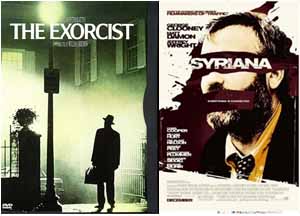
In a previous post, Desiree Marshall faulted director Thomas Gaghan’s recent movie Syriana, implying that a combination of bias and ignorance spoiled what might otherwise have been a useful exploration of identity and politics in the Middle East. While her misgivings are likely shared by others, she and most of the film’s other reviewers have missed its point entirely. Syriana is not at all “about” the Middle East except in the sense that it uses the debris of current events to reveal larger truths and tell much older stories. In fact, Syriana is what French anthropologist Claude Levi-Strauss would recognize as a structural transformation of another tale: director William Friedkin’s 1973 screen version of novelist William Peter Blatty’s The Exorcist. The two films are variants of the same myth. Continue reading Pazuzu, Inc.: On the Movie Syriana