Category Archives: Film and Video

Inventing Muslims: 1001 Inventions Exhibit now in New York

New York launch for 1001 Inventions

1001 Inventions at the New York Hall of Science Uncovers a Thousand Years of Science and Technology Developed Throughout Muslim Civilization.

Five-Year Global Tour Makes U.S. Debut Following Record Breaking Runs in London and Istanbul

17 November 2010, New York — After blockbuster runs in London and Istanbul, 1001 Inventions, an exhibition highlighting the scientific legacy of Muslim civilization in our modern age, will make its United States premiere at the New York Hall of Science (NYSCI) on December 4, 2010.

The exhibition reveals the forgotten history of men and women from a variety of faiths and backgrounds whose contributions to the advancement of scholarship and technology during the Middle Ages helped pave the way for the European Renaissance. This period of history from the 7th through 17th centuries is commonly–though, often erroneously—referred to as the “Dark Ages.”

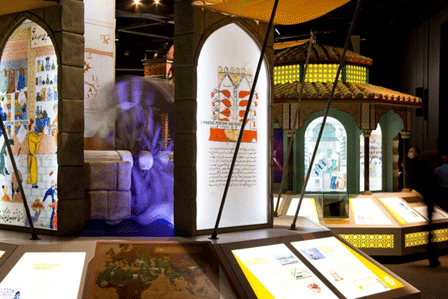
The centerpiece of the exhibition is a 20-foot replica of Al-Jazari’s “elephant clock,” which dates to the 13th century. Other signature elements include a model of a ninth century flying machine and a scale model of a Chinese junk ship built in the 15th century. Divided into seven zones, 1001 Inventions includes more than 60 interactive exhibits that delve into discoveries that shaped the home, school, market, hospital, town, world and universe. Visitors will learn when scientists first discovered how we see, how ancient approaches to health influence modern medicine, why East and West share so much architectural heritage, and the origins of everyday items like coffee, toothbrushes, soap, and much more. Continue reading Inventing Muslims: 1001 Inventions Exhibit now in New York

Performing Islam


Performing Islam is the first peer-reviewed interdisciplinary journal about Islam and performance and their related aesthetics. It focuses on socio-cultural as well as historical and political contexts of artistic practices in the Muslim world. The journal covers dance, ritual, theatre, performing arts, visual arts and cultures, and popular entertainment in Islam influenced societies and their diasporas. It promotes insightful research of performative expressions of Islam by performers and publics, and encompasses theoretical debates, empirical studies, postgraduate research, interviews with performers, research notes and queries, and reviews of books, events and performances.

Call for contributions for the second issue: Continue reading Performing Islam

Viagra for Aladdin Lovers


“Sex and the City 2’s” stunning Muslim clichés
It’s hard to overstate the offensiveness of the fabulous four’s exquisitely tone-deaf trip to Abu Dhabi

By Wajahat Ali, Salon, May 26

I’m a heterosexual, Muslim dude who until recently thought pleated khakis and loafers were “hip” and mistook Bergdorf Goodman for an expensive Swiss chocolate. So it is not surprising that 40 minutes into “Sex and the City 2,” a 150-minute cotton candy fantasy accessorized with materialism and fashion porn, I was comatose with boredom.

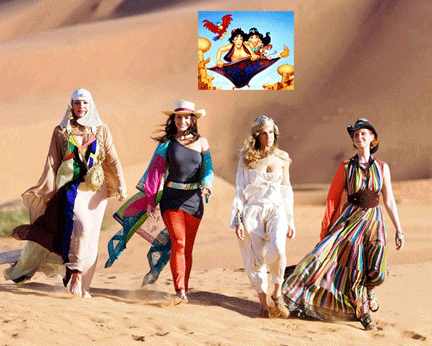
But I was defibrillated by the film’s detour into Abu Dhabi (really Morocco and studio sets) and what can only be described as an Orientalist’s wet dream. After discovering they will visit the Middle East, the ladies whip out hall-of-fame Ali Baba clichés: References to “magic carpet” (a double entendre, naturally), Scheherazade and Jasmine from “Aladdin” come in rapid succession. Upon hearing a stewardess give routine flight instructions in Arabic, Samantha behaves like a wild-eyed child hearing a foreign language for the first time. “I wonder what she’s saying. It sounds so exotic!”

Michael Patrick King’s exquisitely tone-deaf movie is cinematic Viagra for Western cultural imperialists who still ignorantly and inaccurately paint the entire Middle East (and Iran) as a Shangri La in desperate need of liberation from ignorant, backward natives. Continue reading Viagra for Aladdin Lovers

Habibi Rasak Kharban


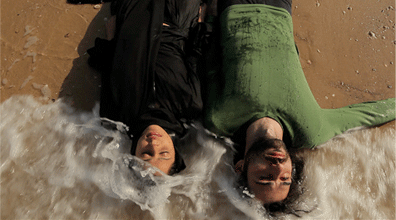
Habibi Rasak Kharban (Darling, Something’s Wrong with Your Head) is a dramatic feature that tells the story of a forbidden love in Gaza. The film is a modern re-telling of the famous ancient Sufi parable Majnun Layla and is the first full-length narrative set in Gaza in over 15 years.

Susan Youssef is the writer and director. This is her first feature film. Her five shorts have screened at venues such as Sundance Film Festival and Museum of Modern Art (NY), and have been acquired for distribution by Video Data Bank, Third World Newsreel, and Canadian Filmmakers Distribution Centre. For information on her past films, click here.

South Park, but not so funny

Who’s Afraid of the Free Speech Fundamentalists?: Reflections on the South Park Cartoon Controversy

by Jeremy F. Walton, The Revealer, April 28, 2010

Recent days have, alas, been marked by a sense of déjà vu all over again for scholars of contemporary Islam. On April 14th, the American cable network Comedy Central aired the first half of a double episode of the immensely-popular cartoon sitcom “South Park.” The episode specifically parodied Islamic prohibitions on the pictorial representation of the Prophet Muhammad by portraying him in concealment, first within a U-Haul truck and then inside an ursine mascot costume. On the day prior to the episode’s airing, the American website revolutionmuslim.com posted the following comments by one Abu Talhah al-Amrikee:

We have to warn Matt and Trey [Matt Stone and Trey Parker, co-creators of South Park] that what they are doing is stupid and they will probably wind up like Theo Van Gogh for airing this show. This is not a threat, but a warning of the reality of what will likely happen to them.

Continue reading South Park, but not so funny

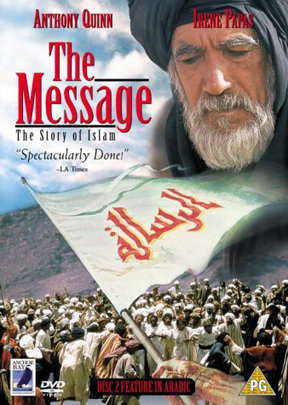
Muslim Cinema: The List

Muslim Cinema: an introduction
With 101 must-see Muslim-themed films

Javed Mohammed, Culture Wars, March 11

The Muslim World and Cinema

Every culture promotes its history, beliefs, heroes, values, norms, and attitude. The African-American director Spike Lee said about his films, ‘I’m just trying to tell a good story and make thought-provoking, entertaining films. I just try and draw upon the great culture we have as a people, from music, novels, the streets’. Is there a parallel to African-American, Asian, or Latin cinema, called ‘Muslim Cinema’? Does it exist, and if so, how can it be understood? Before one can understand the cinema of a people, a little more light needs to be shed on the actual people.

The Muslim world, with approximately one fifth of the world population and in turn its politics, economics, and culture, plays a very important role on the world stage. Headline news is the most popular venue promoting what is known about Muslims, so it becomes imperative for Muslims to be seen and heard from other vantage points. One of these vistas is art, and in the present world Cinema, due its mass appeal and significant availability. An introduction to Muslim Cinema allows Muslims to take a critical reflection about their own beliefs and culture, as well as providing a window for those who are of other faiths to see who Muslims are. Where does one start? Continue reading Muslim Cinema: The List

Fiddler on the mosque

By JONNY PAUL, JERUSALEM POST, April 23, 2010

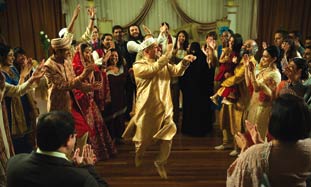
Released this week in the UK is a timely and wholesome comedy that celebrates Jewish and Muslim culture in a way not often seen in cinema. It uses comedy to take a light-hearted look at religion.

The Infidel is about a Muslim who discovers that he adopted and is actually Jewish. Written by renowned Jewish comedian and author David Baddiel, the film is a timely reminder of the commonality between both religions and goes further than most ethnic comedies.

It champions the Jewish and Muslim everyman, celebrating and laughing at aspects that are both unique and common to both religions. The film is novel in that it shows a normal Muslim family, rarely seen in cinema with the tendency to portray Muslims as radicals. Other ethnic films tend to revolve around the idea of ethnic minority adapting to the dominant culture. This film doesn’t do that, it is about minority cultures. Continue reading Fiddler on the mosque

May you never be uncovered


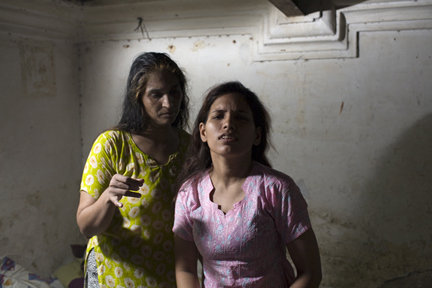
Photograph in a brothel in Pakistan by Kate Orne

Prostitution in Pakistan? Yes it exists, despite the most dire consequences if discovered. Photographer Kate Orne has been documenting the underworld of Pakistani prostitution since 2005 and has formed a website to bring attention to the plight of these women. Prints can be purchased at the website with benefits going to two schools for children and a clinic. Check out the presentation and gallery at http://www.mayyouneverbeuncovered.org/