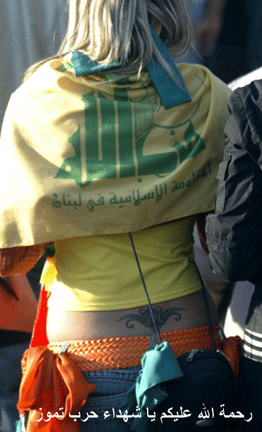
A picture is worth a thousand slogans and not just in Lebanon.
Category Archives: Photography
Picturing Sanaa
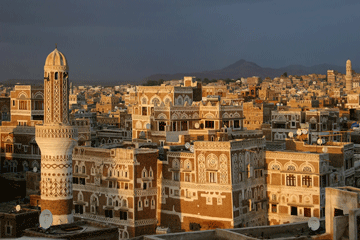
Photograph by Tan Yilmaz
“Sanaa at dusk, taken from the rooftop terrace of Taj Talha hotel. I was not staying there, but non-guests can go up to the terrace for the view (try doing that in elitist Dubai). I did not bother erasing the profusion of unsightly satellite dishes, there are too many. 45mm. focal length, just before sunset. The sky is as dark as it is because of a departing thunderstorm. This is taken 1 day before the last Sanaa photo I uploaded, which was from the Golden Daar hotel. The workshops shows SANAA BY NIGHT.”
Picture Iraq in 1925
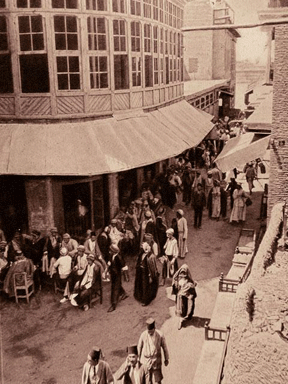
A Street in Baghdad, photo by A. Kerim, 1925.
Can you picture a Baghdad street without damage from the ongoing war in which shrapnel and broken glass draw the blood or ordinary Iraqis of all persuasions? One way is to return to the past more than 80 years ago to the year before the Baghdad Museum was created. The website Iraq Museum International has a number of interesting pages on the archaeological and pictoral history of Iraq. One of these is an online exposition of 72 sepiatone photographs taken by A. Kerim in 1925, published by the Hasso Brothers in Baghdad and printed by Rotophot A.G. in Berlin. These photographs are currently in the Harvard Semitic Museum Photographic Archives. The photographs cover all aspects of life, architecture and daily life and are well worth looking at or using in a classroom.
Reporting the Golf between Us
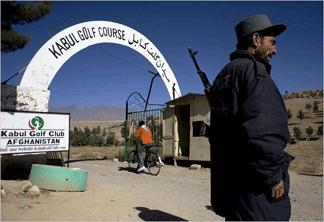
What might be the top story coming out of Afghanistan today? Another Korean missionary kidnapped by the Taliban, a new estimate of a bumper poppy crop, yet again a suicide bombing in Kabul? These are too obvious to be news anymore. How about the largely unused and downright laughable Kabul Golf Course? This is the front-and-center story with two color pictures on the front page of today’s New York Times. And for those who can click a mouse, there is a slide show with thirteen (not a lucky number for an amateur) photographs.
This is no ordinary golf course, which is one of the reasons it makes the first page. Here is the description reported today by Kirk Semple:
It is the Kabul Golf Course, Afghanistan’s only one, and Mr. Abdul, who picked up a putter for the first time when he was 10, is its director and golf pro.
The nine-hole course is extraordinarily rugged by any standard. Continue reading Reporting the Golf between Us
Love at First Site
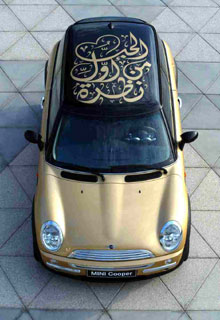
[Photograph from http://www.ameinfo.com/images/news/4/3174-mini.jpg.]
Love makes the wheels go round…

A Dialogue With Allah
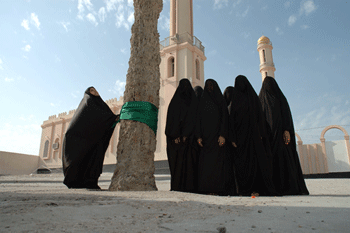
Figure 1: Mosque, women and palm tree.
By el-Sayed el-Aswad
Folk culture provides members of the society with living models in the form of iconic images, key symbols, and root metaphors that enable them to express themselves, and the other as well. Sanctity or religious meaning is bestowed on an object or place for the reason that a religiously significant event (a miracle, wonder or blessing) is associated with it.
At an art exhibition at the College of Art, Bahrain University last year, 2006, I was surprised to see very beautiful and stunning pictures in which a group of women were climbing palm trees (figure 2-5). Recognizing the cultural significance of the palm tree in Arab societies, I decided to interview Waheeda Malullah (figure 6), the artist whose photos show that the climbing of palm trees is not just aimed at the collection of dates commonly consumed in the Arab Gulf countries, but rather at the engagement in spiritual communication with invisible spheres of the cosmos and the achievement of blessing or grace (baraka), among other objectives. Continue reading A Dialogue With Allah
The Reach of War
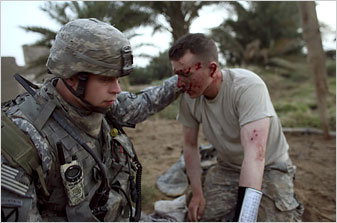
[Photograph by Michael Kamber for the New York Times.]
While the news media feed on the battle between congressional democrats and the Bush administration over the war budget, the war continues day by day with no congressionally prodded end in sight. The war in Iraq also dominates the field of political play for the next presidential election, with Bill Richardson declaring his candidancy yesterday and in no uncertain terms blasting the current war policy. But in all of this the war does not really reach us. Yet it is possible to reach out and feel some of the pain of the war. In today’s online New York Times, Michael Kamber, a photographer, provides a slide show of an attack on an army unit in which an American soldier was killed. I suggest you ignore the talking heads of politicians today and see for yourself the agony of loss on a battlefield with no visible enemy. Don’t wait to see the name in the paper; absorb the context that took a life needlessly to satiate the ideological appetite of the current lame duck (pun intended) administration.
Daniel Martin Varisco