Photograph courtesy of Dr. Dagmar Riedel
Category Archives: Photography
Not your Daily Bread
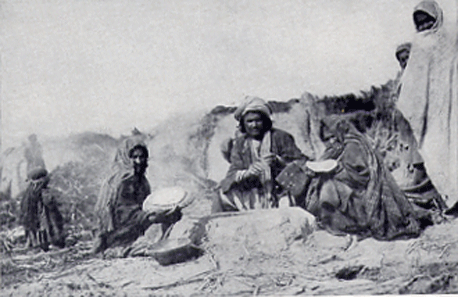
Baking bread in Seyistan on the Afghan Border
[It is hard to find a society in the Middle East without a thriving history of bread preparation. Before the modern loaf and bleached flour assaulted our tastebuds, a variety of flat breads were baked, either in clay overs or other makeshift ovens. Here is a description of both Afghan and Turcoman bread making from a century ago, as reported by Ellsworth Huntington in the National Geographic Magazine in 1909. Webshaykh.]
The method of cooking it was very different from that employed in the oases, where ovens of mud shaped like beehives, with a hole in the top, are heated with a fire of weeds, and the dough is stuck against the inside of the hot oven, where it hangs until it is so far cooked that it falls down into the ashes. The bread of the Afghan caravan was cooked by heating small, round cobblestones in the fire and then poking them out and wrapping dough an inch thick about them. The balls thus formed were again thrown into the fire to be poked out again when cooked. The bread tasted well there in the desert, although in civilized communities the grit and ashes would have seemed unendurable. Continue reading Not your Daily Bread
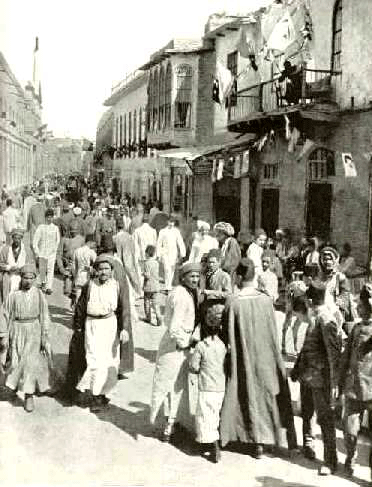
Baghdad, 1914
Syrian Bread a Century Old
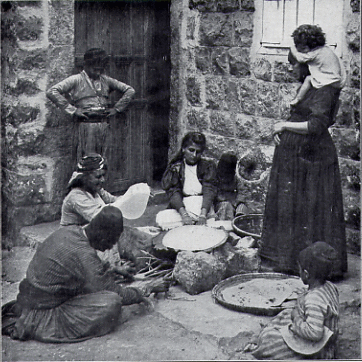
Baking Bread in Syria: The hearth is simply two stones raised on end, over which an iron plate is laid, on which the bread is baked. Source: National Geographic Magazine, XIX(3):171, 1908.
Iranian Revolutionaries, 1906
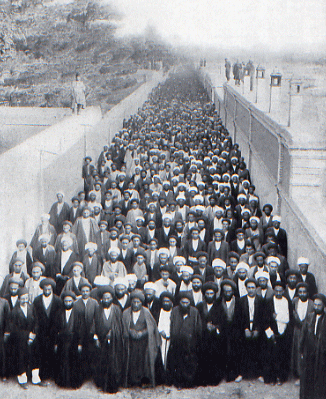
“Crowd of Persian Revolutionists, Who, fearing the vengeance of the royal troops, took refuge int he British Legation in Teheran in 1906, and insisted on remaining there until the Shah gave them a parliament.”
Revolution is no stranger to modern Iran. In the May, 1908 issue of The National Geographic Magazine, published just a century ago, there was an article by W. P. Cresson entitled “Persia: The Awakening East.” Here is an excerpt from Cresson’s account of the newly formed parliament:
The strong nationalistic spirit that marks the new era in Persian affairs is one of the most interesting features of the present movement in Persia. It is not among the frock-coated European dandies of the court that we must look for the men who are now taking the leading part in the new agitation for reform. Many of the constitutionalistic leaders wear the flowing robes and white turban of the Mohammedan priesthood. Recently the Liberal Parliament by an overwhelming majority voted to suppress the publication of a Teheran newspaper which had dared to propose the substitution of a new civil code modeled on European lines for the old common law based on the precepts of the Koran. One of the chief causes of popular complaint against the leaders of the Court party is their subserviency to foreign influences and their unpatriotic policy of importing foreign officials into Persia, notably in the case of the customs administration. Continue reading Iranian Revolutionaries, 1906
Picturing Damascus
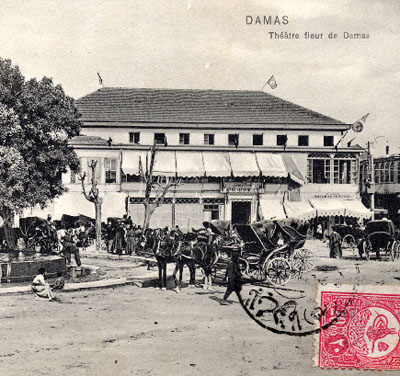
Visual archives abound on the Middle East and a growing number of these now appear on the Internet. One of these is mideastimages.com, which hosts a variety of historic photographs focusing on the cities of Aleppo, Baghdad, Cairo, Damascus, Istanbul, Jerusalem and Palmyra. Here is a postcard mailed from the Thomas Gate post office in Damascus during the Ottoman period. It depicts the Flower of Damascus Theatre, owned by Habib Shamas, in the Marje Square. In 1912 this theatre hosted the first movie played in Damascus. The theatre was converted to a Cinema in 1918. (Source: DAMASCUS BY Dr. K. SHIHABI 1986)
A License to Bomb
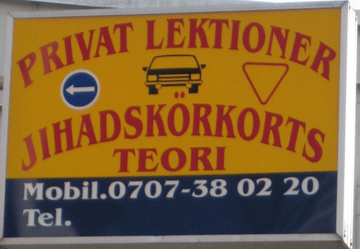
If you are wondering where suicide bombers learn to drive, please note that it is not in madrasa driver’s training, despite what the signs may say.
[Photograph courtesy of Jon Anderson.]
Norma’s Take on Carthage: Part Two
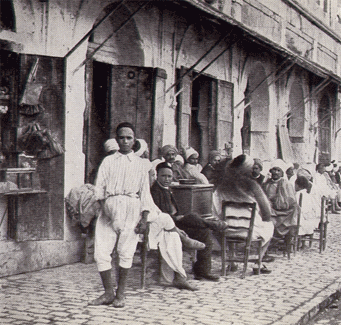
The Café in the Place Halfaouine.
In an earlier post I provided the Orientalist musings of Ms. Norma Octavia Lorimer, whose By the Waters of Carthage (1925) is classic put-down travel mongrelism. If you thought the first part was bad, read on below…
“OH, MY DEAR!
Come and take me to the desert; it lies over there, in the great Beyond, like Death — waiting — waiting — waiting.
I have seen camels in their proper atmosphere, lading their common everyday life of indifference, though so far, I must admit, I have not seen them trying to get through the eye of a needle. These strange supercilious leavings of the prehistoric past are almost as scornful of mankind as new-born babies. A Horse looks as foolishly modern besides a camel as an Englishman in his blue serge suit looks beside a burnoused and biblical Moslem…
I have been in the souks (bazaars), and it is true that there above all places you can hear the East ‘a-calling’; it is there that you forget that Tunis is under French protection and it has fine boulevards and theatres and a Petit Lourve, for all that is on the other side of the horseshoe gate (the porte de France, as it is called), and my hotel is within in. It is in the bazaars before midday that you get a glimpse of how the people live, for the pulse of the city is there, if an Arab city has a pulse. Continue reading Norma’s Take on Carthage: Part Two