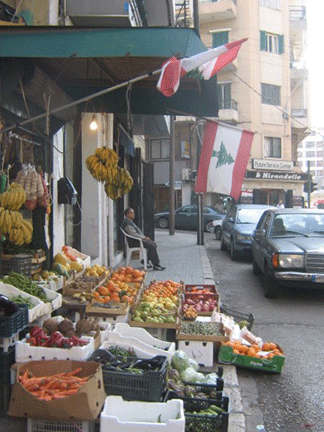
The photograph above was taken by Estella Carpi, who is currently working on a development project in Cairo, on a trip to Beirut in early April.
The photograph above was taken by Estella Carpi, who is currently working on a development project in Cairo, on a trip to Beirut in early April.
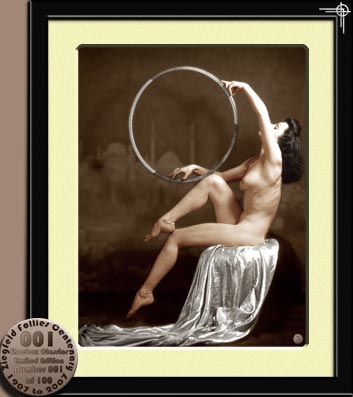
Ziegfeld Follies Girl representing Scheherazade from The Arabian Nights
On a personal note, today is my birthday. It is hard to be serious on such a foreboding occasion, especially when the magic number now exceeds the number of varieties of Heinz pickles. Besides (myself), the sun is shining and it is spring and silliness is in the air. [Isn’t it silly that we drop the ‘y’ to make silliness gramatically correct?] Since I have been preparing a powerpoint for a class on the history of ways in which the human body has been depicted, especially in the art of Adam and Eve in Eden, I have come across a number of Google-ill-begotten images, some of which are hilarious, some risque and some poignant. Take, for example, the picture above, which is not off a current porn site but actually a Ziegfield Follies Centennial print, indeed the first in the series.
So what do you see here? Continue reading Daydreams and Arabian Nights
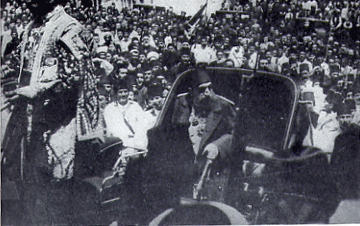
The sultan of the Ottoman Empire going to mosque the day after the constitution was announced.
Social Freedom for Turkish Women
by Mary Mills Patrick.
[The following excerpt is from “The Emancipation of Mohammedan Women,†published in the National Geographic Magazine, January 1909 (Volume XX, No. 1, p.p. 61-62).]
Their past experience has been slowly preparing the Turkish women for the larger opportunities that the constitution gives them. On the morning of the 24th of July all classes of the Turkish Empire entered into a new life, but the greatest change of all took place in the harems. Women everywhere threw off their veils. A prominent woman in Salonica openly assisted her husband in the political celebration.
One woman went so far as to have her picture published in a Paris paper. At this the members of the Reactionary party rose up in common protest and said, “If this be the result of freedom, that our women display their faces to the public with such brazen immodesty, we do not wish a constitution.â€
The turkish women are true patriots, and when they saw that the question of freedom for women appeared to have such deep significance to the nation, not only from a political and social, but also from a moral point of view, they said with one accord, “Of what consequence is so small a matter as the veil! We will continue to wear our veils, and will seek the larger opportunities that the new constitution gives us.†Turkish women everywhere have accordingly resumed their veils; but it is a very different thing to wear a veil voluntarily from being obliged to do so, and eventually they will probably appear in the streets without them.
The moral freedom that the revolution has brought the Turkish women is showing itself in many different lines. The freedom of the press has been offered to women. They are writing for the papers openly and without fear of censorship, and their voices are being heard in regard to the affairs of the nation.
Mary Mills Patrick was President of the American College for Girls at Constantinople.
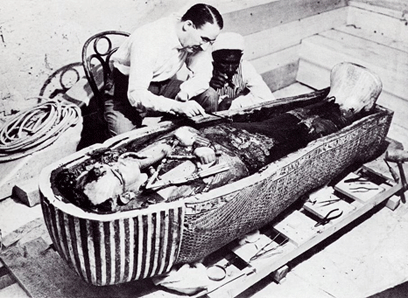
Howard Carter cleaning the sarcophagus.
February 16, 1923 — one of those days that marks a momentous event, if you are an Egyptologist or just curious about the Pharaonc past. On this day British archaeologist Howard Carter entered the tomb of what turned out to be the golden hold of King Tutankhamun. For a treasure trove of photographs and details about this discovery, see Tutankhamun: Anatomy of an Excavation, an online resource of the Griffith Museum at Oxford.
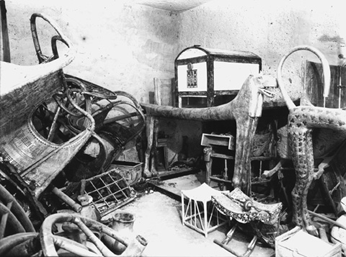
The tomb when first opened.
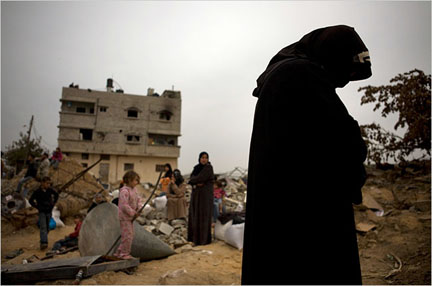
Residents returned to their homes around Gaza City on Friday. Tyler Hicks/The New York Times
Gaza is not history, nor is it likely to be soon. The bombs may have ceased on both sides, but the human toll presages a bleak future. Both sides have grievances, but the grief from death, maiming and sheer destruction of property and homes is incredibly disproportional. Even Independent observers must acknowlege this:
Up to 10 times as many Palestinians were killed as Israelis. The Palestinian Ministry of Health says 1,314 Palestinians were killed, of whom 412 were children or teenagers under 18, and 110 were women. On the Israeli side, there were 13 deaths between 27 December and 17 January, of whom three were civilians killed by rockets fired from Gaza. Of the 10 soldiers killed, four were lost to “friendly fire”.
Even if the Palestinian figure is disputed, it is clear that the death toll was massively higher for Palestinians than Israelis. Proportionality is not simply a matter of numbers, however. Continue reading Disproportional suffering
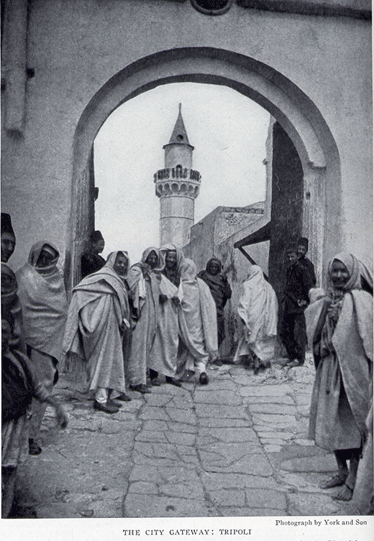
Photograph of one of the main gates of Tripoli, Libya, taken around 1925 for The National Geographic Magazine by York and Son.
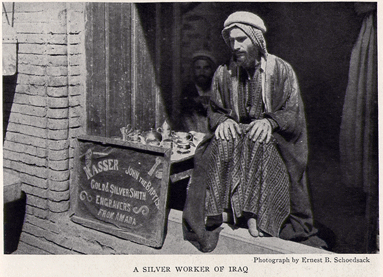
In a previous post, I commented on a 1925 National Geographic Magazine article by Major F. A. C. Forbes-Leith. In his journey from London to Quetta, the major passed through Iraq and met some of the famous silver makers from Amara.
Daniel Martin Varisco
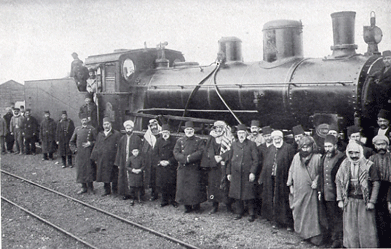
Engine “Abdul Hamid” on the Mecca Railroad; Source: National Geographic Magazine XX(2):158, 1909
[A few years before World War I, when the Ottoman empire was still an empire, the Sultan Abdul Hamid sponsored a railway link between Damascus and Mecca for the pilgrim route. Although the Hijaz Railway is little known today, it has already merited a Wikipedia article. The following is from a report published a century ago on the opening of the railway. Webshaykh.]
The gauge of the line is the somewhat curious one of 1.05 meter (3 feet 5 1/4 inches), which was necessary, when the line was first commenced, to correspond with the gauge of the Beirut-Damascus line, over which the rolling stock had to be brought. The branch to the Mediterranean, at Haifa, was constructed subsequently. The rolling stock has been obtained principally from Belgium, with the exception of the engines, which are made by a German firm. The rails were supplied by the American Steel Trust, but a French firm domiciled in Russia, and by the firm of Cockerill, in Belgium.
The engineers in charge of sections were also of various nationalities — French, Poles, Hungarians, etc. — while the guiding spirit in the construction has been Meissner Pasha, a very able German engineer. Continue reading The Mecca Railway