Category Archives: Photography

Sailing Forbidden Coasts


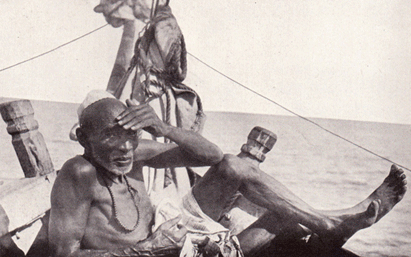
Sheik Issa Embarks on the ‘Altair’ for Arabia. He is honored and respected among the Danakil as a leader and saint. Not only was he a gracious host, but he offered to accompany the Altair’s party from the Somali coast over to Arabia, in order to afford them protection from pirates.


[Webshaykh’s Note: Much attention has been given to the Somali pirates loose in the Gulf of Aden. Piracy is no stranger to this corner of the Horn of Africa, nor to seafaring anywhere in history. Here is an excerpt by an American woman visiting the French Somaliland coast in 1930. Ms. Treat indeed provides a colorful narrative treat of her journey aboard a dhow captained by a French convert to Islam. The whole article is well worth reading, as the following excerpt suggests.]

by Ida Treat, The National Geographic Magazine, 1931

Wading through the warm lagoon, breast deep, we crossed the damp sand among the mangroves, treading down the rubbery shoots among which lay quantities of black sea snails, for it was low tide. Beyond the mangroves, the beach stretched bare and white to the four huts, bleached as driftwood, and of so light a construction it seemed that a puff of wind would scatter them across the sand.

Two downy baby camels, in a narrow inclosure of mimosa thorns, darted snakelike necks through the ranches as we passed. From the largest of the huts a man came toward us. I recognized Sheik Issa, whom I had sen at Obock, his lean torso bare, the wooden prayer beads about his neck, swinging across the sand with a vigorous, youthful stride, for all his sixty-odd years.

The day before he had sent the Altair from the heights of Djebel Ghin and had walked all night to be at Angar to welcome us. Continue reading Sailing Forbidden Coasts
THE STORY OF PYRAMID THOTHMES


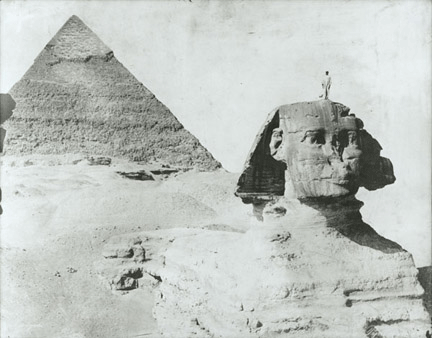
Sphinx and Pyramid at Giza

THE STORY OF PYRAMID THOTHMES

THOTHMES, who loved a pyramid,
And dreamed of wonders that it hid,
Took up again one afternoon,
His longest staff, his sandal shoon,
His evening meal, his pilgrim flask,
And set himself at length the task,
Scorning the smaller and the small,
To climb the highest one of all.

The sun was very hot indeed,
Yet Thothmes never slacked his
Until upon the topmost stone
He lightly sat him down alone
To make himself some pleasant cheer
And turned to take his flask of beer,
For he was weary and athirst. Continue reading THE STORY OF PYRAMID THOTHMES

“Our Foreign-Born Citizens”


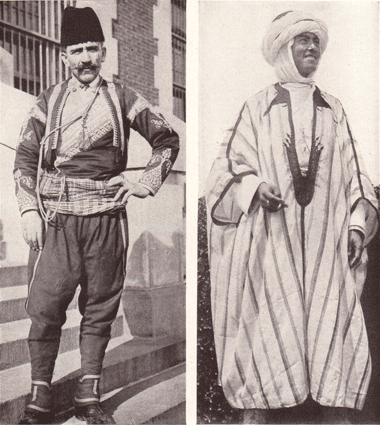
” Turkish Bank Guard” (left), “Even Algeria Sends its Quota to America” (right)

Like many Americans, my father was born in this country, but his father came from Sicily in the 1890s. The year my father was born, 1917, National Geographic Magazine published a lead article entitled “Our Foreign-Born Citizens.” Given the current anti-immigration sentiment of many Americans today, it is useful to look back at the same issue that rocked American politics almost a century ago. Given the optimistic note below that our territory could hold 900 million people, the latest census results showing the U.S. population is now over 300 million is a hopeful, even if not well documented, sign. Here is a sample from the article:

Never in the history of the American people has a measure been passed by Congress as often and vetoed by the President as many times as the immigration bill recently enacted into law. Three presidents of the United States have felt so keenly that the founders of the government and their successors were right in holding that the lack of opportunity to learn to read and write should not bar an alien from freedom’s shores, that they have overridden the will of the four Congresses and have interposed their veto between the congressional purpose and the unlettered immigrant’s desire. Continue reading “Our Foreign-Born Citizens”

Discovering fashion and identity in Yemen


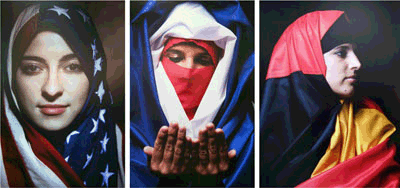
Photographs by Boushra Al-Mutawakel

by Yazeed Kamaldien, Yemen Times, December 16, 2010

A packed crowd swarmed around the Sana’a Styles: Fashion and Identity photo exhibition and artworks event earlier this week, when it opened at the House of Culture on Al-Qasr Street in Sana’a.

Striking photographic essays plastered the venue walls. Large color portraits of Muslim women wearing the hijab, or Islamic headscarf, photos showing women in black veils surrounded by contemporary fashion and snapshots of ordinary Yemenis making a statement with their everyday clothes.

Photographer Sophie Elmenthaler showed a series of photos under the title ‘Hijab and High Heels’. These pictures showed fashion for women that would reveal skin if worn in public, but that Yemeni women would only wear in private. The images included clothes labeled the “cheapest goods from China and India” sold in Sana’a.

A short film showed Yemenis talking about the clothes they wear and what motivates their sense of style. Another series of photos showed women in various uniforms and cultural dress, commenting on how clothes ensured that individuals became part of the communities where they live.

“People with a strong sense of assertiveness accept identities of their social group,” reads the statement from this series of photos. Continue reading Discovering fashion and identity in Yemen

Raising Dust in Palestine


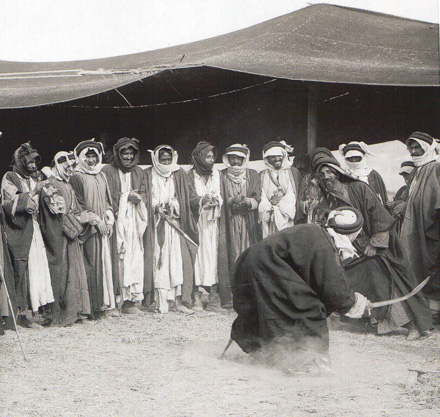
Sword dance at a Bedouin wedding in Palestine, early 1900s; Rowe 2010, opposite p. 116

We hear so much about the political turmoil between Palestinians and Israelis that the traditional culture and its transformation are all but forgotten. Bombs continue to go off or be dropped, settler slabs destabilize the opportunity for a variety of people to live together, hawks and doves flitter away in a rhetorical fog. Yet there is movement, especially in dance. Nicholas Rowe, a choreographer and dancer from Australia has recently published a moving portrait of the changing dance tradition among Palestinians, with a focus on how dance reflects political stalemate and obstacles. This is his Raising Dust: A Cultural History of Dance in Palestine (London: I. B. Tauris, 2010).

A brief description of the book is provided by the publisher: Continue reading Raising Dust in Palestine

Performing Islam


Performing Islam is the first peer-reviewed interdisciplinary journal about Islam and performance and their related aesthetics. It focuses on socio-cultural as well as historical and political contexts of artistic practices in the Muslim world. The journal covers dance, ritual, theatre, performing arts, visual arts and cultures, and popular entertainment in Islam influenced societies and their diasporas. It promotes insightful research of performative expressions of Islam by performers and publics, and encompasses theoretical debates, empirical studies, postgraduate research, interviews with performers, research notes and queries, and reviews of books, events and performances.

Call for contributions for the second issue: Continue reading Performing Islam