Category Archives: Photography

Old World Travel 90 years on: #3 An Arab Cafe


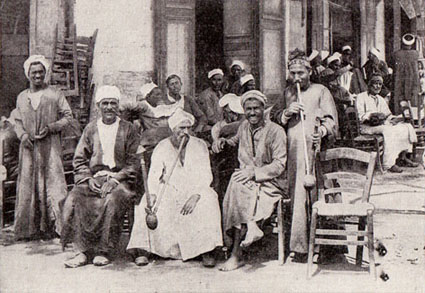
“These cafes are picturesque places where one sees the street life of Cairo at its best. Note the more humble style of Turkish pipe smoked by this Arab without being set on the floor.

Exactly 90 years ago a four-volume set of encyclopedia-like human interest books was published as The Human Interest Library: Visualized Knowledge by Midland Press in Chicago. In a previous post I commented on its thoroughly “Orientalist” flavor. The section on Egypt covers mainly the archaeological history with only a few brief comments on the then contemporary state of Egypt. On one plate (volume 4, p. 114) there is a photograph of “An Arab Cafe” (shown above) underneath one of the mummy of Sethi the First. There is also a scene of two water carriers (shown below).
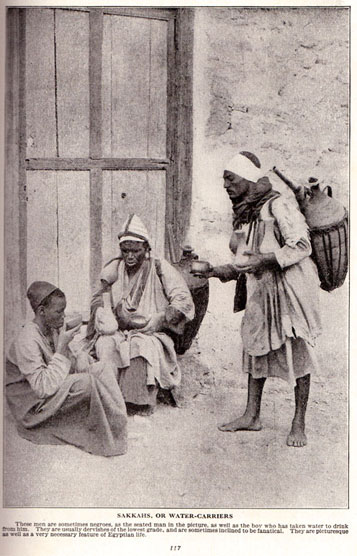

“These men are sometimes negroes, as the seated man in the picture, as well as the boy who has taken water to drink from him. They are usually dervishes of the lowest grade, and are sometimes inclined to be fanatical. They are picturesque as well as a very necessary feature of Egyptian life.”

It is not until the last page of the article that “Egypt today” is uncovered. Not surprisingly, the Pharaonic past is for more than prologue here:

Egypt today, as the case with most of these ancient countries is merely the shadow of its former self; its inhabitants lack the energy and popwer which seem to have belonged to their ancestors. The French some years ago constructed the Suez Canal and on a sandbar which was built up from the the dirt out of the canal the modern city of Port Said was located. It is in some ways the most cosmopolitan city in the world being the gateway between the Occident and the Orient. In visiting Egypt the former usually lands at Port Said or Alexandria, then there is a ninety mile trip by rail to the city of Cairo. It seems quite odd to be riding by street car the six miles out from Cairo to the pyramids. It seems such an awe-inspiring thing to connect these ancient monuments with such a modern achievement. It is, however, typical of Egypt today in that ancient and majestic relics are on the one hand in contrast with the impudent signs of modern native life on the other; the little Bedouin children plan and the burros graze over spots the penetration of the sanctity of which once demanded the penalty of death.

Ah, the sentiments of the Occidental tourist in an antique land where the “impudent signs of modern native life” mar the view of ancient relics. Selah.
Old World Travel 90 years on: #2 The Simoon and Mirage


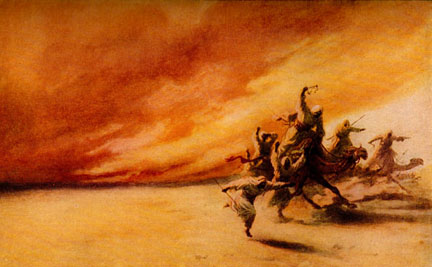
Exactly 90 years ago a four-volume set of encyclopedia-like human interest books was published as The Human Interest Library: Visualized Knowledge by Midland Press in Chicago. In a previous post I commented on its thoroughly “Orientalist” flavor. Not only was the Sahara portrayed as a barren landscape with people who have nothing to do, but the only winds of change are violent storms summed up in the Anglicized “simoon.” Above is an image from the frontispiece to volume 2 in the series and entitled “The Dreaded Simoon – The Scourge of the Desert”. I have not been able to find the name of the artist, which is clearly pre-1921. The caption reads: “The fury of the simoon is like the blast of a furnace. Winged with the whirlwind. and charioted with thunder, it blasts everything in its course. It has the appearance of a train of fire whose murky smoke fills the whole wide expanse of the desert.”

Here is the text describing “The Scourge of the Desert” (Vol. 4, p. 97):

As the color plate shows, the simoon, described by writers, must have presented a majestic and awe-inspiring spectacle. Continue reading Old World Travel 90 years on: #2 The Simoon and Mirage

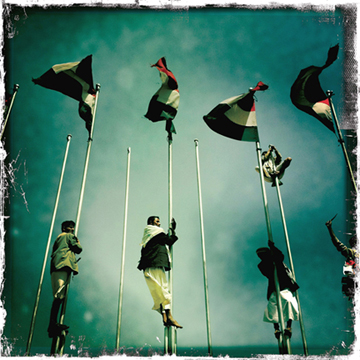
Yemen’s Unfinished Revolution


Photo by Karim Ben Khelifa

By TAWAKKOL KARMAN, The New York Times, June 18, 2011

Sana, Yemen

AFTER more than five months of continuous protests, I stand today in Change Square with thousands of young people united by a lofty dream. I have spent days and nights camped out in tents with fellow protesters; I have led demonstrations in the streets facing the threat of mortars, missiles and gunfire; I have struggled to build a movement for democratic change — all while caring for my three young children.

We have reached this historic moment because we chose to march in the streets demanding the resignation of President Ali Abdullah Saleh, an end to his corrupt and failed regime and the establishment of a modern democratic state. On June 4, our wish for Mr. Saleh’s departure was granted, but our demand for democracy remains unfulfilled.

Following months of peaceful protests that reached every village, neighborhood and street, Yemen is now facing a complete vacuum of authority; we are without a president or parliament. Mr. Saleh may be gone, but authority has not yet been transferred to a transitional presidential council endorsed by the people.

This is because the United States and Saudi Arabia, which have the power to ensure a peaceful transition to democracy in Yemen, have instead used their influence to ensure that members of the old regime remain in power and the status quo is maintained. American counterterrorism agencies and the Saudi government have a firm grip on Yemen at the moment. It is they, not the Yemeni people and their constitutional institutions, that control the country. Continue reading Yemen’s Unfinished Revolution

Orientalist Images #2


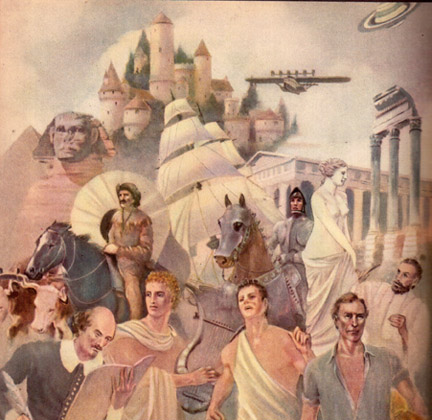
Half of the painting for the inside cover of Richards Cyclopedia, by Edwin Winfield Hall


[With this post I continue a series dedicated to photographs in an “Orientalist” mode. In addition to
Reading Orientalism, the title of my last book, the creation of an imagined Orient is very much a pictorial voyeuristic voyage. In this series I focus on Western images of the Middle East and North Africa, both those that perpetuate stereotypes and those that chip away at the bias. Readers of the blog are welcome to send in images they have found and want to share.]

I continue with an image from a 1933 edition of Richards Cyclopedia, with 24 volumes published in New York by J. A. Richards, Inc and edited by Ernest Hunter Wright and Mary Heritage Wright. This is an unusual encyclopedia, arranged by topics in a more or less arbitrary order but replete with images. The inside cover, half of which is shown above, is a collage of cultural references. Across the top one finds the beginnings of civilization (at least in the thinking of the time) in the ancient Egyptian pyramid and sphinx, with a towering medieval castle above and both a modern airplane and image of Saturn looking down on ancient Greece, where a beautiful half-naked Grecian standing odalisque butts up against a knight in shining armor. There are ships and covered wagons in this pictorial representation of manifest destiny. The part not shown is distinctively American progress, though with a Maharajah inexplicably riding an elephant in front of a giant oceanliner. Continue reading Orientalist Images #2

Cruising above the Empty Quarter


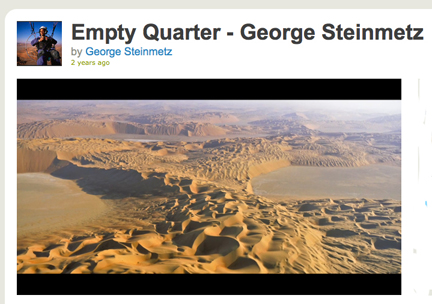
There is a spectacular photographic website devoted to a book by George Steinmetz, who took photographs across the fabled Empty Quarter of Arabia.

I became captivated by Arabia’s Empty Quarter as a young man when I read Wilfred Thesiger’s Arabian Sands. The Empty Quarter is larger than France without a single permanent point of water or human habitation. It’s both the world’s largest sand sea and one of the hottest places on earth, and has only been traversed a handful of times. I didn’t want to repeat Thesiger’s epic journeys many decades later, but when I discovered motorized paragliding I found a way to visualize this remote landscape in a new way. I made three paragliding trips into the sands, first for GEO in Saudi Arabia, and then returned two years later to go from Riyadh to Oman and Yemen for National Geographic, and finally made a personal trip to the southern most reaches of the U.A.E. to complete my field work. What I found was one of the most beautiful and unseen wilderness on earth. On its fringes I encountered elements the oil wealth that has forever changed Arabia, but I also found Bedouins still clinging to traditions, and offering up a level of hospitality that was truly humbling. This body of work would simply not have been possible without their kindness.

Empty Quarter is George’s second book, published by Harry N. Abrams. This is the most extensive compilation of photographs ever taken in the Arabian Desert. Measuring 9.5 x 13 inches, the book has 208 pages with 150 color photos and captions.

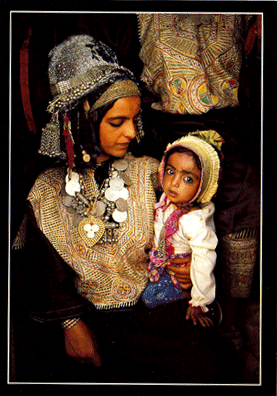
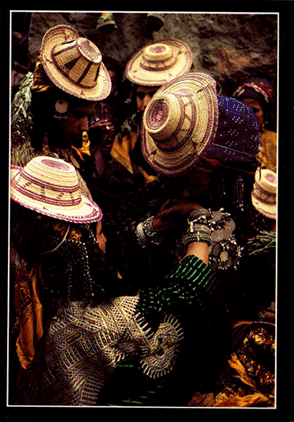
With Marechaux in Yemen

The news out of Yemen continues to be dismal. There are reports of several thousand Hashid tribesmen arriving at the gates of Sanaa. The day-to-day nightmare continues. Such ugliness in such a beautiful country. The scenes of blood-soaked bodies are available on several Arabic websites, but our thoughts must also be with those who live. Here are two pictures from the superb French photographers, Pascal and Marie Maréchaux.