Category Archives: Archaeology and Antiquities

Oldest song in the world…


Listen to the Oldest Song in the World: A Sumerian Hymn Written 3,400 Years Ago

Open Culture, July 8th, 2014

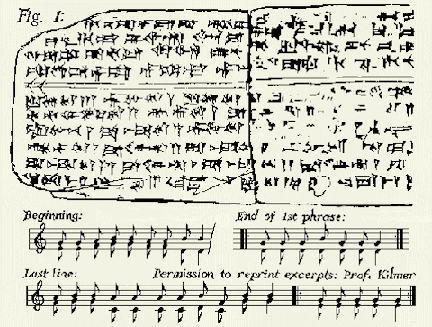
In the early 1950s, archaeologists unearthed several clay tablets from the 14th century B.C.E.. Found, WFMU tells us, “in the ancient Syrian city of Ugarit,” these tablets “contained cuneiform signs in the hurrian language,” which turned out to be the oldest known piece of music ever discovered, a 3,400 year-old cult hymn. Anne Draffkorn Kilmer, professor of Assyriology at the University of California, produced the interpretation above in 1972. (She describes how she arrived at the musical notation—in some technical detail—in this interview.) Since her initial publications in the 60s on the ancient Sumerian tablets and the musical theory found within, other scholars of the ancient world have published their own versions.

The piece, writes Richard Fink in a 1988 Archeologia Musicalis article, confirms a theory that “the 7-note diatonic scale as well as harmony existed 3,400 years ago.” This, Fink tells us, “flies in the face of most musicologist’s views that ancient harmony was virtually non-existent (or even impossible) and the scale only about as old as the Ancient Greeks.” Kilmer’s colleague Richard Crocker claims that the discovery “revolutionized the whole concept of the origin of western music.” So, academic debates aside, what does the oldest song in the world sound like? Listen to a midi version below and hear it for yourself. Doubtless, the midi keyboard was not the Sumerians instrument of choice, but it suffices to give us a sense of this strange composition, though the rhythm of the piece is only a guess.
Syria’s World Heritage in Peril


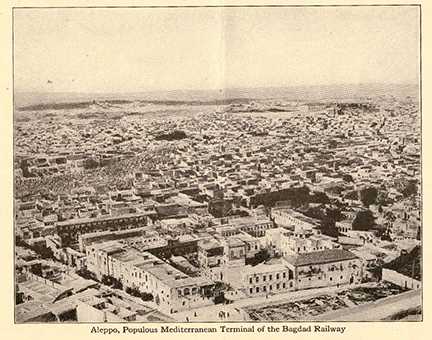
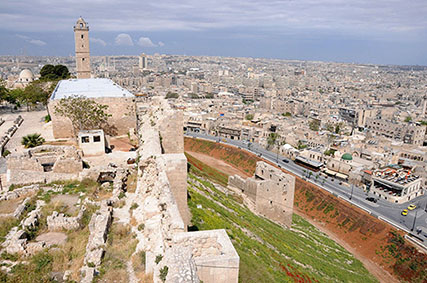
Aleppo from the Citadel before the recent destruction

New high-resolution satellite image analysis: 5 of 6 Syrian World Heritage sites ‘exhibit significant damage’

September 19th, 2014, Archaeology News

In war-torn Syria, five out of six World Heritage sites now “exhibit significant damage” and some structures have even been “reduced to rubble”, according to new high-resolution satellite image analysis conducted by the nonprofit, nonpartisan American Association for the Advancement of Science (AAAS).

The AAAS analysis, offering the first comprehensive look at the extent of the damage to Syria’s precious cultural heritage sights, was completed in partnership with the University of Pennsylvania Museum of Archaeology and Anthropology’s Penn Cultural Heritage Centre (PennCHC) and the Smithsonian Institution, and in cooperation with the Syrian heritage Task Force. The National Science Foundation funded the analysis, which provides authoritative confirmation of previous on-the-ground reports of damage to individual sites.

“Only one of Syria’s six World Heritage sites‒ the Ancient City of Damascus‒ appears to remain undamaged in satellite imagery since the onset of civil war in 2011,” said Susan Wolfinbarger, director of the Geospatial Technologies and Human Rights Project at AAAS. Historic structures residing at the other five sites, including ancient mosques, schools, and civilian as well as government buildings, have all been damaged, and in some cases, destroyed, AAAS reported. Wolfinbarger added, however, that “the Damascus site also could have damage not visible in satellite images.” Continue reading Syria’s World Heritage in Peril

Saving Syria’s Antiquities

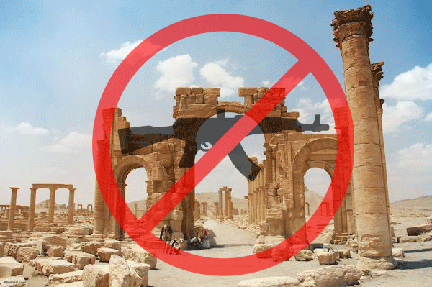
The turmoil and ruthless slaughter that is destroying both lives and heritage in Syria has multiple consequences. Beyond the humanitarian crisis, which is huge, there is widespread looting of antiquities in a country where there is a valuable heritage. Dr. Amr Al-Azm has started a campaign to save these antiquities. Details below. Click here to sign the petition to the UN.

Treasures from our museums and ancient cities in Syria are being looted and destroyed, falling victim to the war’s blind aggression. My former archeology students are working diligently and risking their lives to protect our country’s cultural heritage.

It’s important that our heritage is preserved, not only for its intrinsic beauty and historical value, but also because it helps us reconstruct Syrian identity. Now, the market for stolen artefacts is in the millions, but one important thing can make a difference.

The UN must ban the trade in Syrian artefacts.

So far they have ignored numerous calls to push through a resolution as they did in the past to protect Iraq’s heritage, but there’s something much larger at stake now that should get them to act. Looting Syria’s history is big business and the extremist group known as ISIS have added millions of dollars to their war chest because of it.

Syrians are now not only watching their history being torn down and sold to foreign buyers, but they’re having that money turned against them in the form of more weapons.

— Dr. Amr Al-Azm

Associate Professor of Middle East History, Shawnee University
Professor at the University of Damascus (1998-2006)
Director of Science and Conservation Laboratories at the General Department of Antiquities and Museums in Syria (1999-2004)