
Here is a very useful source for downloading pdfs of Arabic texts on a wide range of subjects. Check it out here: https://ebook.univeyes.com/disciplines
Here is a very useful source for downloading pdfs of Arabic texts on a wide range of subjects. Check it out here: https://ebook.univeyes.com/disciplines

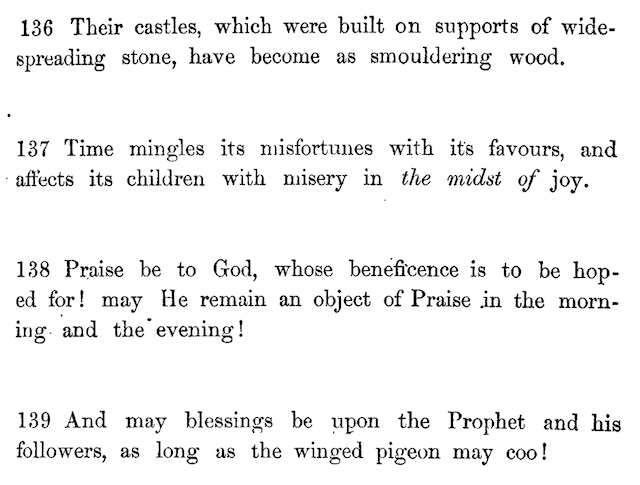
The war that has dragged on in Yemen for seven years has created a major humanitarian disaster. Yemen has experienced war and conflict before since the early days of the Queen of Sheba. The last of the South Arabian kingdoms before the coming of Islam was captured in a qasida by the 12th century Yemeni scholar Nashwan b. Sa‘id al-Himyari. In reading this poem recently I was struck at how relevant the last lines of his poem are for the current political crisis and I share these with you. The full poem can be read online at https://ar.wikipedia.org/wiki/%D8%A7%D9%84%D9%82%D8%B5%D9%8A%D8%AF%D8%A9_%D8%A7%D9%84%D8%AD%D9%85%D9%8A%D8%B1%D9%8A%D8%A9. An English translation was made by W. F. Prideaux in 1879 and can be found here: https://archive.org/details/dli.granth.93715/page/n3/mode/2up.




If you are bored with what you cook, give this rather ancient set of recipes a try. Read all about it on the MyMet website.


This is a beautifully filmed and played Youtube video of Lebanese music performed in the ruins of a temple in Lebanon.


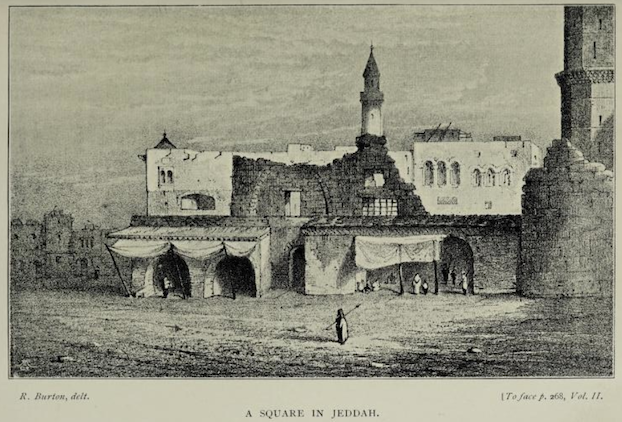
The current de facto ruler of Saudi Arabia, MBS, has promoted a major development scheme entitled Vision 2030. This time, instead of sending henchmen with cleavers, he is authorizing imported Western bulldozers to basically turn the older parts of the historic port of Jeddah into a wannabe Dubai. As noted in a recent article on Qantara:
“Currently, the areas most affected by the destruction are those to the south and east of the old city, the Balad, parts of which have been designated UNESCO World Heritage sites. Prior to evacuation, between 10,000 and 50,000 people lived in each of these neighbourhoods. That means tens of thousands are likely to lose their homes. Estimates circulated by dissidents and demolition critics range from hundreds of thousands to one million."
The port of Jeddah has been the main stopping point for Muslim pilgrims on their way to Mecca for almost fifteen hundred years. It is described by early geographers in detail, given the amount of travelers who passed through. For the modern kingdom, however, history means nothing and can be erased by the whims of the super rich. This continues the destructive Wahhabi impulse that sacked Kerbala in 1802, as described below by ‘Uthman b. Abd Allah b. Bishr (d. 1872) in his Unwan al-Majd fi Tarikh Najd (Mecca, 1930):
“In the year 1802, Ibn Sa’ud made for Karbala with his victorious army, famous pedigree horses, all the settled people and Bedouin of Najd, the people of Janub, Hijaz, Tihama and others…The Muslims [i.e. the Wahhabis] surrounded Karbala and took it by storm. They killed most of the people in the houses and the markets. They destroyed the dome above al-Husayn’s grave. They took away everything they saw in the shrine and near it, including the coverlet decorated with emeralds, sapphires and pearls which covered the grave. They took away everything they found in the town—possessions, arms, clothes, fabric, gold, silver, and precious books. One cannot even enumerate the spoils! They stayed there for just one morning and left after midday, taking away all the possessions. Nearly 2000 people were killed in Karbala.”
When the well-primed news media talk about reform in Saudi Arabia, it is worth noting that reform has a long way to go, given the roots of its blood-soaked Wahhabi past. It will take more than letting women drive at the same time that women who protest are jailed, basic human rights in the kingdom are ignored, and heads are still chopped off in public. Even the chopping up of a journalist who dared to call out the corruption is now ignored, because of the profit for a family which defies the morality of the country’s own Prophet. As long as the Saudi regime buys Western military supplies, they are given free rein to use them, resulting in the world’s worst humanitarian disaster in Yemen, with thousands dead and more dying every day, and fueling the sectarian divide between the Saudis and Iran.
There is a saying that blood is thicker than water, but it seems that for the Saudi elite it is oil which is thicker than either blood or water. They have plenty of oil, have shed lots of blood and are desperate for water. All this leads to an economic domino effect: the world craves oil, oil revenues fuel a family wealth fund which spreads an intolerant interpretation of Islam worldwide, and then much of the oil revenues come back to oil-hungry countries who sell weapons to the Saudis.
Imagine if Greece leveled the Parthenon for a shopping mall and Italy replaced the Colloseum with a football field. In a sense that has already happened to Mecca and Medina. Welcome to Saudi Arabia in 2030…
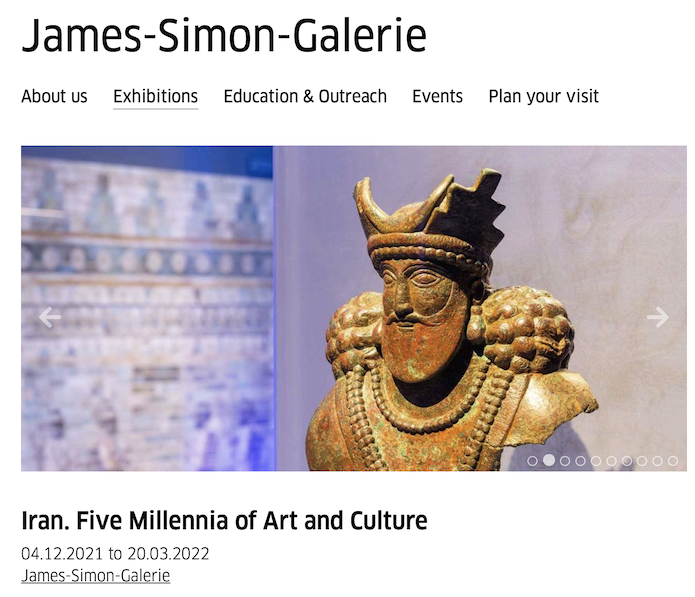
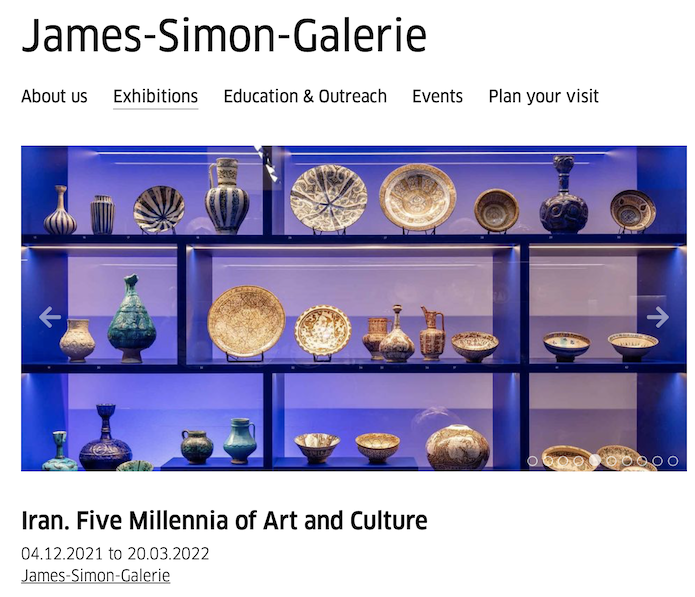
The James Simon Galerie of the Staatliuche Museen zu Berlin has an ongoing exhibition on Iranian art. Click here for details.

The Manhattan District Attorney’s office has conducted a major investigation into an antiquities dealer who bought looted materials from archaeological sites and museums. Read about it here:

My friend, the historian G. Rex Smith, has recently translated into English a marvelous travel diary by the French military official and traveller Pierre Loti (1850-1923). It is also available on Amazon as a Kindle Book. This day-by-day diary details Loti’s trip along the caravan trail of 1900 from the coast at Bushire to Shiraz and his ultimate goal of Isfahan in order to visit the area during the season of roses. One might expect such an account to be dry, but Loti comments on what he saw, including the people, along the way and one gets a first-hand sense of what it was like to travel a treacherous route that was at times over pure desert and at other times up or down seemingly impenetrable mountain heights. There is also a brief account of his stop at Muscat on the way to Persia. Smith, with the aid of his son, has done an admirable job in reflecting the flavor of the original French and includes 24 photographs taken by Loti. This is a book well worth reading, whether you are interested in Persia at the time or not.
The original French version is available as a pdf here. Archive.org has quite a few of his works.
For information about Loti online, check out https://biography.yourdictionary.com/pierre-loti and https://museeprotestant.org/en/notice/pierre-loti-1850-1923-2/.