Category Archives: Journalism and Media

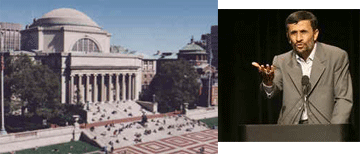
The Courage of Professor Bollinger

“I am only a professor, who is also a university president, and today I feel all the weight of the modern civilized world yearning to express the revulsion at what you stand for. I only wish I could do better.” Columbia University President Lee Bollinger to Iranian President Mahmoud Ahmadinejad, 24 September 2007

Back in the dark days of the American “culture wars” of the 1990s, I read a surprising newspaper column on higher education by a well-known conservative writer–I can’t remember whether it was George Will or Joseph Sobran. Since both of them usually made me shudder, I was surprised to agree quite wholeheartedly with an argument he was making about the nature and content of college education. Colleges, he wrote, should not offer students courses on popular culture. Not because popular culture is necessarily evil or degenerate, but because this (the content, if not the analytical position) was something they could get from the market. Works by and talk about Madonna, the Ramones, and, even then, the Simpsons, are things students receive daily in their cars and their apartments and from their friends. What a university education should offer students is precisely what is not normally available in the broader world, what they cannot get on the open market: Shakespeare, Moliere, general relativity, the history of Polish nobility in the 16th century. None of these topics can be researched or taught or sustained as bodies of knowledge without subsidy. The market can provide us with the lovely Gwyneth Paltrow in Shakespeare in Love, but not with Shakespeare himself (the exceptions–Kenneth Branagh’s Henry V, Baz Luhrmann directing the extraordinary Claire Danes in Romeo and Juliet, and a few others–prove the rule. They were successes precisely because they were so rare and so surprising). All of what we think of as high culture, from symphony concerts to sculpture, depends on financial support from foundations and governments and wealthy individuals to support its performance and availability (the fact that we can still buy Shakespeare’s plays in bookstores is due entirely to the fact that the market for his work is supported by his forced consumption in high school and college classes). Continue reading The Courage of Professor Bollinger

Fear of Mosques

On Thursday Newsday (p. 2) published the latest in the loose-neocon-cannon-fodder remarks of Rep. Peter King, from Seaford, Long Island, New York. He remarked on a blogged video (politico.com) that there are “too many mosques in this country, there’s too many people who are sympathetic to radical Islam.” Before I read this in the morning, I had just returned from teaching a class on the Peoples of the Middle East when I found a request to discuss Rep. King’s comments with New York’s Eyewitness News Channel 7. The reporter arrived in less than an hour and I provided the context on why Muslims, especially on Long Island, take offense at these kinds of remarks. About 10 seconds of my commentary (although not the part directly relevant) made the evening news. Later in the afternoon I was contacted by a New York Times reporter who was following the same story. My comments to him did not make the brief “Metro Note” on King in today’s edition. With the daily rags telling Ahmadinejad to “Drop Dead” for daring to ask to lay a wreathe at the 9/11 site and Rudy vaunting that he would set Iran back “five or 10 years” if they dare develop nukes, the King’s comments seem to be but an echo of the more newsworthy Islamophobia on display. Continue reading Fear of Mosques

Bulldozing the [Arti]Facts

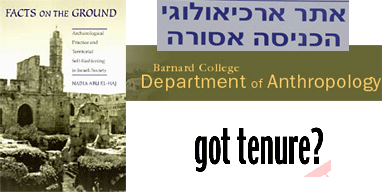
As an individual in Academe who has already achieved the career-defining rite of pedagogical passage known as “tenure,” the issue of a fellow scholar potentially being denied tenure in a highly politicized media campaign becomes an issue of concern. I am not so puffed up to think that tenure status is ipso facto a mark of praiseworthy expertise. There are far too many examples out there of professors who are not any better for having been collegially granted a life sentence or who drop out of publishing and professional sight once they are “in.” Some use the bestowed honor to promote their own partisan views at the expense of teaching others by example to enhance critical thinking. But one thing that I do find sacred about the status is that it is necessarily judged in the local academic context. If one’s peers and administrative lords agree that a certain professor deserves tenure, then so be it. It is not as though a pope is being elected to shepherd the whole flock. Outside interference is indeed interference, especially when the deliberated judgments of a range of responsible individuals at a major college are being challenged.

One current case at Barnard College has hit the media, a rarity except when an outside group has a strong partisan bias. This is the case of Nadia Abu El-Haj, who teaches anthropology. Continue reading Bulldozing the [Arti]Facts

The Problem with ‘My Problem with Jimmy Carter’s Book’

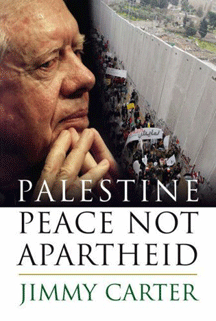
Middle East Quarterly, published by Daniel Pipes’ organization Middle East Forum, contains an article titled “My Problem with Jimmy Carter’s Book”, by Kenneth Stein, the first executive director of the Carter Center in Atlanta from 1983 to 1986, and currently a professor of Contemporary Middle Eastern History at Emory University. Stein, it will be remembered, resigned from his affiliation with the Carter Center, where he was a Middle East Fellow for over two decades, in protest over former President Jimmy Carter’s book, Palestine: Peace Not Apartheid. Touring the country explaining his objections to his former boss’s perspective on the Israeli Palestinian conflict, Stein has refrained from tarring Carter with the label “Jew-hater” (this from the ever-subtle David Horowitz), or claiming that Carter’s criticisms of Israeli policy stem from Carter having “enriched[ed] himself with dirty money”–dirty Arab oil money, specifically–from Shaykh Zayed bin Sultan al-Nahyan of the United Arab Emirates, “an unredeemable anti-Semite and all-around bigot” (this from the extraordinary Alan Dershowitz in an article) It should be noted, since Dershowitz does not, that much of the alleged dirty money that flowed through the Carter Center would have supported—and in the early years, been managed and disbursed by–Professor Stein. Continue reading The Problem with ‘My Problem with Jimmy Carter’s Book’

Soccer Diplomacy

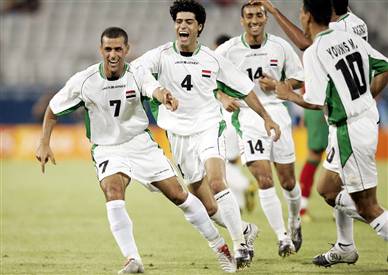
Forget the World Cup head butt, football (soccer for those who think “football” is a foreign word for the world’s most popular sport) may now be one of the only bright spots in war-torn Iraq’s immediate future. In case you have not heard, the Iraqi National Team won the Asia Cup. They did it with Shi’a, Sunni and Kurd and without the threat of torture for a missed goal. Their star, Younis Mahmoud, scored the winning goal against Saudi Arabia. Soon after ordinary Iraqis took the streets with guns, but shot into the air in celebration rather than at each other. At least for one day. Simon Apter has a nice article about this in The Nation.

Iraq’s success in soccer is, perhaps, one of the few concrete triumphs to have come out of the quagmire. Call it a beneficent side effect. The WMDs were, indeed, not there, but the bastinado was, awaiting whomever Uday capriciously felt had embarrassed the country with a sub-par performance. Running possibly the only Ministry of Sport complete with a torture chamber and jail, Uday made Bob Knight look like Francis of Assisi. Continue reading Soccer Diplomacy

Exposing Extremism—No Matter Where It Is Found

By Bruce B. Lawrence

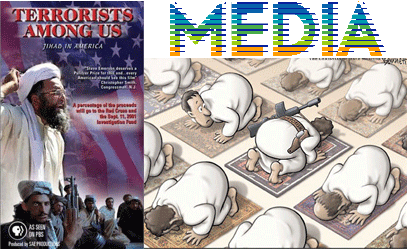
Robert Benchley, the American humorist, once quipped that “there are two categories of people in the world, those who constantly divide the people of the world into two classes, and those who do not.” Less funny, but persistent is the reflex to divide all approaches to Islam into two categories. The first are those who seek the truth in Islam. They ask: What are the various forms of Islam? How can we determine which is the true form of Islamic belief, and how do we know what are authentic norms for Islamic conduct? In opposition, there are those who have already decided there is no truth in Islam. Instead, they regard Islam itself as the true enemy—the enemy of global peace, the enemy of civil society and, above all, the enemy of Western civilization. Continue reading Exposing Extremism—No Matter Where It Is Found

BBC Reporter Johnston Freed

BBC NEWS, 2007/07/04 08:37:02 GMT

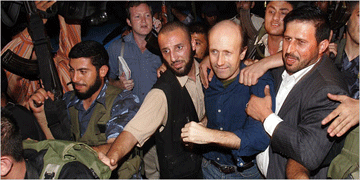
BBC correspondent Alan Johnston has been released after 114 days in captivity in the Gaza Strip. He describes the “appalling experience” at the hands of his captors, called the Army of Islam.

“I am hugely grateful to all the people – an amazing number of people that worked on the Palestinian side, the British government, the BBC from top to bottom, and a huge amount of support from BBC listeners and viewers.

I had a radio almost throughout, and was able to follow all the extraordinary level of support and interest in my case, and it was a huge psychological boost.

I am immensely grateful. It’s just the most fantastic thing to be free. Continue reading BBC Reporter Johnston Freed

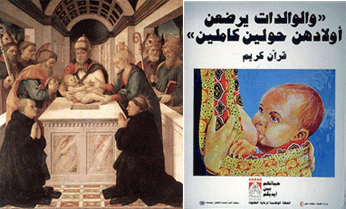
Fat Chance Fatwas

Breastmilk and urine: two unlikely bodily fluids to be news fit to print in the New York Times. But an article by Michael Slackman in Tuesday’s edition pours it on, the kind of hook that tabloids feed on, and then it gets milked for less than it is worth. Here is the hook at the front:

First came the breast-feeding fatwa. It declared that the Islamic restriction on unmarried men and women being together could be lifted at work if the woman breast-fed her male colleagues five times, to establish family ties. Then came the urine fatwa. It said that drinking the urine of the Prophet Muhammad was deemed a blessing.

For the past few weeks, the breast-feeding and urine fatwas have proved a source of national embarrassment in Egypt, not least because they were issued by representatives of the highest religious authorities in the land.

Continue reading Fat Chance Fatwas