Category Archives: Journalism and Media

Misreading the Arab Media

By LAWRENCE PINTAK, JEREMY GINGES and NICHOLAS FELTON, The New York Times, May 25, 2008

“ARABIC TV does not do our country justice,” President Bush complained in early 2006, calling it a purveyor of “propaganda” that “just isn’t right, it isn’t fair, and it doesn’t give people the impression of what we’re about.”

The president’s statement, along with the decision by the New York Stock Exchange to ban Al Jazeera’s reporters in 2003, is a prime example of how the Arab news media have been demonized since the 9/11 attacks. As a result, America has failed to make use of what is potentially one of its most powerful weapons in the war of ideas against terrorism.

For proof, in the last year we surveyed 601 journalists in 13 Arab countries in North Africa, the Levant and the Arabian Peninsula. The results, to be published in The International Journal of Press/Politics in July, shatter many of the myths upon which American public diplomacy strategy has been based.

Rather than being the enemy, most Arab journalists are potential allies whose agenda broadly tracks the stated goals of United States Middle East policy and who can be a valuable conduit for explaining American policy to their audiences. Many see themselves as agents of political and social change who believe it is their mission to reform the antidemocratic regimes they live under. When asked to name the top 10 missions of Arab journalism, they cited political reform, human rights, poverty and education as the most important issues facing the region, trumping Palestinian statehood and the war in Iraq. Overwhelmingly, they wanted the clergy to stay out of politics. And, aside from the ever-present issue of Israel, they ranked “lack of political change” alongside American policy as the greatest threats to the Arab world.

Though many Arab journalists dislike the United States government, more than 60 percent say they have a favorable view of the American people. They just don’t believe the United States is sincere when it calls for Arab democratic reform or a Palestinian state, as President Bush did again this month in Egypt.

Make no mistake, the Arab press has many flaws, including being subject to state control; only 26 percent of our respondents said they felt their fellow Arab journalists “act professionally” and only 11 percent said they were truly independent in their work. Nevertheless, Arab news outlets are more powerful and free today than at any time in history. If the next administration is going to try to reach out to the Arab people, it won’t get far by blaming the messenger.

Lawrence Pintak is the director of the Kamal Adham Center for Journalism Training and Research at the American University in Cairo and the author of “Reflections in a Bloodshot Lens: America, Islam and the War of Ideas.” Jeremy Ginges is an assistant professor of psychology at the New School for Social Research. Nicholas Felton is a graphic designer in Brooklyn.

Hometown Baghdad

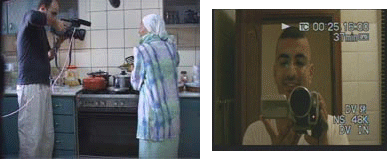
Hometown Baghdad is an online web series about life in Baghdad. It tells the stories of three young Iraqis struggling to survive during the war.

The series premiered on March 19th 2007 and the final episode went live on June 17. All episodes are viewable here.

The series was acclaimed in press throughout the world. See the press page for more.

Hometown Baghdad was produced by global youth dialogue company, Chat the Planet. Find out more about Chat here.

STAND UP for Muslims Comics

America at a Crossroads, PBS, May 11, 2008

It’s an age-old American tradition: immigrant groups take up comedy to fight against discrimination. One path to understanding is to make people laugh. Now Muslim-Americans have come forward to help dismantle the stereotypes and hatred that have surged since September 11, 2001.

STAND UP: Muslim American Comics Come of Age is the story of five comedians: Ahmed Ahmed, Tissa Hami, Dean Obeidallah, Azhar Usman and Maysoon Zayid.
Tissa Hami

Each of these artists felt the aftershock of 9/11 personally. At a time when people of Middle Eastern origin were advised to lay low, they all chose to stand up — and tell jokes. This film explores how they are responding to 9/11, each in a different way, but all using humor to define who they are.

STAND UP is the story of Ahmed’s battle to get beyond playing “Terrorist No. 4.” It’s about Obeidallah’s journey to discover his Arab heritage. It’s about Zayid’s resolve to turn being “a Palestinian Muslim woman virgin with cerebral palsy from New Jersey” into a career asset. It’s about Usman’s quest to become the Muslim comedy role model he himself never found. It’s about Hami’s determination to challenge American conceptions about Muslim women. Continue reading STAND UP for Muslims Comics

Bint al-Shati’: A Female Voice In Islamic Law

from al-Ahram, July 2004

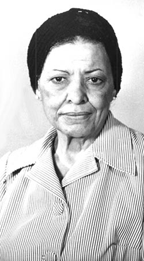
Aisha Abdel-Rahman, better known as Bint Al-Shati’, might have become famous for her fiction and poetry but it was her stories on rural Egypt which launched her writing career in Al-Ahram. The “Daughter of the Shore”, writes Professor Yunan Labib Rizk, had a weak spot for the countryside and its people

From the outset of her career, Aisha Abdel-Rahman, a prominent scholar and writer, preferred to go by the name Bint Al-Shati’ (Daughter of the Shore). She adopted this pen-name, which alludes to her birthplace in Damietta, out of respect for her family’s customs — her father was a scholar in a religious institute in that northern Egyptian coastal city — and because it was also a custom of that age for women writers to conceal their true identities.

Bint Al-Shati’ first made her mark in Al-Ahram in the summer of 1935 when the newspaper allocated considerable front-page space to the problems of rural Egypt. She was only 23 at the time (she was born in 1913), which is not so odd in itself — it was Al-Ahram ‘s policy to give a chance to young and talented aspiring writers, of whom some later became its prominent featured writers and literary and intellectual celebrities. What was odd, given her conservative family background, was the level of education she attained. Her father, an Azharite, would not allow her “modern schooling” so he educated her himself, and so solid was his instruction that she came out first among all the female students who sat for the competency certificate for teachers “from their homes” in 1929. Thus encouraged, she received her secondary school baccalaureate in 1934. This was the only certificate she was armed with when she began writing for Al-Ahram the following year. But then whoever said that degrees make a writer? Continue reading Bint al-Shati’: A Female Voice In Islamic Law

Human rights violations in the name of religion

by Wazhma Frogh, from Persian Mirror

As the world is witness of Afghanistan stepping into development and rehabilitation phase, but experiences have revealed that no country can ever develop without a sound base for human rights issues. Afghans are suffering from a very harsh situation and human values are worthless in many parts of the region. As I am a researcher on women issues in Afghanistan and I travel frequently to different parts of the region to find out the living circumstances of women.

Some three months before I has a visit to an eastern south province of Afghanistan and observed the situation of women and children, their rights have been massacred entirely under the shadow of ignorance those who call themselves Muslims. In this province, in every 10 families , 9 of them have sold their daughters at a value equivalent to 300 US $. Continue reading Human rights violations in the name of religion

Jihadi studies


The obstacles to understanding radical Islam and the opportunities to know it better

by Thomas Hegghammer, Times Literary Supplement, April 2, 2008

We were all frightened by the destruction caused on 9/11. Yet most of us, regardless of political orientation, assumed that there would be people in the intelligence services or in academia who possessed detailed knowledge about the jihadists. It might take time, and we might disagree on the methods, but the experts would eventually bring the perpetrators to justice. How wrong we were. Of course, the CIA knew the basics about al-Qaeda, such as the location of the Afghan training camps and the approximate whereabouts of the top leadership. But as Osama bin Laden slipped out of Tora Bora one foggy morning in early December 2001, al-Qaeda left the realm of tactical intelligence and became the complex organization-cum-movement which, six years later, we are still struggling to understand. For a few years, the commanders of the so-called War on Terror enjoyed the benefit of the doubt. After all, we did not know what they knew. However, it has become increasingly clear how little was known about al-Qaeda back in 2001, and how long it will take for us thoroughly to understand the dynamics of global jihadism. Continue reading Jihadi studies

Gangs of Thugs


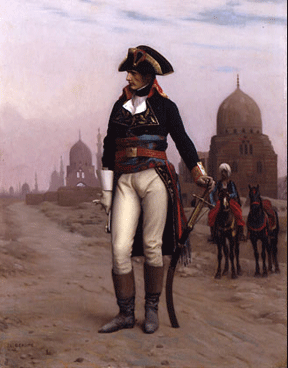
Painting by Jean-Léon Gérôme’s “Napoleon in Egypt,” 1867-68.

Please read the following quote:

“Gangs of thugs looting, as well as other hooligans, thieves, pickpockets, robbers, highwaymen, all having a field day. Relations between people ceased, and all dealings and business came to a standstill. The roads in the city became insecure, not to mention those outside it. Violence flared up in the countryside, and people began to kill each other. They stole cattle and plundered fields. They set fire to the barns and sought to avenge old hatreds and blood feuds, and so on.”

So who said this and what tragedy is being described? If you are thinking that this could be the post of an embedded journalist in Iraq or an Iraqi blogger looking out at the violence on the streets in the past couple of days, it would not be a surprise. Of course, this kind of atrocity-ridden rabble-ous melee has happened over and over again. When security goes down the tubes, violence almost always takes over. This is not because humans are evil by nature, but evil times draw out the worst in us all.

The excerpt above was written as an eye-witness account about events in Cairo in 1798. The author was ‘Abd al-Rahman al-Jabarti, an Islamic religious authority who wrote a chronicle of events about the invasion of Egypt by a Western power. Continue reading Gangs of Thugs