Category Archives: Journalism and Media

On God and Obama: When Wright is Wrong

A new book with the promising but pathetically journalistic title The Evolution of God has just appeared with media fanfare. The fanfare I have seen thus far is an op ed piece and a Time Magazine article by the author, Robert Wright. In both the author’s lack of knowledge brands the work fiction from the start. Let’s start with the Time Magazine article, which is entitled “Decoding God’s Changing Moods.” As a veteran journalist, Wright knows that Bible codes sell well, even though there is nothing to decode in his supposed code. Continue reading On God and Obama: When Wright is Wrong

Bremer vs. History: There Lies the Problem

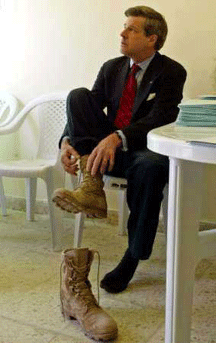
The Iraq War will not go away with a whimper. There are too many callous individuals with a vested interest in suicide bombing and too little real progress in everyday security and opportunity. The pundits, some swirling like vultures and others cooing like doves, are picking apart the pieces of the Bush administration’s bungling. One of the main players, who probably was not booted out too soon, was Paul Bremer, the Old West style sheriff of Iraq from May, 2003 until June, 2004. Among the more controversial decisions made under Bremer was the dissolution of the Iraqi Army. It is hard to find anyone these days who thinks this was a good idea, given that it was an army of conscripts who were quite likely to follow orders and help restore order. But Bremer is cashing in on the pundit circuit. Here is an interview given to the newspaper Asharq Alawsat. Some of the insights are enlightening. For instance, the military found Saddam by getting information freely given by an insurgent with no waterboarding in sight. But on other matters, Bremer lives up to the old saw that history is a pack of lies agreed upon. The only problem is that few people, and certainly few historians, will agree with Bremer. There, of course, lies the problem.

Asharq Al-Awsat Talks to Paul Bremer (Part One)

By Talhah Jibril, Asharq Alawsat, May 12, 2009

Washington, Asharq Al-Awsat – Paul Bremer was the de-facto Governor of Iraq between 11 May 2003 and 28 June 2004 in his role as the head of the Coalition Provisional Authority. As US Administrator of Iraq Bremer was the chief executive authority in the country and was effectively in charge of all Iraqi civil administration following the collapse of Saddam Hussein’s regime, and prior to the creation of the Iraqi Interim government. Bremer’s stewardship of Iraq was plagued with controversy, particularly his decision to disband the Iraqi army, as well as his implementation of the policy of Debathification. Critics have attributed the strength of the insurgency and the worsening situation in Iraq during this period to some of his policies. Continue reading Bremer vs. History: There Lies the Problem

Advice for the former Vice President

The Old Faithful of Nonsense

By Eugene Robinson, The Washington Post, Tuesday, May 12, 2009

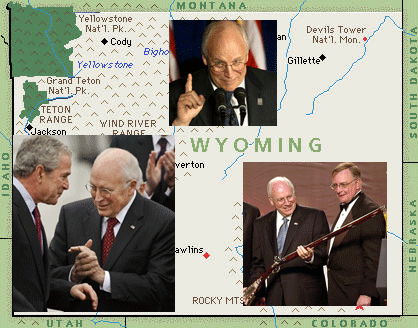
Can’t we send Dick Cheney back to Wyoming? Shouldn’t we chip in and buy him a home where the buffalo roam and there’s always room for one more crazy old coot down at the general store?

For the final act of his too-long public career, Cheney seems to have decided to become an Old Faithful of self-serving nonsense. His latest in a series of eruptions came Sunday on “Face the Nation,” when he continued to press his revisionist case for torture — and, for good measure, counseled his beloved Republican Party to marginalize itself even further from public opinion and common sense. Continue reading Advice for the former Vice President

10 Conceptual Sins

“10 Conceptual Sins” in Analyzing Middle East Politics

by Eric Davis, from The New Middle East, January 28, 2009. For an Arabic translation of this post, click here.

Sin # 1: “Presentism.” Unfortunately, many of those who analyze Middle East politics, whether journalists, policy analysts, or academics, do not take history seriously. That is, they fail to situate Middle East politics in a historical context. If they did, they would gain many more insights into the political dynamics of the region.

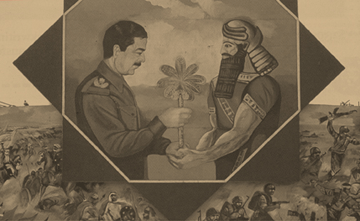
Analysts would have realized why, for example, Iraqis showed little enthusiasm when American troops toppled Saddam Husayn’s regime in April 2003. This response did not indicate that Iraqis were ungrateful as the vast majority were relieved to see the end of Saddam’s regime. Rather, many Iraqis, who did have a historical consciousness, knew that the US had supported Saddam Husayn during the Iran Iraq War. Iraqis also remembered that, when President George Bush senior called upon them to rise up against Saddam Husayn in 1990, many took him at his word. However, not only did the US not intervene to help the rebels during the February-March 1991 uprising (Intifada), it gave permission for Iraqi helicopter gun ships to enter the fray which turned out to be critical in suppressing it. Continue reading 10 Conceptual Sins

Repairing American public diplomacy

Repairing American public diplomacy

by William Rugh, Arab Media and Society, Winter, 2009

It is widely believed among academics who study the subject, and among former practitioners, that public diplomacy has not achieved its full potential,[1] and we are hopeful that the Obama Administration will now solve some of its problems. This essay focuses on the most important challenges, which in many ways concern broadcasting to the Arab world.

Public diplomacy is of course not a panacea. America’s foreign policy decisions such as the Iraq war, or its policies at home such as the Patriot Act and Guantanamo detentions, have been strongly criticized abroad, undermining our international reputation and respect. Public diplomacy by itself cannot eliminate all criticism of our policies. It can only help to mitigate objections by explaining the U.S. government’s reasons for these policies, and by reminding foreign audiences of the aspects of America they still admire, in its society, culture and political system.

It is also true that the election of Barack Obama, which has generated a generally positive reaction around the world, will not by itself burnish America’s tarnished image abroad. His new policies may help, but misunderstandings of the United States will continue, out of ignorance or deliberate distortion. Public diplomacy programs can help present an accurate picture of America to foreign audiences, a task more important than ever in this age of 24/7 information proliferation.

What are the systemic problems hindering U.S. public diplomacy and how can the Obama Administration fix them? Continue reading Repairing American public diplomacy

April through March Fools

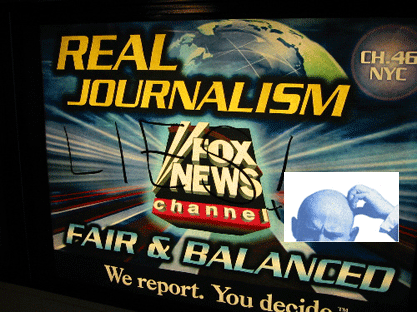
Most of us probably passed April Fools Day with only minor irritations. After all, fooling in jest is sort of fun. Then there are those fools who seem to operate 365 days a year and stream into our consciousness non stop. Take, for example (and it is a very foolish example that unfortunately fools quite a few people) Fox News Facts (and please forgive the oxymoron but remember the moron part). On April 1 anchoress Alisyn Camerota interviewed one Nonie Darwish about the appointment of Harold Koh, a former dean at Yale, to be the State Department legal advisor. The following is the transcript, and you can watch the video here.

ALISYN CAMEROTA (Fox anchor): The White House is defending its nominee to be State Department Legal Adviser. Now, some of the criticism of this nominee, Harold Koh, is based on remarks that he reportedly made saying that Islamic Sharia law should apply in U.S. courts, even though those laws are used in some countries to justify stripping women of basic rights and even worse, frankly. Continue reading April through March Fools

Islamophobia 101, A call to analyse

[Webshaykh’s Note: This is the start of a new blog thread dedicated to energizing scholarly and pedagogical attempts to combat, or at least mitigate, the ongoing volume of Islamophobia in the media, especially on the Internet. The question is simple: what can be done to respond to Islamophobia in the media by our efforts in the blogosphere, formal media outlets, classroom, community and scholarly forums? I invite fellow scholars, professors and teachers and anyone concerned with this issue to contribute to the discussion here at Tabsir.]

People of any particular religious faith are understandably offended when someone or something they hold to be sacred is dragged through the media-made mud of ridicule. There is no way to completely stop desecration, even when hate crime laws are in place. As long as there are synagogues with walls and anti-Semites with paint, swatstikas will be painted. As long as there are artists who stretch their creative energies to the limit of tolerance, animal dung will adorn the body of the Madonna. And as long as so many individuals in Western societies fear Islam through the veil of their own ignorance and historically constructed disdain, the Prophet Muhammad will be pictured as a profligate. The Danish cartoon controversy was only the tip of the iceberg, one that created a titanic rift in the Muslim community worldwide. The irony is that portraying Muhammad in any form is considered wrong in Islam, so that placing a stud missile in the turban of a caricatured Mahound (to drop a literary motif of the same controversial dimension) glosses over the level of misunderstanding motivating those who made and appreciated the cartoon images.

So what is the proper response to the volume of prophet bashing out there, not only in the case of Islam. Here are a few suggestions to jumpstart the process of analysis so that we as scholars can mitigate the paralysis created by an Islamophobia that is only a mouse click away.

• Identify resources (books, relevant articles, websites, speakers) which provide a scholarly and objective-as-possible perspective on Islamophobia
• Discuss the merits of whether or not to provide examples of Islamophobic writing, art and videos that are admittedly offensive to many Muslims
• Provide lesson and project ideas to encourage students to critically assess the Islamophobia in specific examples they are likely to find in the media and on the Internet
• Engage with fellow scholars and concerned Muslims about the most effective and least offensive ways to combat and mitigate Islamophobic writing and art
• Link examples of Islamophobia to other forms of verbal and artistic ridicule of sacred materials.
• Expose Islamophobic rhetoric by politicians, celebrities and other people in the news.

Having set out the goals, I invite colleagues contribute comments, commentaries and examples for and against Islamophobia for this series, please email the webshakh at daniel.m.varisco@hofstra.edu. I will post the first commentary tomorrow.

Daniel Martin Varisco
New Age Islam in the Digital Age

A LONG STRUGGLE AHEAD: Sultan Shahin set up a website that has taken on the religious right head-on.

Praveen Swami, The Hindu, March 24, 2009

Back in the summer of 1999, Sultan Shahin found himself being hectored by an earnest young man outside London’s Finsbury Park mosque.

“You Indian Muslims are cowards,” Shahin was told “but soon you will have just two choices: either to become a true Muslim like us, or to perish.”

For Shahin, the experience was transformative. “It became clear to me that the Islam that I believe in was under serious threat,” he says, “and that I would have to do something if the religion I loved was not to be demeaned by the evil that was being spoken in its name.”

Last year, Shahin set up a website that has taken on the religious right head-on. Though run on a shoestring budget and without the help of full-time staff, New Age Islam (http://www.newageislam.com/) is visited by hundreds of readers every day. Its electronic newsletter has over 29,000 subscribers.

New Age Islam provides its audience to a wide range of original theological and political writing that does not figure in the mainstream media. In recent weeks, New Age Islam has seen debates on Niyaz Fatehpuri, a twentieth-century literary figure with unconventional ideas on the concept of divine revelation, as well as the neo-conservative televangelist Zakir Naik. Continue reading New Age Islam in the Digital Age