Category Archives: Journalism and Media

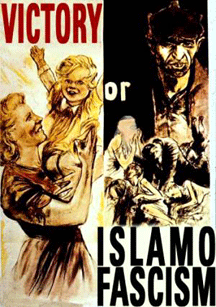
On Fascist-Islamophobia

The Self-Fulfilling Prophecy of a Clash of Civilizations

Excerpt from “Fascist-Islamophobia”: A Case Study in Totalitarian Demonization by Dr. Robert Dickson Crane, published in The American Muslim, October, 2007. To read the entire article, click here.

The future of America and of global civilization will depend on whether and when the leaders of each of the world’s nations can join to bring out the best of each civilization in order to build a single civilization of global pluralism. The purpose must be to bring out the best of the past in order to build both for the present and the future a global federation of independent nations in the pursuit of peace through compassionate justice.

The opposite alternative is mutual demonization whereby members of one civilization join the extremists of another in supporting the extremists’ perversion of their own religion. In practice this would bring out the worst of the past to paralyze the present and destroy the future.

The many books by Robert Spencer and a host of lesser professionals in demonization typify a genre of books that have captured the imagination of an entire nation. Amazon’s list of books on Islam and Muslims available for purchase in the Year 2007 exceeds 75,000. Of the first 400 listed, fifty could be classified as Islam-bashing, and half of these are militantly or extremely so. A critique of any one of them could serve as a critique of them all, though Robert Spencer’s book is perhaps the most sophisticated in its virulence. The basic theme is a self-fulfilling prophecy that brands Islam as inherently terrorist and thereby provokes Muslims to become exactly what they are said to be. Continue reading On Fascist-Islamophobia
Iranians in The Mist

Demystifying Iran

by Noor Iqbal, Foreign Policy in Focus, July 29, 2009

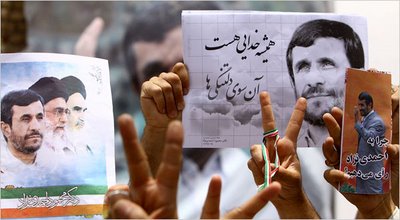
Post-election turmoil in Iran has brought the country closer to the top of America’s foreign policy concerns. More importantly, though, it has piqued the interests of the American public. Green is the new black, Moussavi and Khamenei have become household names, and tweeting about Iranian politics has never been more popular.

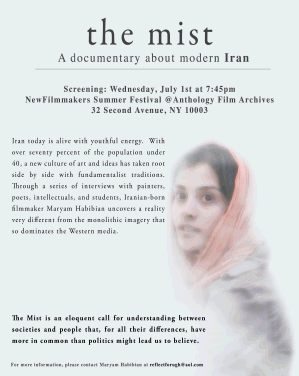
But what is Iran like beyond its politics and the Western media hype? Iranian-born filmmaker Maryam Habibian tackles this question in her most recent documentary, The Mist. The film delves into the lives of young artists, poets, playwrights, and intellectuals in Iran whose creative energy flourishes alongside fundamentalist traditions. It explores the balance they reach between artistic expression and the limitations of a conservative political regime. Habibian shows her viewers another side to Iran, one that has been largely overlooked by conventional media. She is committed to showing her audience that a society cannot be defined solely by its political system and that when it comes to Iran, we are not facing a clash of civilizations.

Her film was recently screened in New York City as part of the NewFilmmakers Summer Festival.

NOOR IQBAL: What motivated you to make this film? Continue reading Iranians in The Mist

The Propaganda Value of a Detained Journalist


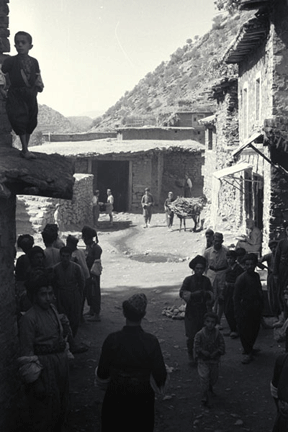
A street in Tawila, a Kurdish village near the border with Iran. Iraq, 1950, Photo by Wilfred Thesiger

by William O. Beeman, New America Media, August 06, 2009

New America Media Editor’s Note: New America Media correspondent Shane Bauer is one of three Americans presumed to be detained by the Iranian government near the Iran-Iraq border last weekend. Commentator William O. Beeman writes that their situation raises profound political questions.

“In the wrong place at the wrong time” is an apt description for three Americans currently being detained in Iran. They will likely be released, but not before Iranian authorities have wrung maximal publicity over their situation, painting them as Western intelligence operatives. The process could take months.

The timing for this event could not be more inopportune. Iran is on high emotional alert. It is flush with righteous indignation and paranoia vis-à-vis Western nations. It has undergone a contentious election where opponents of President Ahmadinejad were accused of collaboration with Western powers. Understanding the current state of mind in Iran is crucial to predicting the fate of the three travelers. Continue reading The Propaganda Value of a Detained Journalist

Sociology of Islam and Muslim Societies Newsletter


Charles Kurzman, Department of Sociology, University of North Carolina

The Sociology of Islam and Muslim Societies website is an important resource for anyone interest in the study of Islam from a sociological perspective. The current summer issue is available online at the main website. In the current edition, Charles Kurzman has an introduction well worth reading. He observes,

The sociology of Islam and Muslim societies is “hot,” for all the wrong reasons. It is not because globalization has drawn the world closer together, or because sociology is internationalizing its focus beyond its historical interest in Western Europe and North America. No, the sociology of Islam is “hot” because of the common but inaccurate association of Islam with terrorism and international conflict. The world wants to know why we are seeing such violence in the name of Islam, and sociologists — along with other social scientists — are expected to have answers. Violence and stereotypes related to Muslims are, sadly, good for business in the sociology of Islam. Continue reading Sociology of Islam and Muslim Societies Newsletter

The War Within


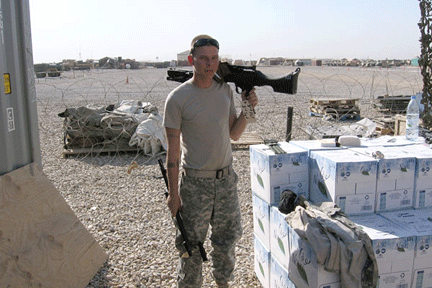
Sgt. Blaylock in Iraq

On Dec. 9, 2007, Sergeant Blaylock, heavily intoxicated, lifted a 9-millimeter handgun to his head during an argument with his girlfriend and pulled the trigger. He was 26.

“I have failed myself,” he wrote in a note found later in his car. “I have let those around me down.”

Economics trumps politics, even though the two are always in bed together. The bailouts on Wall Street and the impending end of unemployment handouts on Main Street have occupied the news channels, while the back roads of Iraq have receded in the wishful rear-view thinking about the war. But along comes a New York Times video report that brings it all back. The video documents the suicide of Sgt. Jacob Blaylock, who was haunted by the death of two close friends, to the point of posting dark poems on his Facebook page. Suicides, despite the comedic Mash theme are not painless. For the full article on the issue of suicides of returned Iraqi war veterans, click here.

Smoke Rises in the Middle East


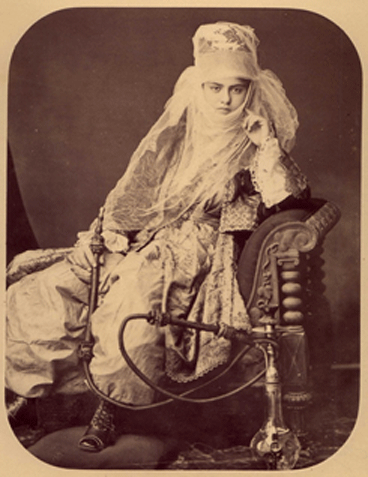
Hooked on Hookah, 1909

No, this is not another post about terrorism, nor the violent protests following the recent Iranian election, nor more reports of suicide bombs in hotel lobbies. The smoke from these tragedies is not about to disappear any time soon. The smoke I am talking about is from the tobacco industry. Newsweek (July 27 issue) provides a breakdown of smokers worldwide. While China leads all populations with almost 334 million smokers (32% of the overall population), they are actually lower percentage wise than Turkey with its 19 million users, accounting for 36% of the population. Other Middle Eastern countries surveyed fare a bit better than the United States (24% of the population) with 21% (28 million users) in Pakistan, 17.6% (9 million users) in Iran and only 14.2% (2.4 million users) in Iraq. I suspect even these numbers are under reported, given the ubiquity of cigarettes in the region. Health warnings or not, tobacco is still sultan in the Middle East and indeed the entire world. Continue reading Smoke Rises in the Middle East

Documenting the Study of Islam

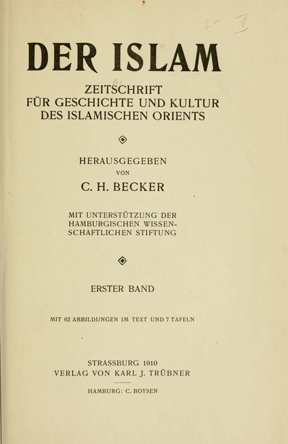
The Internet has become the ultimate research library, especially for older and rare volumes that one used to have to look at only in rare book collections or major university libraries. I noticed recently that several of the earliest journals devoted to the study of Islam now have their earliest versions available online. The extraordinary site, The Internet Archive, now has the first 11 volumes of Der Islam, the first 6 volumes of Die Welt des Islams, and the first 12 volumes of The Moslem World. This is a great resource for scholars, but also worth a browse, especially if you know some German. There is much of value, historical as well as continuing scientific, in these early volumes.

Media fantasies in Iran

by Abbas Barzegar, The Guardian, Friday June 26, 2009

It’s not about the election, Ahmadinejad, or the even the protesters. The world has been captivated by the events in Iran because for many, Iran is to Islamism what the Soviet Union was to communism and presumably today we are somewhere near the fall of the Berlin Wall.

Indeed as the media has been telling us, all the right ingredients are here: a charismatic leader, fractions in the political hierarchy, and a critical mass of protesters. The opposition has begun shouting “Allahu Akbar” from the rooftops and wearing black to commemorate their martyrs just like they did 30 years ago. Iran’s diaspora pundits and dissidents have come out in droves to tell us about the unwillingness of the police to use force on the protesters … just like they did 30 years ago. There are even dissident clerics in the fight, and better yet the protesters now have Twitter and Facebook to help.

I don’t know whose cruel joke this is, but these protests have never been about a revolution nor have any of the opposition leaders ever suggested that. Continue reading Media fantasies in Iran