Category Archives: Journalism and Media

Pakistaniaat: New Journal


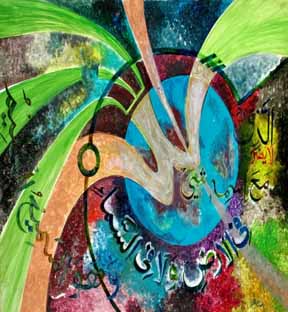
Current cover illustration by Amar Raza, “A Prayer for Protection”

There is a new online journal for anyone interested in Pakistan studies. The first issue of the second volume is now available. Here is the journal description of focus:

Pakistaniaat is a refereed, multidisciplinary, open-access academic journal offering a forum for a serious scholarly and creative engagement with various aspects of Pakistani history, culture, literature, and politics.

Though several existing journals do pay a fair degree of attention to the issues of South Asia and Postcoloniality, we feel that under the current climate of high capital and war on terror, Pakistan, often subsumed under the larger registers of South Asia or Postcolonial Studies, needs a particular space of its own in our academic and creative undertakings. Thus, Pakistaniaat aims to provide a public space on the Internet to introduce and discuss hitherto neglected aspects of Pakistani cultural and literary production and to make this knowledge available to a worldwide audience. Continue reading Pakistaniaat: New Journal
Why does this land make me quiver?

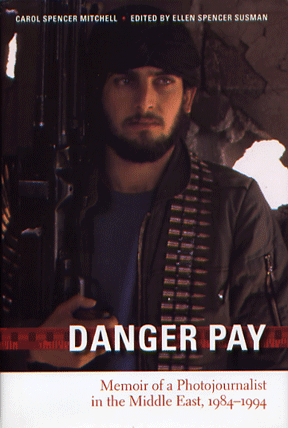
[Webshaykh’s note: Carol Spencer Miller (1954-2004) worked as a photojournalist in the Middle East, covering the crises there for some of the major American and european journals and newspapers. She had access to the elites, including King Hussein and Yassir Arafat, as well as ordinary people. Although she died before publishing her reflections on this experience, her book has been edited by her sister as Danger Pay: Memoir of a Photojournalist in the Middle East, 1984-1994 and is now available as an intriguing first-person memoir of events that seem to recycle more than disappear from the news cycle. I provide here an excerpt about her feeling of disorientation reporting on the Israeli/Palestinian issue.]

It grows increasingly unclear to me why people call this a “Westernized” country. the phones don’t work, the press is censored, there are guns everywhere. I am perpetually uneasy. How, I wonder, can anyone relax when wherever you look, there is someone toting or pointing a machine gun? they casually rest across shoulders, carried by anybody who wants to. Will I get used to the sight of civilians wearing sandals, shorts, T-shirts, and Uzis. in movie theaters, at the supermarket, at shopping malls, and at bars? They aren’t frightening as much as disconcerting.

This is a difficult country to get accustomed to. There are bomb shelters in homes and children’s playgrounds, security at every store, the ever-present notion of “security reasons,” the way people dress, as if they don’t give two hoots about appearance (they don’t). Restaurants and movies open on Fridays are stoned by the ultra-Orthodox Haredim. Continue reading Why does this land make me quiver?

On the loss of his grandfather


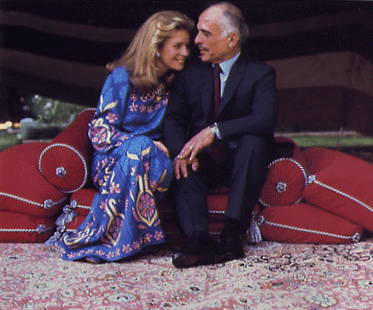
King Hussein with Queen Noor, 1985; Photograph by Carol Spencer Mitchell

[Webshaykh’s note: Carol Spencer Miller (1954-2004) worked as a photojournalist in the Middle East, covering the crises there for some of the major American and european journals and newspapers. She had access to the elites, including King Hussein and Yassir Arafat, as well as ordinary people. Although she died before publishing her reflections on this experience, her book has been edited by her sister as Danger Pay: Memoir of a Photojournalist in the Middle East, 1984-1994 and is now available as an intriguing first-person memoir of events that seem to recycle more than disappear from the news cycle. I provide here a second excerpt about her interview with King Hussein about the murder of his grandfather in which he himself was almost killed.]

On the Loss of His Grandfather

CS: What do you remember about the day your grandfather was assassinated?

KH: (He is silent for a moment,) You want me to go through the whole experience? I remember it very vividly … very vividly. (He is silent again.)

My grandfather was everything to me – a father, an example – who a few days before had asked me a strange question, which I’ve tried to live up to ever since. He asked me to ensure that his work was no lost and that I would continue to serve the Arab nation and this country as he had done. That particular day, I went with him to the city of Nablus because people insisted that we spend the day with them. We had the intention to go pray at the Al-Aqsa Mosque. I remember being in the uniform that he insisted I wear that morning. It was the only one that I had. I remember the meeting that he had in Jerusalem with certain Palestinians that fateful Friday. I remember him speaking about his relations with some of them. The fact that his differences with people were not always of a personal nature, but were matters of policy and approach. I remember him speaking of death and that he wished he would go while he was still in possession of his faculties and the best way in his view would be from a bullet from an unknown assailant. Continue reading On the loss of his grandfather

On Yemen (and some a bit off)


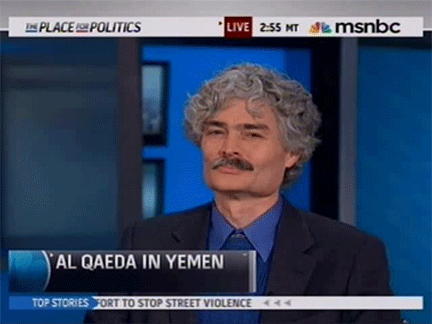
Varisco interviewed about Yemen on MSNBC, January 16

For the past week or so, just before the terrible human tragedy in Haiti, Yemen was once again a front page news story in the Western media. This time it was not about qât, nor about the rhino horn used in Yemeni dagger hilts, but the issue was exotic nevertheless. Yemen is newsworthy because of the recent attempted suicide mission of a Nigerian who met with members of the relatively recently reframed Al-Qaeda in the Arabian Peninsula. At first, the political talking heads were eager to brand Yemen as a lawless tribal haven for the next stop of our continuing war on terror. Joe Lieberman added Yemen to his own version of the axis of evil, which I have previously commented upon. But then late last week Yemeni officials announced that six al-Qaeda figures had been killed in an airstrike, and on Saturday three more had been arrested near the Saudi border.

On Saturday, on my return from delivering two lectures in Toronto, I went straight from the airport to MSNBC, where I was interviewed (if that term works for about two minutes of air time) about the recent strikes on al-Qaeda in Yemen. Earlier in the week, I sat down for an extended interview on the current situation in Yemen with Karla Schuster of Hofstra University, an interview which can be seen on Youtube. Continue reading On Yemen (and some a bit off)

Karim Ben Khelifa in Yemen


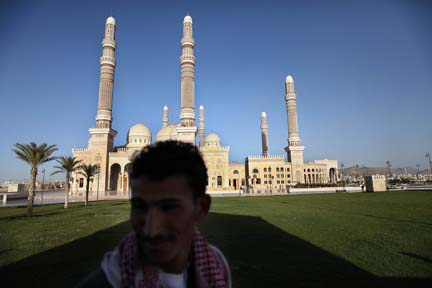
The newly built presidential mosque, which cost an estimated $60 million; photography by Karim Ben Khelifa

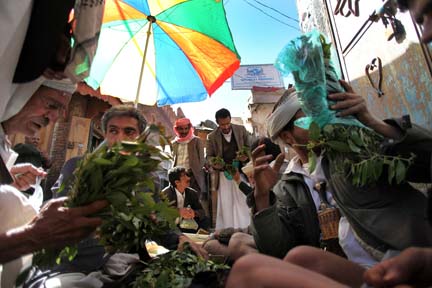
Much of the reporting on recent events in Yemen is pathetic. A rare exception is the work of photojournalist Karim Ben Khelifa, who is currently on assignment in Yemen. Thus far he has posted two sets of photographs, one on the Wall Street Journal, and the other for the New York Times. Check out these websites for superb photographs, two of which I reprint here with the permission of the photographer.


Qât market in Sanaa, Yemen; photography by Karim Ben Khelifa

Grinding a Greater Axis of Evil


“Yemeni protesters staged a demonstration in the southern part of the country on Thursday after a raid against Qaeda militants”: Photograph from Agence France-Presse for The New York Times

In the midst of two unfinished major wars, the United States has quietly opened a third, largely covert front against Al Qaeda in Yemen. Eric Schmitt and Robert Worth, The New York Times, December 27, 2009

Terrorism takes a toll far beyond the lives lost everyday, even when a plot is thwarted. On Christmas day a 23-year-old Nigerian named Umar Farouk Abdul Mutallab attempted to set himself off as a human bomb on a Northwest Airlines flight from Amsterdam to Detroit. On the surface he hardly fit the profile of a crazed militant fresh out of a training camp in the hills of Pakistan. His father was a recently retired chairman of First Bank of Nigeria and he is an engineering student at University College London. But it now seems that his father was so concerned about his son’s politics that he warned the U.S. embassy about him just a month ago. Initial reports indicate that the explosives were said by Mutallab to be provided by al-Qaeda in Yemen. Based on this claim certain U.S. politicians, most notably Senator Joseph Lieberman of Connecticut, have called for Yemen to be added to the growing terrorist axis of evil. “So I leave you with this thought that somebody in our government said to me in the Sana’a, the capital of Yemen. Iraq was yesterday’s war. Afghanistan is today’s war. If we don’t act preemptively, Yemen will be tomorrow’s war. That’s the danger we face.” Lieberman told Fox News.

Lieberman is actually calling for Yemen to become today’s war, but the key to his thinking is best summed in another line from the same interview: “We’ve got to constantly be thinking like the terrorists here.” Well, Joe, this is the problem. You are thinking like the terrorists when you suggest going into a country you know nothing about and dropping bombs. Unfortunately, it appears we have already started doing that. Continue reading Grinding a Greater Axis of Evil

Broken Taboos in Post-Election Iran

by Ziba Mir-Hosseini, Middle East Report Online, December 17, 2009

The on-camera martyrdom of Neda Agha-Soltan, the 26-year old philosophy student shot dead during the protests after the fraudulent presidential election in Iran in June, caught the imagination of the world. But the post-election crackdown has two other victims whose fates better capture the radical shift in the country’s political culture. One victim was the protester Taraneh Mousavi, detained, reportedly raped and murdered in prison, and her body burned and discarded. The other is Majid Tavakoli, the student leader arrested on December 8, after a fiery speech denouncing dictatorship during the demonstrations on National Student Day.

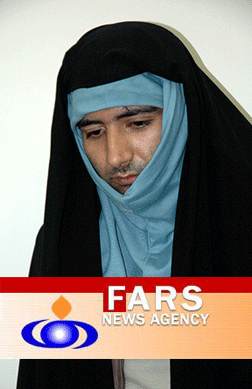
Following his arrest, pro-government news agencies claimed Tavakoli had been caught trying to escape dressed as a woman and published a series of photographs showing him wearing a headscarf and chador — a common version of the “modest” garb (hejab) mandated for women by the Islamic Republic. Attempts at flight in such gender-bending disguises are a classic trope in Iranian political history. The best-known instance was when the first president of the Islamic Republic, Abol-Hasan Bani-Sadr, after his deposition in 1981, allegedly fled the country in women’s dress — the Fars News Agency put a photo of him in a scarf next to that of Tavakoli. But in pre-revolutionary Iran clerics, too, such as Ayatollah Bayat, are said to have evaded the Shah’s authorities by concealing themselves beneath chadors, which pro-government media outlets now choose to ignore. Continue reading Broken Taboos in Post-Election Iran

Why they hate us: You can count on it

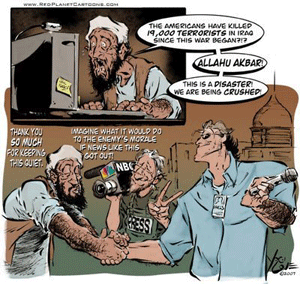
Why they hate us (II): How many Muslims has the U.S. killed in the past 30 years?(II): How many Muslims has the U.S. killed in the past 30 years?

by Stephen M. Walt, The New ForeignPolicy.com, November 30

Tom Friedman had an especially fatuous column in Sunday’s New York Times, which is saying something given his well-established capacity for smug self-assurance. According to Friedman, the big challenge we face in the Arab and Islamic world is “the Narrative” — his patronizing term for Muslim views about America’s supposedly negative role in the region. If Muslims weren’t so irrational, he thinks, they would recognize that “U.S. foreign policy has been largely dedicated to rescuing Muslims or trying to help free them from tyranny.” He concedes that we made a few mistakes here and there (such as at Abu Ghraib), but the real problem is all those anti-American fairy tales that Muslims tell each other to avoid taking responsibility for their own actions.

I heard a different take on this subject at a recent conference on U.S. relations with the Islamic world. In addition to hearing a diverse set of views from different Islamic countries, one of the other participants (a prominent English journalist) put it quite simply. “If the United States wants to improve its image in the Islamic world,” he said, “it should stop killing Muslims.” Continue reading Why they hate us: You can count on it