Category Archives: Journalism and Media

From Islamist Watch to Islamic Mimbar: The Politics of Hypocrisy


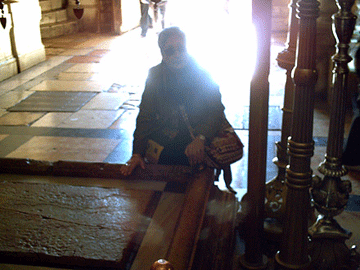
Raheel Raza at the Church of the Holy Sepulchre in Bethlehem

by Huma Dar, Dept. of South and Southeast Asian Studies, University of California at Berkeley

On Thursday, June 10, 2010, Jerome Taylor, the Religious Affairs Correspondent of The Independent posted an article headlined, “First Woman to Lead Friday Prayers in UK.” Two-thirds of the way down this article, we find that:

“Ms Raza’s appearance in Oxford is a repeat of a similar prayer session in 2008 which was led by Amina Wadud, an American-born convert and Muslim feminist. But this is the first time a Muslim-born woman will lead a mixed prayer service in Britain.”

Taylor’s differentiation between “American-born convert” and “Muslim-born woman” and labeling of the latter as the “first woman” in the headline create a false hierarchy and subtly delegitimize Dr. Wadud, a leading Muslim scholar and author of Qur’an and Woman: Rereading the Sacred Text from a Woman’s Perspective, a path-breaking text in the study of gender and Islam. Taylor’s late admission of “repeat” after the (mis)leading announcement of “First” in the headline does not quite cover up for the critical sins of omission and commission, especially as Raheel Raza, the Pakistani-Canadian woman leading the prayer at Oxford, is neither an ‘Alima or a scholar of Islam nor is she known for her advocacy of Muslims at large.

In fact Raza is a rather polarizing figure amongst Muslims in North America and her record does not indicate much learning in the letter or spirit of Islam, as in speaking truth to power and standing with the oppressed. Continue reading From Islamist Watch to Islamic Mimbar: The Politics of Hypocrisy
Death to Arabic?


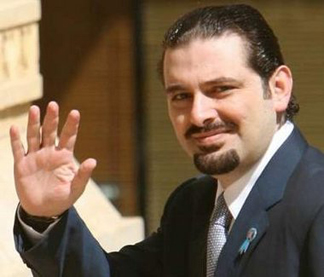
Saad Hariri


Arabic will die out if it is locked up in classrooms
by Achraf El Bahi, The National, April 08. 2010

In his inaugural address to parliament last December, the Lebanese prime minister Saad Hariri kept mispronouncing words and whole phrases in Arabic, smirking the entire time.

Not only did the Georgetown-educated, English-speaking Mr Hariri laugh at his mistakes, but he also cackled when Nabih Berri, the speaker of parliament, asked him if he needed someone to help him out.

Being bad at Arabic is almost like being bad at an obscure sport, say croquet: no one particularly cares if you fail to grasp the quaint and overly complex techniques needed for mastery of the subject.

In Lebanon, French is the language of the learned and the sophisticated. The same is true in Algeria, Tunisia, Morocco and other former French colonies in the Arab world. Failing to speak proper French in those countries is a handicap in professional and social life. Continue reading Death to Arabic?

Miss USA (and no burqa)


[Editor’s Note: For a change we can report something about a Muslim woman and not have to discuss the issue of wearing hijab. For videos from the pageant website, click here.]

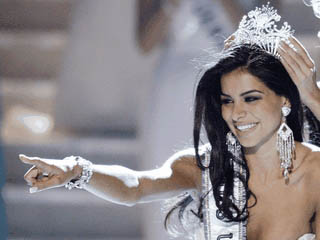
Arab-American Crowned 2010 Miss USA

The Independent, May 17

Lebanese immigrant Rima Fakih says it was a certain look from Donald Trump that tipped her off that she had won the 2010 Miss USA
title.

The 24-year-old Miss Michigan beat 50 other women to take the title last night, despite nearly stumbling in her evening gown.

She told reporters later that she believed she had won after glancing at pageant owner Trump as she awaited the results with the first runner-up, Miss Oklahoma USA Morgan Elizabeth Woolard.

“That’s the same look that he gives them when he says, ‘You’re hired,”‘ on Trump’s reality show “The Apprentice,” she said.

“She’s a great girl,” said Trump, who owns the pageant with NBC in a joint venture.

Fakih took top honours at the pageant at the Planet Hollywood Resort & Casino on the Las Vegas Strip after strutting confidently in an orange and gold bikini, wearing a strapless white gown that resembled a wedding dress and saying health insurance should cover birth control pills. Continue reading Miss USA (and no burqa)

Hate, Times Squared


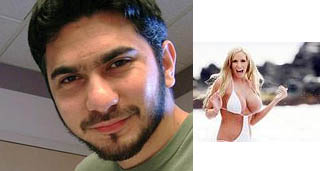
Photos juxtaposed on May 6 by the New York Post, tabloid journalism at its most blatant

Faisal Shahzad, not your typical terrorist: unless you think being a Pakistani Muslim makes you a typical terrorist. Anyone reading yesterday’s New York Post (Wednesday, May 5) and taking the blustered and bloated tabloid rhetoric seriously could easily make such an assumption. I do not, as a rule, read tabloids, although seeing what many others do read is a useful reality check from time to time. But on the train home from Manhattan yesterday there was a crumpled up newspaper under the train seat and at least 45 minutes to unwind. The cover was, for a change, not a pun. It might be called a revelation, as it read: “REVEALED: WHY HE DID IT. EXCLUSIVE. Revenge for US drone attacks on Taliban terrorists.” Six pages (and more) were devoted to the story, although there was little that I found exclusive in the shoddy news reporting and vengeful commentary by the tabloid’s stalking heads.

Let’s start with the cover and what the tabloid pictures for us. Continue reading Hate, Times Squared

The Baraka 500

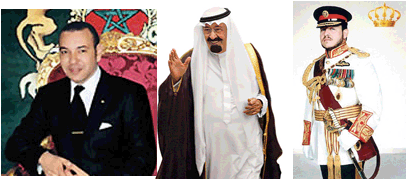
Every good capitalist knows about the Fortune 500, the annual ranking of the top grossing corporations in the United States. Now Muslims who read English have their own ranking of the top 500 most influential Muslims. The Royal Islamic Strategic Studies Center in Amman and Prince Alwaleed Bin Talal Center for Muslim-Christian Understanding have jointly issued a new book, edited by John Esposito and Ibrahim Kalin of Georgetown University. This is scheduled as the first in an annual series that will provide short biographies of prominent Muslims in a variety of fields. According to the editors, the aim is to “highlight people who are influential as Muslims, that is, people whose influence is derived from their practice of Islam or from the fact that they are Muslim.” So who tops the list?

As fortune would have it, this effort should probably be dubbed the Baraka 500, but more for the politics of the sponsors than the demonstrated holiness of the individuals. Deciding who are the influential individuals that happen to be Muslim is no easy task, especially considering that most Muslims have not been consulted in the process. So before you read any further, jot down who you think are the top ten Muslims in the world. I suspect that you will not duplicate the “official” list provided by Esposito and Kalin for their Saudi and Jordanian sponsors. Continue reading The Baraka 500

Blame it on Lady Gaga

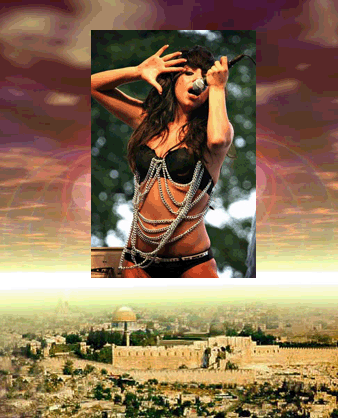
Why is the “Muslim world” angry with America, asks columnist Bret Stephens in the Wall Street Journal? Well here are your two choices:

Pop quiz—What does more to galvanize radical anti-American sentiment in the Muslim world: (a) Israeli settlements on the West Bank; or (b) a Lady Gaga music video?

If your answer is (b) it means you probably have a grasp of the historical roots of modern jihadism. If, however, you answered (a), then congratulations: You are perfectly in synch with the new Beltway conventional wisdom, now jointly defined by Pat Buchanan and his strange bedfellows within the Obama administration.

Of course, how could it be Israeli policy. It must be the loose women and jazz singers that really upset Muslims, because that is what Sayyid Qutb said way back in 1951 after visiting Colorado (if only they had shut down those speak-easys in Boulder, who knows!). Yes, here is what Qutb, the “intellectual godfather of al Qaeda,” said:

“The American girl,” he noted, “knows seductiveness lies in the round breasts, the full buttocks, and in the shapely thighs, sleek legs and she shows all this and does not hide it.” Nor did he approve of Jazz—”this music the savage bushmen created to satisfy their primitive desires”—or of American films, or clothes, or haircuts, or food. It was all, in his eyes, equally wretched.

Qutb, notes the columnist, was also anti-Semitic, and blamed the Jews for being at war against Islam. And, to seal the argument for Stephens, here is the real beef (or cheesecake or kosher wine) because: Continue reading Blame it on Lady Gaga