Category Archives: Yemen

Yemen College of Middle Eastern Studies


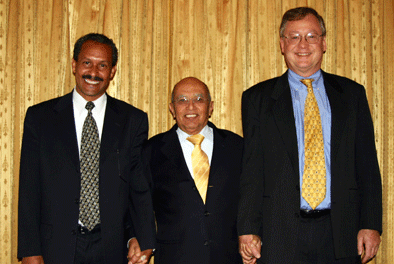
left to right, Sabri Saleem, founder; Dr. ‘Abd al-Karim al-Iryani; Dr. Steven Caton, Dean

by Bradley Heinz, Yemen Observer, January 5, 2008

Sana’a may well be on its way to hosting the leading center for scholarship of the contemporary Middle East, so say members of the Board of Governors of the newly organized Yemen College of Middle Eastern Studies (YCMES). In preparation for the inaugural year, prominent scholars, businessmen, and diplomats from Yemen and beyond met Thursday to discuss the logistics and direction for Yemen’s newest teaching and learning center. The meetings are set to last through Saturday and are being held at the Taj Shiba Hotel.

“These meetings are extremely important. They’re the beginning of the realization of an educational vision in the making for years,” said Steve Caton, Dean of the new college and an anthropologist who studied the role of poetry in Yemeni society. Continue reading Yemen College of Middle Eastern Studies

The Sad Case of Sa‘da

[Note: News about internal affairs in Yemen rarely makes the news, unless the word Al-Qaeda is associated with a local act of terrorism. But there are grievances and skirmishes that have virtually nothing to do with the West’s fear of global jihad. One of these is the ongoing violence in the north of Yemen near Sa‘da. The following report by Mohammed Bin Sallam brings us up to date on the problem.]

Al-Houthi warns of annihilative catastrophe amid indicators of fifth Sa’ada war

by Mohammed Bin Sallam, Yemen Times, December 16

The military authorities are deploying huge army units these days throughout the restive governorate of Sa’ada. The excessive presence of troops implies a government’s intention to wage a new war against Houthi supporters after Eid Al-Adha vacation.

SA’ADA, December 16 — Sa’ada is currently experiencing much scornful conducts by authorities such as the extensive arrest campaigns, demolition of homes, forcing children and women to live outdoors and the excessive deployment of troops. “Such procedures usually indicate a government’s intention to wage a war against innocent people in the war-ravaged governoratet,” Abdulmalik Badraddin Al-Houthi, field leader of Houthi loyalists said in a letter sent out to Joint Meeting Parties (JMP) and NGOs last week.

He confirmed that he and his supporters are compelled to defend themselves and confront any new attacks by the government troops against them.

“I fear any destructive consequences of such a tragic and dangerous situation in the war-torn governorate. Earlier, we sent you a letter during the fourth war urging you to intervene in the crisis, taking into account that you are concerned with what is happening in Sa’ada and that you are partners in religion, homeland and fate,” Al-Houthi said in his letter, addressed to JMP leaders. “All the Yemeni people suffer from the consequences of Sa’ada wars. Those who don’t suffer from murder and property damage are bound to face negative economic impacts because the influential groups exploit the country’s wealth and exercise property theft at the expense of starving and poor citizens.” Continue reading The Sad Case of Sa‘da

Picturing Sanaa


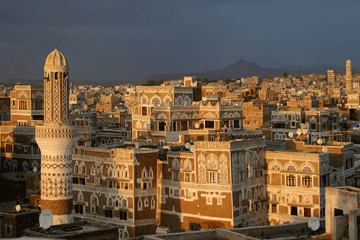
Sanaa Satellites

Photograph by Tan Yilmaz

“Sanaa at dusk, taken from the rooftop terrace of Taj Talha hotel. I was not staying there, but non-guests can go up to the terrace for the view (try doing that in elitist Dubai). I did not bother erasing the profusion of unsightly satellite dishes, there are too many. 45mm. focal length, just before sunset. The sky is as dark as it is because of a departing thunderstorm. This is taken 1 day before the last Sanaa photo I uploaded, which was from the Golden Daar hotel. The workshops shows SANAA BY NIGHT.”

Al Qaeda’s generational split

by Gregory D. Johnsen
The Boston Globe, November 9, 2007

RECENT CONFUSION over the status of Jamal al-Badawi, one the masterminds of the attack on the USS Cole in Yemen in 2000, illustrates the difficulties of containing an increasingly fractured jihadist movement. Badawi, who escaped from prison early last year, had surrendered to the Yemeni government in early October, only to be released as part of a plea deal. These events have sparked confusion and anger in the United States.

In Yemen, meanwhile, authorities have continued to make misleading and ambiguous statements about his whereabouts. It would be easy to assume, as many have done, that the country’s reaction was that of a reluctant ally eager to shirk its responsibility in the war against Al Qaeda. This reading, as Rudy Giuliani suggested, demands that the United States threaten Yemen with a reduction in aid.

But what to the United States is a cohesive organization bound together by a common hatred is to Yemen a fragmented movement that is rife with infighting and dissension. Continue reading Al Qaeda’s generational split

Chew Some Qat

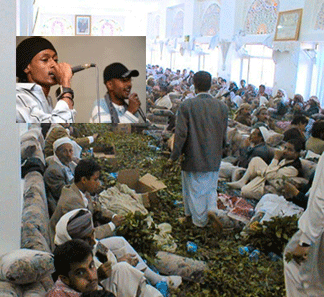
One of the unique aspects of living in Yemen is chewing qat, the tender young leaves of the shrub Catha edulis. In the late afternoon Yemenis often get together with their supply of qat, a water-pipe (narghila) and plastic bottles of spring water. Much has written about the plant and its use. For starters, check out the Qatalog on Yemen Webdate.

Youtube now brings you rap versions by Yemeni artists. Chew on this or this for awhile.

Yemeni Tribes as Social Entities

Tribes should be social entities not political participants, says al-Dhaheri

Reported by Zaid al-Alaya’a, Yemen Observer, Sept. 22, 2007

Dr. Mohammed Mohsen al-Dhaheri, chairman of the Political Sciences Department at Sana’a University, spoke with the Yemen Observer about the contemporary role of tribes in the governance of Yemen and the conflict between the traditional and modern authorities. He is the author of two books about the socio-political relationship between the tribes and the state in Yemen.

Yemen Observer: What do you think of the newly established National Solidarity Council, and what do you think prompted its establishment?

Dr. Mohammed al-Dhaheri: First, I would like to say that this is what we can call political meddling. Tribes in Yemen have certain mechanisms to demand their rights. For example, some tribes will block highways or kidnap foreigners to add urgency to their demands. I can not put this council in the frame of a tribal bloc. It is can not what I would call a tribal council nor is it a partisan council. You can see that politicians meet with the sheikhs and with the academics. The council represents a period in tribal meetings that Yemen has not witnessed before. You can not call it an opposition entity as it has many members from the GPC, and academics etc. As you see there is a sort of dichotomy that starts to prevail in Yemen. This council has encountered other gatherings from tribes led by Sheikh al-Shaif. Continue reading Yemeni Tribes as Social Entities

Traveling Light in Arabia

[Note: the following list of items for light camping in Arabia is provided by G. Wyman Bury for the early part of the 20th century.]

CAMP EQUIPMENT
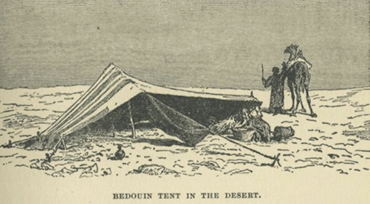
Try to do without a tent. Arabs hate pitching tents after a long day’s march, and seldom pitch them well. They draw fire and afford no protection, while preventing your own observation; they also betray the site of your camp to bad characters and casual callers on the look out for supper.

BEDDING
Avoid Wolseley valises or anything with pleats and folds, which become the permanent abiding places of parasitic insects.
‘Blankets.’ One each for the men. A few extra for convalescents or invalided men. Two for yourself.
‘Pillows.’ Carry your spare clothes in a green canvas sack. Continue reading Traveling Light in Arabia

The Little Rebellion that Was


[Illustration: Emir Hamad Bin Khalifa al-Thani of Qatar, left; bombed out buildings in northern Yemeni town of Sa‘da in 2004 fighting, center; Husayn al-Houthi, right.]

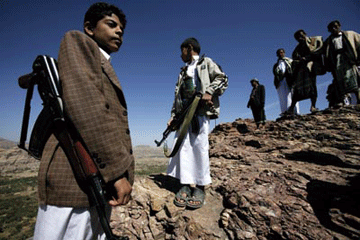
In September, 2004, Yemen’s military captured and killed a Zaydi cleric in the northern part of their country. His name was Husayn al-Houthi and he is alleged to have started a rebellion with a strong anti-American thrust. Although claims were made that he was trying to revive the Zaydi imamate (which was toppled in 1962 in the revolution that formed a republic in North Yemen), such an al-Qaeda clone conspiracy theory are exaggerated. Nevertheless, his followers carried on a regional rebellion, lately under the leadership of his son Abd al-Malik, and as a result thousands of soldiers, rebels and civilians have died and tens of thousands of civilians have been displaced. It is not surprising that you may not have seen much about the fighting in the media. Indeed it has been a little rebellion compared to events in Iraq, Afghanistan or Gaza, and it certainly did not threaten the ruling government’s overall hold on the country. But it was certainly a big deal in Yemen. And now, with mediation by the Emir of Qatar, it appears that there will be an end to the armed conflict. Details are provided in today’s Yemen Observer.

Al-Houthi rebels descend the mountains, lay down their weapons

Written By: Nasser Arrabyee
Yemen Observer, Jun 30, 2007

Al-Houthi rebels have come down from the mountains of northern Yemen to put down their weapons and return home, as instructed by a Qatari-brokered agreement to end the five-month war between them and the government troops, said mediators Thursday. Continue reading The Little Rebellion that Was